Home › Volumes › Butterflies › Sulphurs and Whites
Little Sulphur
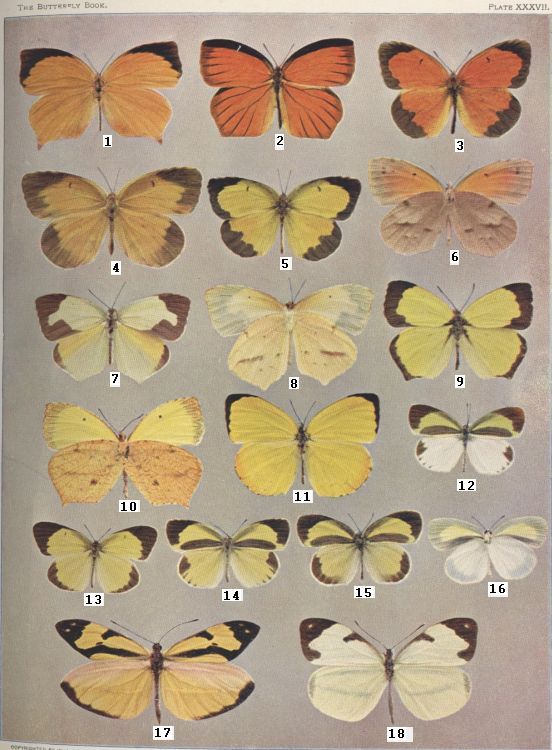
Butterfly.--Allied to the three following species, from which it may at once be distinguished by the absence of the black bar on the inner margin of the fore wings and by the profusely mottled surface of the under side of the hind wings. It is subject to considerable variation, albino s and melanic males being sometimes found, as well as dwarfed specimens of very small size. Expanse, 1.25-1.60 inch.
Early Stages.--These have not been thoroughly studied and described, in spite of the fact that the insect is very common in many easily accessible localities. The caterpillar feeds on Cassia and on clover.
T. lisa ranges from New England south and west as far as the foot-hills of the Rocky Mountains, and into Mexico and Honduras. It is found in the Antilles and Bermuda. An interesting account of the appearance of a vast swarm of these butterflies in the Bermudas is given by Jones in "Psyche," vol. i, p. 121:
"Early in the morning of the first day of October last year (1874), several persons living on the north side of the main island perceived, as they thought, a cloud coming over from the northwest, which drew nearer and nearer to the shore, on reaching which it divided into two parts, one of which went eastward, and the other westward, gradually falling upon the land. They were not long in ascertaining that what they had taken for a cloud was an immense concourse of small yellow butterflies (Terias lisa, Boisduval), which flitted about all the open grassy patches and cultivated grounds in a lazy manner, as if fatigued after their long voyage over the deep. Fishermen out near the reefs, some few miles to the north of the island, very early that morning, stated that numbers of these insects fell upon their boats, literally covering them. They did not stay long upon the islands, however, only a few days, but during that time thousands must have fallen victims to the vigorous appetite of the bluebird (Sialia sialis, Baird) and blackbird (Mimus carolinensis, Gray), which were continually preying upon them."
As the nearest point of land is Cape Hatteras, about six hundred miles distant, it is seen that, weak and feeble as this little creature appears, it must possess, when aided by favoring winds, great power of sustained flight.