Home › Volumes › Butterflies › Nymphs
Liliana
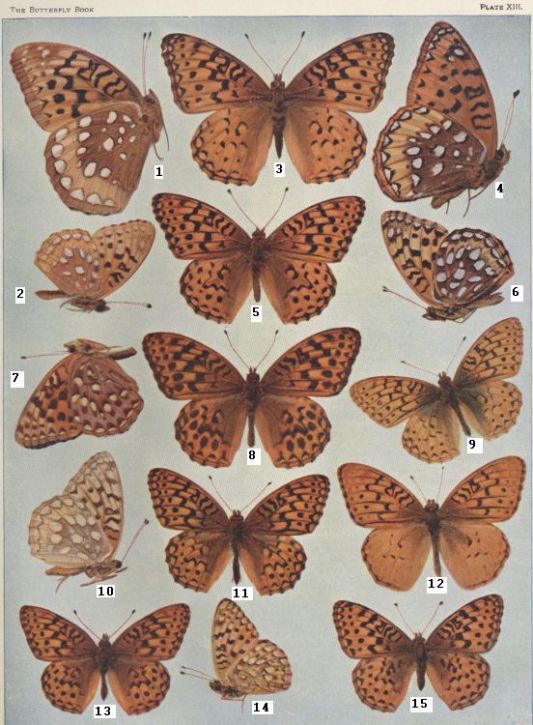
Butterfly, male.--The wings on the upper side are reddish-fulvous. The black markings and the spots are slight. The fore wings on the under side are yellowish-buff; the base and the hind margin to below the cell, brown, with buff on the median interspaces. The outer end of the cell is yellowish-buff. The subapical patch is brown, adorned by two or three well-silvered spots. The five upper marginal spots are well silvered. The hind wings are brown, but little mottled with buff. The spots are well silvered. The marginal belt is narrow, ochreous-brown.
female--The female is much paler than the male, and the marginal spots on both wings are much lighter. On the under side the wings are as in the male sex, with the basal area and the nervules of the fore wings red. Expanse, male, 2.20 inches; female, 2.35 inches.
Egg.--W. H. Edwards gives the following description: "Conoidal, truncated, depressed at summit, marked vertically by twenty-two or twenty-three ribs, which are as in other species of the genus; the outline of this egg is much as in eurynome, the base being broad, the top narrow and the height not much more than the breadth; color yellow."
Caterpillar.--The same author has given us a description of the caterpillar immediately after hatching; but as the young larvae were lost after being sent to Maine to be kept over winter, we do not yet know the full life-history.
The range of this species is northern California and Utah, so far as is known at present.