Home › Volumes › Butterflies › Nymphs
Lacinia
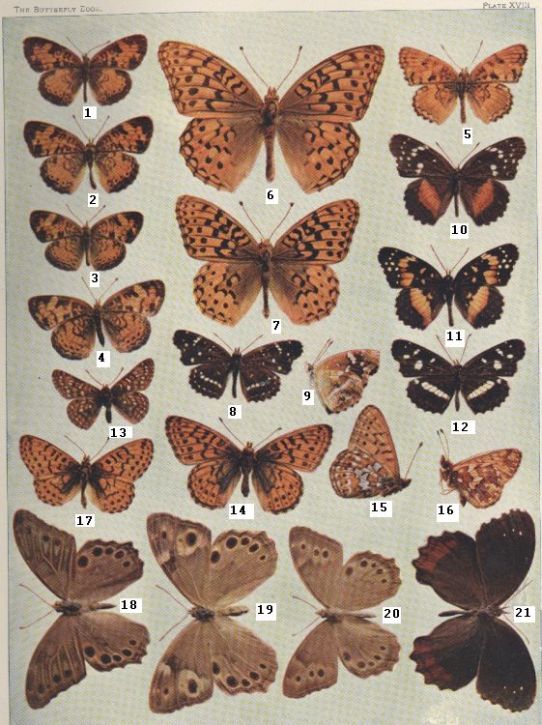
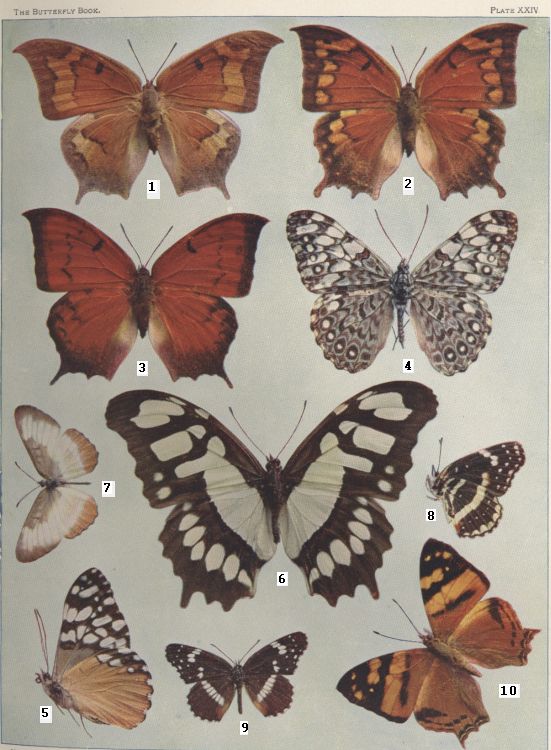
Butterfly.-This is a protean species, a dozen or more well-marked varietal forms being produced, many of them from a single batch of eggs. The wings on the upper side are black; both primaries and secondaries are crossed about the middle by a band of spots, generally broken on the primaries and continuous on the secondaries. These spots in the typical form lacinia are fulvous, and the bands are broad. In the form crocale the spots are white, the bands narrow. A great variety of intergrading forms are known and are represented in the author's collection, most of them bred specimens reared from the egg. On the under side the fore wings are marked as on the upper side. The hind wings on the under side are black, with a marginal row of spots, a transverse straight median band, a short basal band, and a costal edging, all bright straw-yellow; in addition there is a submarginal row of small white spots and a crimson patch of variable size at the anal angle. Expanse, male, 1.50-2.00 inches; female, 1.75-2.75 inches.
Early Stages.-These are described fully by Edwards in the "Canadian Entomologist," vol. xxv, p. 286.
Lacinia ranges from Texas and New Mexico to Bolivia.
FAUNAL REGIONS
That branch of zoological science which treats of the geographical distribution of animals is known as zoogeography. None of the zoological sciences has contributed more to a knowledge of the facts with which zoogeography deals than the science of entomology.
Various divisions of the surface of the earth, based upon the character of the living beings which inhabit them, have been suggested. At the present time, however, it is agreed that in a general way five major subdivisions are sufficient for the purposes of the science, and we therefore recognize five faunal regions, namely, the Palaearctic, which includes the temperate regions of the eastern hemisphere; the Indo-Malayan, covering the tropics of Asia and the islands lying south of that great continent, including Australia; the Ethiopian, covering the continent of Africa south of the lands bordering on the Mediterranean, and extending northward into the southern part of Arabia; the Neotropical, covering the continent of South America and the islands of the Caribbean Sea and the Gulf of Mexico; and, finally, the Nearctic, covering the temperate and polar regions of North America. The butterflies with which this volume deals are mostly nearctic species, only a few species representing the neotropical region being found as stragglers into the extreme southern portion of the United States.
These five faunal regions are characterized by the presence of certain groups of insects which are more or less peculiar to them. In the Palaearctic Region, for instance, we find a very great development of the Satyrinae, of the genera Argynnis, Melitaea, and Lycaena, and of the genus Colias. The genus Papilio is but poorly represented, there being only three species found on the entire continent of Europe, and comparatively few in Asia north of the Himalayan mountain-ranges.
As soon as we pass from the boundaries of the Palaearctic Region into India there is discovered a great number of species of the genus Papilio. The Euploeinae, of various genera, swarm, and splendid creatures, magnificent in color, present themselves, replacing among the Nymphalinae the small and obscurely colored forms which are found among the mountains of Europe and on the great Asiatic steppes. In the Indo-Malayan Region one of the most gorgeous of the papilionine genera is known as Ornithoptera. These great "bird-wing" butterflies are most brilliant in color in the male, and in the female attain an expanse of wing reaching in some species eight and even nine inches, so that it would be impossible to represent them in their natural dimensions upon a page such as that which is before the reader. One of these giants of the butterfly family, named Victoria after her Majesty the Queen of England, is found in the Solomon Islands, and is probably the largest of all known butterflies. One specimen, belonging to the author, has an expanse of wing exceeding nine inches. Among the strangest of recent discoveries is Ornithoptera paradisea, which is found in New Guinea. The male has the hind wings produced in the form of a very delicate and slender tail; the upper surfaces of the wing are broadly marked with shining green and lustrous orange upon a velvety-black ground. The female is black with white spots, slightly marked with yellow, being obscure in color, as is for the most part characteristic of this sex among butterflies, as well as other animals.