Home › Volumes › Butterflies › Satyrs
Dark Wood-nymph
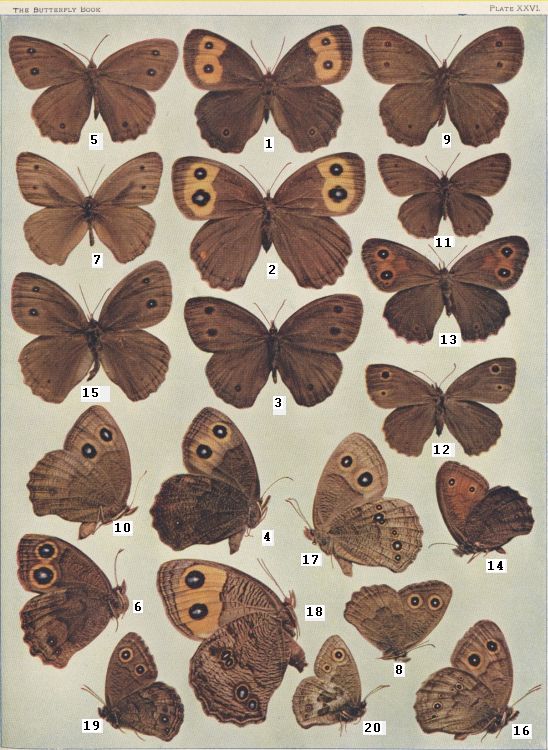
Butterfly.--The male is dark in color; the female is paler. There are two eye-spots on the fore wings in the usual location, indistinct on the upper, distinct on the lower side of the wings. The under sides of the wings are variable. In the type they are dark; in other specimens they are paler. They may or may not have ocelli on the secondaries. The form with obsolescent ocelli has been named silvestris by Edwards. Both the fore and hind wings are abundantly and evenly marked by little striae, and crossed on either side of the median area by obscure, irregular, transverse dark lines, either one or both of which may be wanting in some specimens. Expanse, 1.50-1.75 inch.
Early Stages.--These have been described and beautifully figured by Edwards in the third volume of his great work, to which the reader may refer. The caterpillar is green, cylindrical, tapering before and behind, marked with longitudinal pale-yellow lines. The chrysalis is green or black, striped with narrow white lines. The egg is somewhat firkin-shaped, flat at the top and base, vertically ribbed, and honey-yellow. The larva feeds on grasses.
Charon is found in the Northwest, ranging from British Columbia as far as New Mexico.