Home › Volumes › Butterflies › Satyrs
Common Wood-nymph
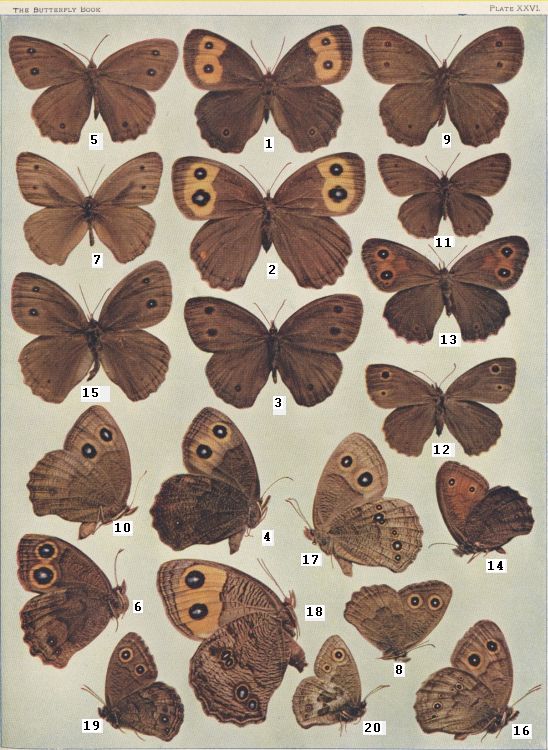
Butterfly.--Closely resembling the preceding species, but only two thirds of its size. The figures in our plate give a correct idea of its appearance. The number of the ocelli is not constant, and occasionally specimens occur in which they are almost wanting. Several varietal forms have been described: S. maritima, from Long Island and Martha's Vineyard, in which the wings are smaller, the band inclined to orange-yellow, and the upper side of the wings is darker than in the typical form; and S. texana, from the extreme South, in which the ground-color of the wings is paler brown, the yellow band ochreous, and the spots on the under side of the hind wings larger than in the other forms.
(a) Satyrus alope, from nephele, Kirby, Plate XXVI, Fig. 3, male; Fig. 4, female, under side; Plate IV, Figs. 7, 8, chrysalis (The Clouded Wood-nymph).
This varietal form of S. alope, long held to be a species, but now known to be a dimorphic variety, is characterized by the partial or entire suppression of the yellow band on the primaries and the tendency of the eye-spots to become obsolete. It is the Northern form of the species, and is found in Canada, New England, and on the continent generally, from the Atlantic to the Pacific, north of the latitude of central New York and southward on the mountain masses of the Appalachian ranges.
(b) Satyrus alope, form olympus, Edwards, Plate XXVI, Fig. 9, male; Fig. 10, female, under side (Olympus).
This form of S. alope is common in the region west of the Mississippi. The males are a trifle darker and the females a shade paler than in the form nephele, which they closely approximate, and from which it would almost be impossible to separate them without a knowledge of the country whence they come.
(c) Satyrus alope, form ariane, Boisduval, Plate XXVI, Fig. 5, male; Fig. 6, male, under side (Ariane).
In ariane we have a decidedly dwarfed form, in which the males and the females are quite dark. The ocelli, though small, are persistent, well defined, rarely showing a tendency to disappear completely. This form is found in British America, Oregon, and the northwestern portion of the United States.
(d) Satyrus baroni, Plate XXVI, Fig. 15, female; Fig. 16, female, under side (Baron's Satyr).
This is another form, dark on the upper side and reddish below, in which the ocelli on the under side show a tendency to become obsolete, and in some specimens are wholly wanting.
There are other varietal forms, one of which, named boopis by Behr, is commonly found on the Pacific coast in northern California, Oregon, and Washington, and the ocelli, while prominent on the upper side of the wings, are almost obsolete below.
Early Stages.--The early stages of S. alope (typical form) and its variety nephele have been well described by several authors. The caterpillar feeds on grasses. There is, however, a fine field for the entomologist to work out the causes of the rather remarkable variation to which the species is subject.