Home › Volumes › Butterflies › Nymphs
Columbian Silver-spot
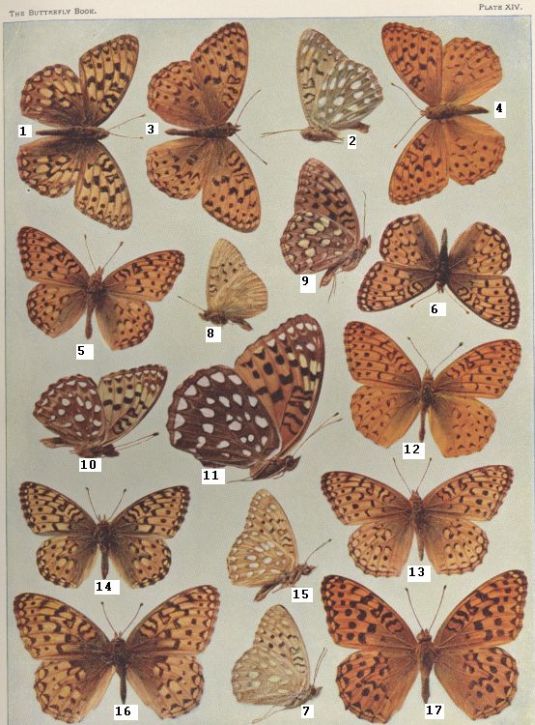
Butterfly.--The male has the upper side of the fore wings pale reddish-fulvous. In the median band of both wings the spots to not flow together, but are separate and moderately heavy. The under side of the fore wings is pale fulvous, buff at the tip; spots silvered. The hind wings on the under side are light rusty-red, but little mottled with buff on the disk; the submarginal band is narrow, buff, and sometimes almost wholly obscured by the darker ground-color. The spots, which are small, are well silvered. The female is much lighter than the male, and, as usual, the dark lines are heavier than in that sex. The spots of the median band are bent and partly lanceolate, and the light spots of the outer border are whitish. Expanse, 2.25-2.50 inches.
Caterpillar, etc.--The early stages have not as yet been worked out.
This species, which is related to electa, may easily be distinguished from it by the pale marginal series of light spots, in the male, between the sagittate spots and the dark outer marginal lines, which latter are confluent, forming a solid dark outer border to the wing, while in electa they are separated by a narrow band of light-brown spots. The female is also much lighter and larger than in electa, as has been pointed out. The types which came from the Caribou mining region of British Columbia are in my possession, as are those of most of the other North American species of the genus.