Home › Volumes › Butterflies › Nymphs
Baltimore
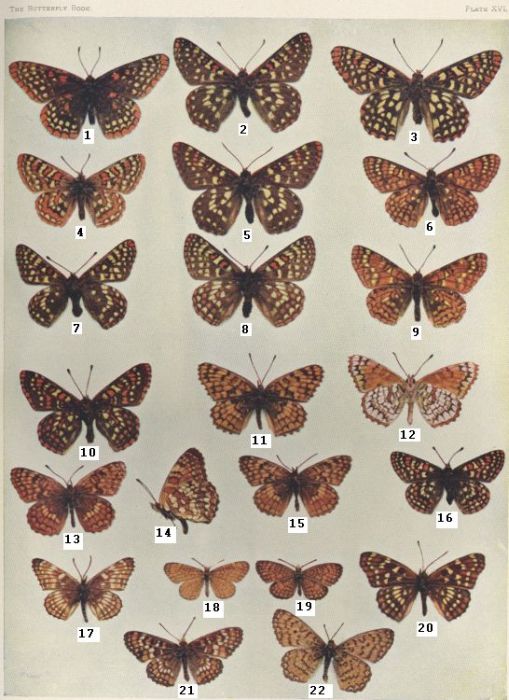
Butterfly, male.--The upper side is black, with a marginal row of red sports, followed by three rows of pale-yellow spots on the fore wings and two on the hind wings. Besides these there are some large red spots on the cells of both wings, a large red spot about the middle of the costa of the hind wing, and a few scattering yellow spots, forming an incomplete fourth row on the fore wing and an incomplete third row on the hind wing. On the under side all the spots of the upper side reappear, but heavier and more distinct, and on the hind wings there are two additional rows of yellow spots, and a number of irregular patches of red and yellow at the base of both wings.
Female.--The female is much like the male. Expanse, male, 1.75-2.00 inches; female, 2.00-2.60 inches.
Egg.--The egg which is outlined upon p. 4, Fig. 8, is brownish-yellow when first laid, then changes to crimson, and becomes black just before hatching. The eggs are laid by the female in large clusters on the under side of the leaf of the food-plant.
Caterpillar.--The life-history in all the stages will be found minutely described by Edwards in "The Butterflies of North America," vol. ii, and by Scudder in "The Butterflies of New England," vol. i. The mature larva is back, banded with orange-red, and beset with short, bristly, black spines. Before and during hibernation, which takes place after the third moult, the caterpillars are gregarious, and construct for themselves a web in which they pass the winter. After the rigors of winter are past, and the food-plant, which is commonly Chelone glabra, begins to send up fresh shoots, they recover animation, scatter, and fall to feeding again, and after the fifth moult reach maturity.
Chrysalis.--The chrysalis is pendant, formed generally at a considerable distance from the spot where the caterpillar feeds, for the larvae wander off widely just before pupation. It is pearly-gray, blotched with dark brown in stripes and spots, with some orange markings.
This very beautiful butterfly is quite local, found in colonies in swampy places where the food-plant grows, but in these spots sometimes appearing in swarms. It occurs in the northern portions of the United States and in Canada, extending as far north as the Lake of the Woods, and as far south as West Virginia. It does not occur west of the Rocky Mountains.