Home › Volumes › Butterflies › Papilioninae Family
Ajax
Butterfly.--This insect, which is one of the most beautiful in our fauna, has been the subject of attentive study in recent years, and is now known to be seasonally polymorphic. We have given in Plate XLIV figures of several of the forms.
(a) Winter form walshi; Edwards, Plate XLIV, Fig. 4, male. In this form, which emerges from chrysalids which have been exposed to the cold of the winter, the black bands of the wings are narrower and a trifle paler than in the other forms, the tails of the hind wing tipped with white, and the crimson spot on the inner margin near the anal angle forming a conspicuous bent bar. A variety of this form, with a more or less distinct crimson line parallel to the inner margin on the upper side of the hind wing, has been named Papilio ajax, var. abbotti, by Edwards.
Another winter form, for which I propose the name floridensis, is represented in Plate XLIV, Fig. 2, by a male specimen. It is characterized by the great breadth and intensity of the black bands on the upper side of the wings, which are quite as broad as in the summer form marcellus. I find this form prevalent in the spring of the year on the St. Johns River, in Florida. Expanse, 2.50-2.75 inches.
(b) Winter form telamonides, Felder, Plate XLIV, Fig. 1, male. In this form the tails of the hind wings are somewhat longer than in walshi, and are not simply tipped, but bordered on either side for half their length with white, and the red spots near the anal angle do not coalesce to form a crimson bar, but are separate. The black transverse bands on the upper side are wider than in walshi. Expanse, 2.75-3.00 inches.
(c) Summer form marcellus, Boisduval, Plate XLIV, Fig. 3, male. In this form, which represents the second generation emerging in the summer and fall from chrysalids produced from eggs of walshi, floridensis, and telamonides, the tails of the hind wings are greatly lengthened, being fully twice as long as in walshi, the black bands are greatly widened, and there is but a single small spot of crimson (sometimes none) above the anal angle of the secondaries. Expanse, 3.00-3.25 inches.
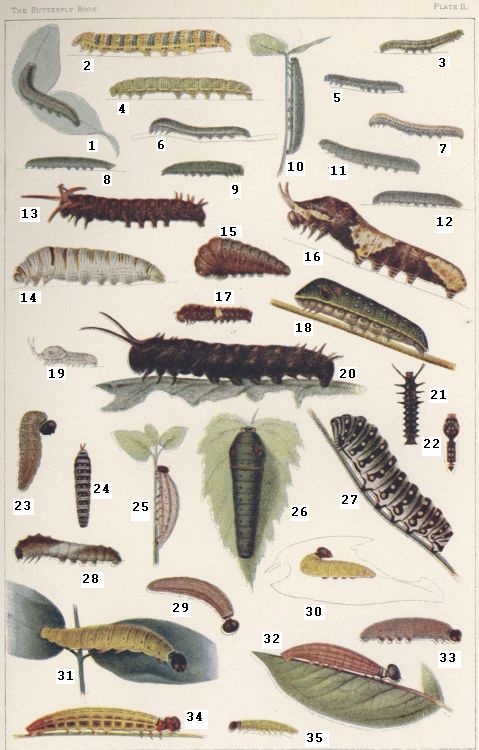
Early Stages.--These are well known. The caterpillar feeds on the leaves of the papaw (Asimina triloba), and wherever this plant is found the butterfly is generally common.
Ajax ranges from southern New England, where it is very rare, west and south over the entire country to the foot-hills of the Rocky Mountains. It is very common in the lower Appalachian region, and in southern Ohio, Indiana, Kentucky, and Tennessee is especially abundant.