Home › Volumes › American Animals › Deer and Their Allies
Woodland Caribou
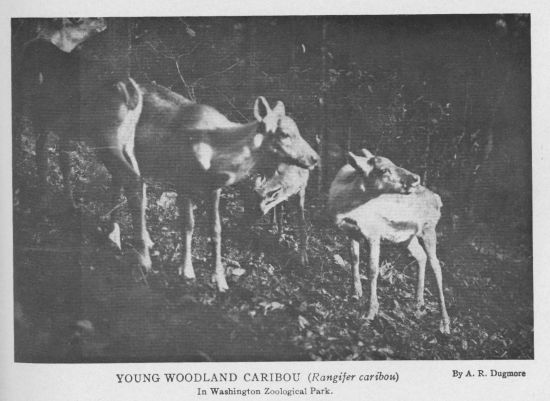
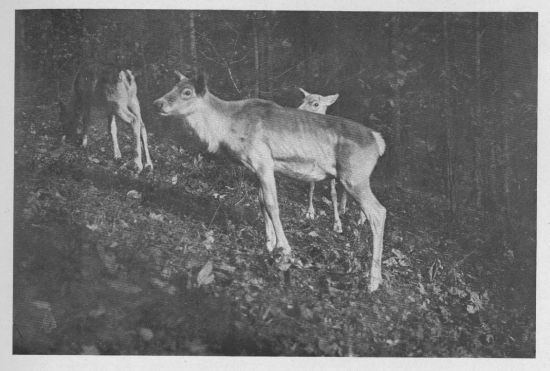
Length.—6 feet. Height at shoulder 4 feet. Length of antler 30 to 40 inches.
Description.—Differs from all the preceding members of the deer family in the presence of antlers on the female as well as the male, the muzzle is also entirely covered with hair and the feet are more deeply cleft. Colour, dark dove-brown, lighter in the neck, posterior part of the abdomen, and inside of legs as well as a band just above the hoofs white, muzzle and face dark except the front of the upper lips. Grayer in winter with head and neck nearly white. Antlers with one (rarely both) of the brow tines flattened and palmate standing out vertically in front of the face, above this is another branched tine more or less palmate and the summit of the antler is again palmately expanded. The exact pattern and extent of the palmation is exceedingly variable.
Range.—Wooded parts of British America, northern Maine and Montana.
Range.—Rocky Mountains of Idaho north into Southern Alaska.
Range.—Kenai Peninsula Alaska.
Range.—Newfoundland.
The caribou's hair in summer is brown to match the dun coloured barrens and marshes. In the fall it grows longer and thicker, the new growth being very much lighter so that in midwinter and early spring the general effect is smoky white--the colour of a snowstorm in the woods, and the moss-hung, snow-flecked spruce trees among which the caribou feed and seek protection during the cold weather. Their rough antlers looking like dead, weather-beaten branches also help them in their everlasting game of hide and seek.
It is evident to the most unscientific that the woodland caribou is only a branch of the great reindeer family, which has either wandered south into the woods of Canada and the northern United States, or else lingered behind when the wide extended ice sheet of the glacial period withdrew again to the Arctic regions thousands of years ago, at the time the little alpine plants, still found on Mt. Washington, got left behind by their kindred. In whichever case they certainly appear to have found the conditions favorable and have increased in size accordingly.
But the woodland caribou still feels at times the old inherited desire for wide open stretches of treeless country, particularly in summer, when they wander out over the extensive barrens and flat bog lands to pasture on the coarse sedge-grass growing there.
Although perfectly at home in the thickets where they winter, browsing on moss and lichens; their power for leaping over windfalls and bush is as yet an acquired art, not instinctive and hereditary as it is with the true deer of the wildwood. W.M.J.Long in his "Wilderness Ways" says: "Caribou are naturally poor jumpers. Beside a deer who often goes out of his way to jump a fallen tree just for the fun of it, they have no show whatever; though they can travel much further in a day and much easier. Their gait is a swinging trot from which it is impossible to jump; and if you frighten them out of their trot into a gallop and keep them at it they never grow exhausted.
"Countless generations on the northern wastes, where there is no need of jumping, have bred this habit, and modified their muscles accordingly.
"But now a race of caribou has moved further into the woods, where great trees lie fallen across the way, and where if there is anybody behind them, or they are in a hurry, jumping is a necessity. Still they do not like it and avoid jumping as much as possible. The little ones, left to themselves, would always crawl under a fallen tree, or trot round it. And this is another thing to overcome, and another lesson to be taught in the caribou school. . . . . .
"One afternoon in late summer I was drifting down the Toledo River, casting for trout, when a movement in the bushes caught my attention. A great swampy tract of ground, covered with grass and low bush, spread out on either side of the stream.
"From the canoe I made out two or three waving lines of bushes where some animals were making their way through the swamp toward a strip of big timber which formed a kind of island in the middle. Pushing my canoe into the grass I made for a point just astern of the nearest quivering line of bushes. A glance at a strip of soft ground showed me the trail of a mother caribou with her calf. I followed carefully, the wind being ahead in my favour.
"They were not hurrying and I took good pains not to alarm them.
"When I reached the timbers and crept like a snake through the underbush, there were the caribou, five or six mother animals, and nearly twice as many little ones, well grown, which had evidently just come in from all directions. They were gathered in a natural opening, fairly clear of bushes, with a fallen tree or two, which served a good purpose later. The sunlight fell across it in great golden bars, making light and shadow to play in; all around was the great marsh, giving protection from enemies; dense underbush screened them from prying eyes--and this was their school-room.