Home › Volumes › American Animals › Deer and Their Allies
Virginia Deer
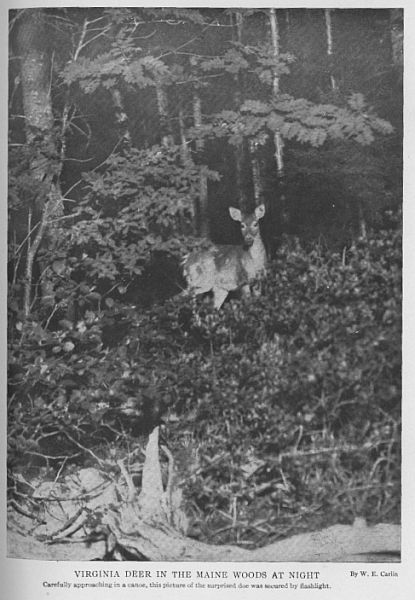
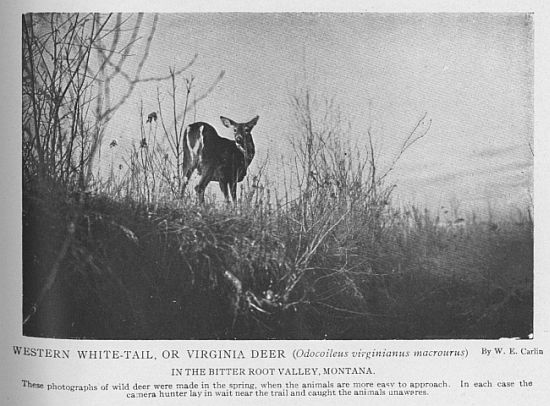
Length.—6 feet. Height at shoulder. 3 feet 1 inch. Length of Antler. 20-24 inches.
Description.—Bright rufous chestnut above in summer with a black band on the chin, throat, under parts and inside of legs white, tail brownish above, white beneath. In winter the upper parts are yellowish gray with white about the eye. Antlers curving outward and then upward, the tips curving in again toward one another, there is a short upright spike near the base, beyond which the beam gives off two upright branches making three nearly equal prongs. At no point does the antler branch dichotomously.
Range.—Eastern North America, separable into several geographical varieties and represented westward to the Pacific by other closely related races.
Range.—New England States and Canada to northern New York.
Range.—Kansas, Nebraska, and the Dakotas, etc.
Range.—Florida.
Range.—Louisiana.
Range.—Texas and northern Mexico.
Range.—Arizona and Northern Mexico.
Range.—California to Washington.
The Virginia deer in one or other of its varieties was originally spread abundantly over our entire country, but the encroachments of agriculture upon the wilderness, the inroad of the lumberman, the fire which ever travels in his wake and the spread of towns and cities have driven the deer from a large portion of their former range and sadly decreased their numbers elsewhere. Such conditions now prevail through many parts of Pennsylvania where the devastation of the lumbermen and the ruin of the magnificent primeval forest are occurrences of yesterday. Farther north and south, in wilds as yet untouched, the deer still hold their own, and in New Jersey a few remain, thanks to the inhospitable pine barrens and impenetrable swamps, as well as to wise legislation properly enforced.
In New England within the last few years these beautiful creatures have ventured to return and dwell again in the haunts of their ancestors, wherever the destruction worked by civilization has not been too severe. Wise laws passed for their protection have yielded good results more quickly than the most sanguine could have hoped.
In 1853 Thoreau wrote: "Minot says his mother told him she had seen a deer come down the hill behind her house and cross the road and meadow in front. Thinks it may have been eighty years ago." Evidently Thoreau supposed that that wild deer seen in Concord about 1770 was one of the last of its race ever to visit that part of the country. Yet if he had lived to be an old man he might frequently have seen them, if not at Concord, at least at other spots in New England from which they were supposed to have been driven forever. Not the pampered stock bred in game preserves, but the sturdy descendants of the native wild deer that the red men hunted through rough forests when the whole country belonged to them alone.
Now they may be seen in quiet country places in various parts of New England, browsing at the edge of leafy woodlands or resting in other could be so welcome a returner as the wild deer, even if he does prove in a way destructive.
The deep snows and severe weather of 1898-9 yielded good opportunities for noting their custom of yarding.
In February when out on my snow-shoes I came upon one of these yards in the birch woods within a mile of the farm house where I write; a series of deep irregular paths marking out a loose net-work over about an acre of buried stumps and blackberry bushes. It had already been abandoned a day or two when I found it, a straight path leading off toward the northwest showing the most recent tracks. The yard had evidently been made and inhabited by a lone doe, possibly two or three with their fawns, the tracks all being alike and of small size.
In many places where the snow was only two or three feet deep they had tunnelled along beneath the heavy laden undergrowth for short distances. Again I found narrow open paths, five feet or more in depth, with almost perpendicular sides. Apparently they had fed almost altogether upon the ground growths under the snow, the twigs beside the paths showing little signs of having been browsed upon.
Four strands of barbed wire proved no obstacle to them, they passed under the bottom wire as freely as a fox or dog would do. Once or twice during the winter I found the trail of what must have been an unusually large stag in the swamps and young pine growths near there and along the borders of cultivated fields; his big hoof-prints with their widespread dew claws were separated by astonishingly long intervals at times.