Home › Volumes › American Animals › Squirrels and Marmots
Red Squirrel
Also called: Chickaree.
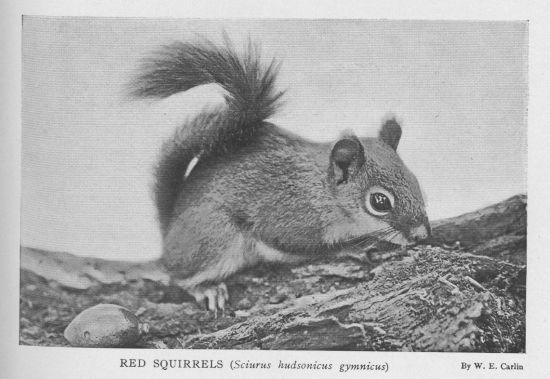
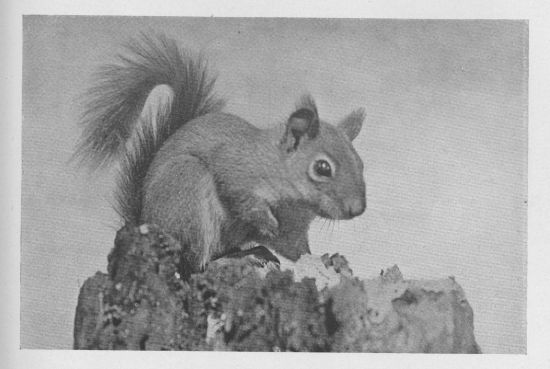
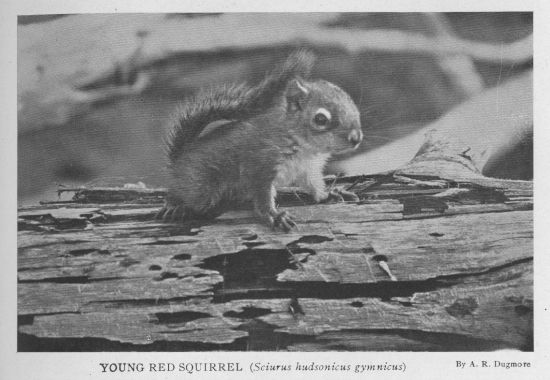
Length.—12 inches.
Description.—In winter back and upper side of tail bright chestnut, sides olive gray, the hairs banded with black; under parts grayish-white. In summer no distinct rufous area on the back, and lower parts pure white with a black stripe on each side, separating the colours of the upper and lower parts.
Range.—Southern Maine, Nova Scotia and Quebec, and in the mountains southward, replaced in the lower grounds and in Labrador by slightly different varieties.
Range.—Southern Maine, Michigan and Minnesota to Virginia and Indiana, except in the Alleghanies.
Range.—Labrador and Hudson Bay region to Alaska. Numerous red squirrels inhabit the Western States, those on the North West coast being quite brown in color.
The red squirrel is possessed of more petty vices and fewer virtues than any other beast that roams the woods. He is quarrelsome, noisy and mischievous and forever prying into the affairs of others. In the winter he makes a regular business of robbing his neighbours of the stores of provisions they have gathered, though he always has more than his share hidden away at home and most zealously guarded; and in summer he robs birds' nests high and low.
Yet one cannot help liking him, for a keen sense of humour and never failing good spirits tip the balance against all sorts of evil deeds. Even in northern New England the cold is never fierce enough to curb his jollity any more than the blistering heat of July.
You are sure to meet him when driving over country roads at any time of the year, for, in most of the Northern States, red squirrels are as common as robins.
Few people realize what thoroughly practical, thrifty and ingenious little animals they really are; for, unlike most thieves, they are not in anyway shiftless or lazy, but are steady hard-workers the year round. There is no idle season for them.
Other squirrels live a careless, gipsy sort of life through the warm weather, only commencing the labour of harvesting when the nuts ripen.
But as early as July, while the young squirrels have still to be watched over and looked after, the industrious red squirrels begin cutting off the green cones of the white pine and work early and late burying them, half a dozen in a place, under the pine needles, to be dug up in the winter and early spring and opened for the seeds they contain.
No amount of snow seems to bother them much when it comes to locating their buried stores.
By the time the business of gathering pine cones is over for the season, the nuts and acorns are beginning to ripen, and there are fall apples to be picked and stored in hollow trees, for the red squirrel is firm in exacting his tithe of the farmers and looks after the collecting of it himself. In the matter of corn, however, he prefers to wait until the farmer has gathered it into his bin, when the squirrel can generally get it without much loss of time.
The hemlock cones hold their seeds all winter, and there is never a day of snow or winter sunshine that the red squirrel may not be seen gathering them from the very tips of the swaying outer branches, in company with the chattering cross-bills and pine-finches, bent on the same errand themselves.
Although with very few exceptions red squirrels refuse to become tame in confinment, most of them are really fond of human society, their keen intelligence enabling them very quickly to decide whom they may safely trust. The lone chopper frequently enjoys the company of the merry little forester who greets him each morning with a volley of exclamations from the top of a wood pile, and endeavours to steal his luncheon before noon time, and later picks up any scattered crumbs, or runs off with the tallow the chopper keeps to grease his axe helve with. Red squirrels like nothing better than a chance to run a race with you when you are driving. One will sit, tail in the air, on the highest stone of a road-side wall, or a stake in the fence, until you are just opposite, then off he goes.
If you manage to leave him behind for a little, and then slow up to see what has become of him, you will see him come tearing after you at the top of his speed, and go by with a flourish, at last whisking up into a tree almost out of breath, where, perched on a conspicuous branch, he may watch you out of sight, hurling all sorts of epithets after you.
In the early spring red squirrels manage to keep pretty busy tapping the sugar maples, climbing for the topmost buds of trees as they begin to swell in the increasing sunlight, and watching the movements of the newly awakened chipmunks and gray squirrels, in the hope that even yet they may betray some unsuspected hoarding of nuts.