Home › Volumes › American Animals › Squirrels and Marmots
Gray Squirrel
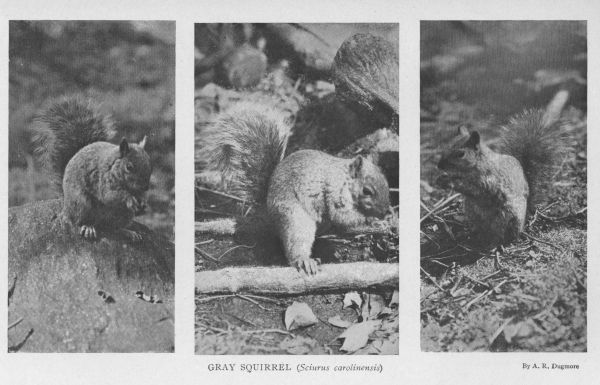
- Length
- 18 inches.
- Description
- Similar in build to the fox squirrel, with large bushy tail. colour yellowish-gray, individual hairs banded with rusty-yellow and black, decidedly rusty on the face, feet and sides. Below white. Hairs of tail rusty-yellow at base, black in the middle, with white tips.
- Range
- Florida to southeastern Pennsylvania, Hudson Valley, Indiana and Missouri; replaced to the North and West by slightly different geographic varieties.
- Range
- Alleghanies of Pennsylvania, northward to New England, New Brunswick, southern Canada and Minnesota.
- Range
- Bayou region of the Louisiana coast.
- Range
- Southern Florida.
The best opportunities for watching the ways of gray squirrels are to be found in the outskirts of towns and villages, where they are not allowed to be shot at or otherwise molested. For though less intelligent than the red squirrels, they are quick to perceive the advantages to be had in a civilized community while the love of stillness and the untainted air of the forest does not appear to be universal among them.
Where they are sufficiently protected they make their homes in shaded trees that have hollow branches, or any cavity in the trunk that they can enlarge for their accommodation. Here they live and raise their families and lay up stores for winter, above rattling streets and humming wires, perfectly indifferent to the noise and heating air that reeks of human beings crowded together like cattle. They are comfort-loving animals, and away in the silent forest, a gray squirrel must be forever on the alert to guard his hidden stores against the thieving red squirrels and the wild mice of the woods, and always listening for the rustle of a fox's footstep on the leaves, or the distant screaming of a hawk. For the red-shouldered hawks are dangerous enemies, and the hours they habitually choose to spend in hunting correspond exactly with the squirrel's working hours--from sunrise to ten o'clock in the morning and from three in the afternoon until near sunset. They watch cat-like for an opportunity to take some unhappy squirrel unawares, or circling high above the treetops their keen eyes penetrate the foliage from constantly varying positions, searching branch and bole and the carpet of fallen leaves beneath till, perceiving the flicker of a bushy tail, the long wings close of a sudden fan-like, and the hunter goes down with a rush to match his quickness against the quickness of a squirrel. Or the still more treacherous goshawk and cooper's hawk, with their narrower wings and slender, yacht-like build, shoot along with baffling swiftness through the undergrowth, just in order to surprise the busy harvesters at their work.
The gray squirrels also know that, in the fall, the men that are found in the woods, unlike the town variety, carry guns and feed on squirrels to a certain extent. With very little encouragement gray squirrels will soon learn to pay you frequent visits, in your room, if you will only leave a window open for them within jumping distance of their treetop, a few nuts or a piece of cake quickly overcoming their shyness. In fact, they often prove to be something of a nuisance about the house. Even in places where they are looked upon as legitimate game they lose much of their fear of man during the close season of spring and summer.
Their habits vary but little whether they live in deep forests or within the limits of a town. Finding a suitable hole in the tree, they enlarge it to suit them, preferring to have plenty of room inside to move about in. the other day I watched one gathering dead leaves for his bed in an old apple-tree. He would run out along the branches to where the brown leaves hung shrivelled in clusters of two or three, rustling in the November wind. Biting off the twig that bore them, he would hurry back with it to his hole. Once the leaves were all brushed from the twig as he went in, and, if ever there was evident surprise and annoyance, it was depicted on his little gray face when a few seconds later he peered out of his doorway, looking for the leaves that he missed. Often half a dozen or more will occupy the same hole, and though the old males are apt to be unpleasantly ugly and tyrannical, they generally appear to get along pretty well on the whole. They also make nests of leaves in the forks of trees, beeches in most instances; they cut off the leaves in branches, while they are still green in summer, and place them in successive layers on a rough platform of twigs in such a manner as to shed the rain perfectly, but without leaving room for more than one or two inmates within.
Gray squirrels warn each other of danger with a kind of flat, rasping bark, finally prolonged into a whining snarl, distinctly audible or an eighth of a mile or more in calm weather.
Varieties of the Gray Squirrel
1. Southern Gray Squirrel. Sciurus carolinensis Gmelin. Description and range as above.
2. Northern Gray Squirrel. S. carolinensis leucotis (Gapper). Lighter and grayer, clear, silvery gray in winter, more yellowish in summer. Perfectly black individuals, known as black squirrels, occur in some localities, but are merely melanistic individuals and not a different species.
3. Bayou Gray Squirrel. S. carolinensis fuliginosus (Bachman). Colours richer and darker than the southern gray squirrel, underparts often tinted with ferruginous.
4. Everglade Gray Squirrel. S. carolinensis extimus Bangs. Grayer and lighter than the southern gray squirrel and much smaller.
Many very handsome squirrels of this and other groups are found in the Western States.