Home › Volumes › American Animals › Deer and Their Allies
Moose
Length.—9 feet. Height at shoulder, 5 feet 9 inches to 6 feet 6 inches. Length of antler, 41 to 44 inches.
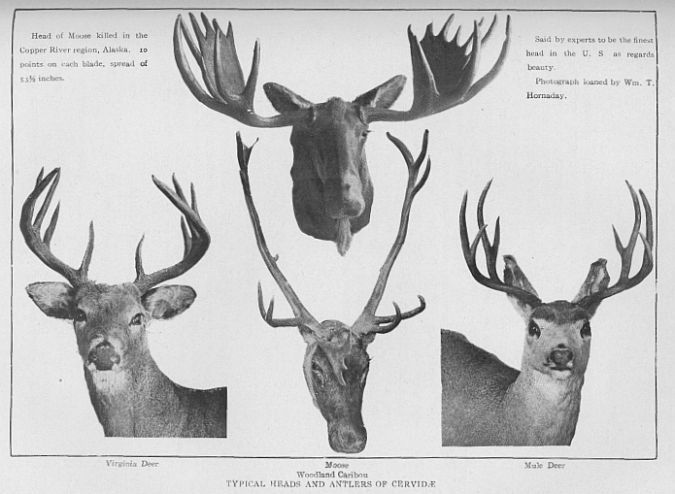
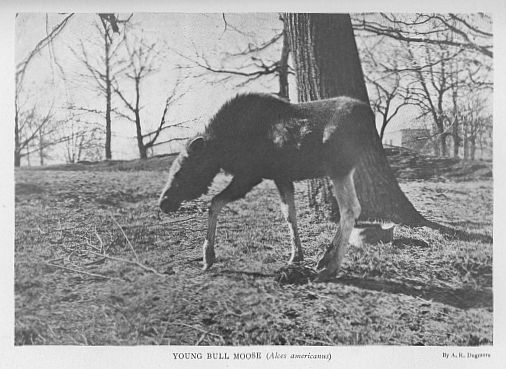
Description.—A crest of stiff erect hairs on the neck, much elongated and forming a hump on the shoulders, nose large, the upper lip protruding well over the lower, ears large, tail very short, legs long, a pendent mass of hair on the throat called the "bell." Colour blackish-brown above, grizzled with gray on the rump, shoulders and sides of the neck, under parts black, inside of legs and their entire lower portions quite gray, feet black, ears gray. Antlers broadly palmate, solid portion nearly two feet at the widest point, several tines project forward and the outer edge of the flat portion is fringed by an irregular series of points.
Range.—Eastern British America, Maine, Minnesota and Montana and formerly northern New York. Replaced in Alaska by the Alaskan moose (Alces gigas Miller), a still larger beast, and the largest known member of the deer tribe.
The moose seems like some old pre-historic creature that has lingered on into the present age, lonely and out of place, as if, having outlived its age and generation, it must necessarily soon become extinct from natural causes.
His massive scoop-shaped antlers and monstrous muzzle, in fact, his whole great ungainly carcass, looks as if it might well belong to some of those forgotten creatures whose bones are found in the river-drift, or dug up from beneath clay strata, buried in some long past interglacial epoch.
Yet the moose lives and breeds in our Maine woods, its flesh serves as an article of food among us and may be bought in the market.
Furthermore, he seems perfectly well fitted to look out for his own safety. His speed and endurance are astonishing, and he carries his large bulk and spreading antlers easily and swiftly through thickets where a man might well hesitate to force his way.
His long legs are very convenient when wading about after water lilies and equally so in reaching upward to peel the bark from the young trees or biting off the tender shoots. When browsing, however, he not unfrequently brings his heavy body also into play and rearing up rides the tree down by sheer force, thus brining the upper branches within reach. Feeding off the ground is another matter, however, the neck being too short to compensate for the great length of leg so that the beast is forced to kneel with the front feet in order to reach the ground in a level spot.
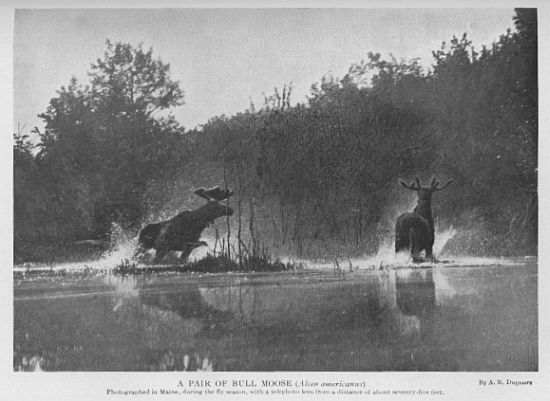
The moose is eminently an animal of the forest and is particularly at home in the dense thickets surrounding the shallow lakes, bogs and watercourses of the north woods, where he may be found wading through the water in search of the yellow splatterdocks, the roots of which at certain seasons form one of his choicest articles of diet. Most of the peculiarities of the moose are undoubtedly due to his habits which are in many respects different from those of other members of the deer tribe.
In running his movements are described as clumsy, never galloping or jumping, but executing a curious shuffling or ambling gait, tossing his head and shoulders as if about to break into a gallop, but only increasing his speed by lengthening his stride, spreading his hind feet in order to straddle the front ones without stepping on them, his hoofs clacking noisily as he goes.
He holds his nose up and his antlers laid back on his shoulders to avoid the branches. When he comes to a fallen tree, as high as a man's shoulder, he does not jump it, but simply steps over without changing his gait.
In winter the moose keep to the hilly woods in the cover of the evergreens and live by browsing on green wood and moss and the resinous foliage of the evergreens. When the snow gets so deep as to hinder their progress, they tramp irregular paths, forming a sort of labyrinth over several acres, making what is known as a "moose yard," where they pass the hardest part of the winter, sometimes several families together.
As food gets scarce and hard to reach, they extend their yards by breaking new paths through the snow, but are often reduced to short commons before the winter is over. At the approach of warm weather they move down to the swamps and lake-side, where they browse on willow, striped maple, birch, etc.; in order to get at the upper branches of a sapling they will rear up against it and bend it down with their weight. In summer they live largely on lily roots and succulent water-plants, wading and running out into the lakes and feeding with their heads partly immersed in the water. During the rutting season, which occurs in the autumn, the old bulls become savage and fearless, roaming the forest on moonlight nights, whistling and calling fiercely and clashing their antlers against trees as a challenge. The cow moose answers with a lower call, which the hunters imitate through birch-bark trumpets, in order to call the bull within gunshot.