Home › Volumes › American Animals › Bears
Grizzly Bear
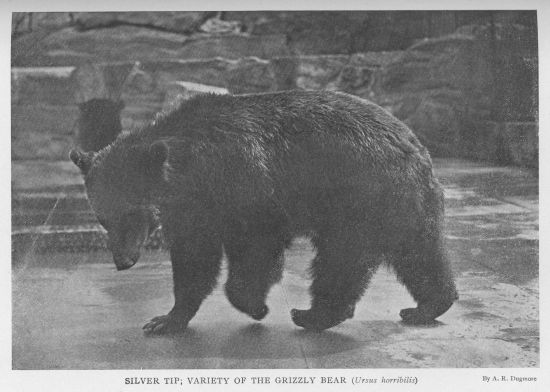
- Length
- 6 feet 6 inches.
- Description
- Fur shaggy, especially long on the shoulders and flanks; front claws much longer than the hind ones, and strongly curved; hind foot relatively longer than in the black bear. Brownish-yellow; darker on the back and legs; long hair, often reddish-brown.
- Range
- Rocky Mountains of Utah to Alaska. Closely related varieties occur in the Southern Rockies and at Norton Sound, Alaska, while a smaller ally, the Barren-ground bear, U. rich-ardsoni Reid, ranges from Hudson's Bay to the Mackenzie and northward.
The grizzly bear is a great rough brute, heavy and lumbering, and easily the largest and most ferocious bear to be found in any part of the world. At the present day, however, he seldom ventures to attack man except in self-defense. In the land where grizzlies are found, only those beasts have survived that excelled in keeping out of sight. Wildness has therefore of late years served the grizzly better than strength and courage in the struggle for existence. He still finds his great muscles useful in the matter of getting a living; there is nothing lives in his country that the grizzly cannot kill and carry away, with the possible exception of the cougar. Indians and certain old-time hunters claim that the cougar will attack and kill a full-grown grizzly; but beyond their stories there seems to be no evidence whatever that a cougar ever killed a grizzly that was too old to be called a cub.
In the earlier days the grizzly bear regularly hunted the bison among the foot-hills of the Rockies.
It is said that one was able to kill and drag off an old bull bison weighing one thousand pounds or more.
At the present time, when the grizzly wishes to go after big game he generally hunts the horses and cattle owned by the herders, and so gets himself disliked. He also hunts deer and wapiti, and in the most northern part of his range an occasional moose.
But he lives to a large extent on much humbler fare; rambling among the crags, with low-hung swinging head, he listens for mice in the grass, and digs them out with claws fashioned to kill an ox at a blow. He also eats insects, berries and wild plums, and munches green fodder in the meadows. The cubs are said to be as funny and amusing as young bears of any sort, and being less unwieldly than the old ones, frequently climb trees.
When an old grizzly has established a hunting range for himself, he writes his challenge with his massive claws and tusks on the trunk of a pine as high as he can reach. His tremendous strength is generally known and respected by other four-footed hunters, who might otherwise be tempted to poach on his preserves. If another bear, wandering in search of better hunting grounds, happens along this path, he is certain to see these warning claw marks, and rising on his hind feet he also strikes the bark in a similar manner. If he fails to scar the trunk as high as the other bear has done, he continues on his travels, leaving the first in undisputed possession. But if the new-comer finds that he can reach as high or higher than the one who first left his challenge there, he is more than likely to remain in the immediate vicinity, scarring other trees here and there, and hunting when and where he pleases.
Unless the first bear has observed the challenge of the newcomer, and, losing courage, retires from the neighbourhood, the two are bound to meet sooner or later and a tremendous fight ensues.
When the supremacy has been finally decided, the vanquished bear, if indeed he has not been killed outright, betakes himself to some distant part of the forest to nurse his wounds in solitude.
The method of challenging all comers is common to a great many wild beasts, large and small; not only bears of all kinds and many of the smaller hunters, but deer and moose as well. And I am inclined to think that when the house-cat stretches up to sharpen its claws on the trunk of a tree, it is a similar challenge for other cats to read.
And who knows but the same instinct, brought up from past ages and more than half forgotten, urges domestic cattle to rub their horns as high as they can reach against any smooth-boled tree in the pasture just as moose and wild deer do in the forest?
Varieties of the Grizzly Bear
1. Grizzly Bear. Ursus horribilis Ord. Description as above. Range. Northern Rocky Mountains from Utah to the interior of British Columbia.
2. Alaskan Grizzly. Ursus horribilis alascensis Merriam. Skull larger, and other cranial and dental peculiarities. Range. Norton Sound District Alaska.
3. Sonoran Grizzly. Ursus horribilis horriaeus Baird. Frontal region of skull not elevated at or behind the eye sockets, as in U. horribilis, but hollowed between them. Range. Southern Rocky Mountains and outlying peaks and ranges, Colorado to Arizona.
4. California Grizzly. Ursus horribilis californicus Merriam. Rather larger than the last. Ears longer. Range. Southern California. (Rapidly approaching extinction.)
No satisfactory comparison of skins of these animals, nor the large brown bears, has been made as yet, and they have been studied mainly from skulls.