Home › Volumes › American Animals › Pocket Gophers
Georgia Gopher
Also called: Pocket Gopher, Salamander.
- Length
- 10 inches.
- Description
- Cinnamon-brown with a somewhat fulvous tinge, an indistinct darker median stripe on the back; below dull ochraceous; hairs on the feet white, tail almost naked.
- Range
- Pine barrens of southern Georgia; represented in Florida and Alabama by closely related geographic races.
- Range
- Eastern Florida, St. Mary's River to Eau Gallic.
- Range
- Western Florida.
- Range
- Extreme Northwestern Florida and Alabama.
- Range
- Cumberland Island, Georgia.
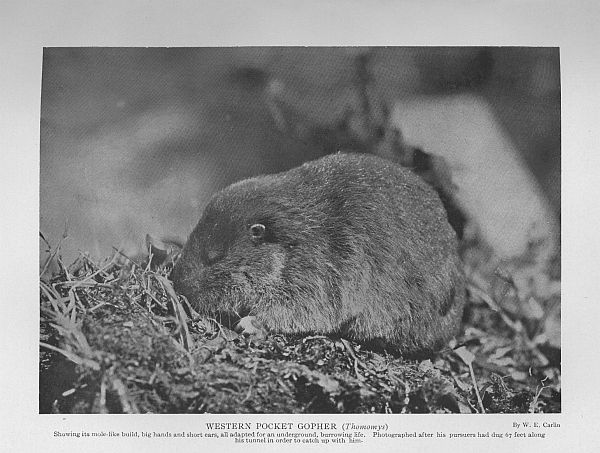
This little animal furnishes another example of the ambiguity of popular names. By all rights of priority and descent he is entitled to the name of gopher given to their Western relatives by the early French explorers, and signifying "honeycomb" in reference to their numerous burrows. Unfortunately our Southern pioneers bestowed this name upon a burrowing tortoise, while the true gopher was christened the "salamander," a name which is misleading and to which he has no just claim. Popular names, however, are too firmly established to yield to argument, and so the Georgia gopher will remain the salamander in spite of us.
Thoroughly adapted for a subterranean life, these animals spend almost all their time in their burrows, and even where they are abundant few people are acquainted with their appearance or habits, their presence being known only by their burrows and the gnawing of roots and vegetables.
"Gopher burrows seem to have neither beginning nor end," writes Vernon Bailey. "They are extended and added to year after year and in many cases those dug by a single animal would measure a mile or more, if straightened out. At the end of a year a gopher may often be found within twenty rods of the point from which he started, but in travelling this distance he has paid no attention to the points of the compass. He follows a tender root for a few feet, then moves to one side, encounters a stone and makes a second turn. A layer of mellow soil entices him off in another direction, and so on through a thousand devious crooks and turns. At intervals openings are made through which to discharge the earth that makes the little piles called gopher-hills."
Gophers have regular storehouses where roots and other foods are stored away, being carried in the peculiar pockets on each side of the face.
Dr. Goode describes their digging habits as follows: "They dig by grubbing with the nose and a rapid shovelling with the long curved fore paws assisted by the pushing of the hind feet, which removes the earth from beneath the body and propels it back with great power a distance of eight or ten inches. When a small quantity of earth has accumulated in the rear of the miner, around he whirls with a vigorous flirt of the tail and, joining his fore paws before his nose, he transmutes himself into a sort of wheelbarrow pushing the dirt before him to a convenient distance."
Except during the breeding season gophers live singly. They are very pugnacious and fight viciously and, when caught away from their burrows, do not hesitate to attack their captor.
Varieties of the Georgia Gopher
1. Georgia Gopher. Geomys tuza (Ord). Description and range as above.
2. Florida Gopher. G. tuza floridanus (Audubon & Bachman). Rather larger and duller in colour, with a white spot under the chin.
3. West Florida Gopher. G. tuza austrinus (Bangs). Paler, with much more white below.
4. Alabama Gopher. G. tuza mobilensis Merriam. Smaller and darker than the Georgia gopher.
5. Island Gopher. G. cumberlandius Bangs. Larger than the Georgia gopher, but like it in colour.