Home › Volumes › American Animals › American Porcupines
Canada Porcupine
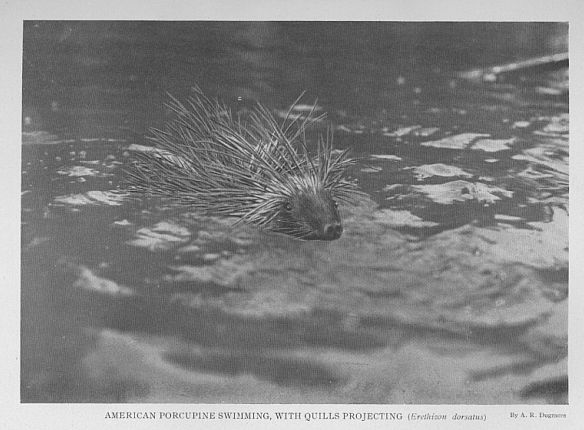
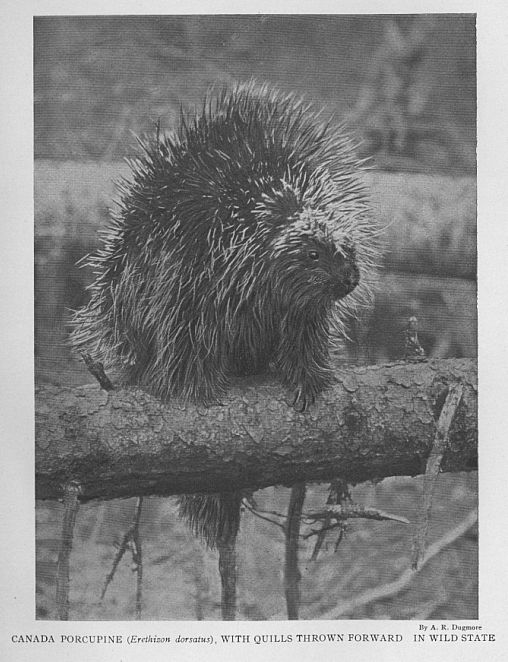
- Length
- 28 inches.
- Description
- Dark-brown to nearly black, quills tipped with yellowish, two to four inches long mostly concealed by the hair, which reaches a length of six inches; toes, for on the front feet and five on the hind.
- Range
- Northern parts of North America south to Maine and in the higher mountains of Pennsylvania. Not found south of the Canadian faunal zone.
The porcupine is much more interesting as a species than as an individual. Looked at either as an example of the beneficent protection which is rendered to every creature according to its needs, or as a branch of the rodent family that has succeeded in perfecting a most unique method of defence through the law of the survival of the fittest, it furnishes an interesting study.
It is easy enough to imagine the long chain of successive steps that have led up from some far-off ancestor, who survived because of the possession of a coat of rougher and more bristling hair than his fellows, and in transmitting this to his decendants also insured them a longer period of existence. But if the one owning the most effective armour was safer from attack than his neighbours, he must also have experienced greater difficulty in finding for himself a mate, for his prickly coat and awkward stumbling carriage would make him just as unpopular with his own people as among his enemies. So instead of choosing according to his taste he must needs take what he could get, his heavy coat of mail preventing him from winning in any contest of activity with his rivals, and in all probability he would be obliged in the end to put up with some equally ill-favoured and stupid outcast of the other sex.
The Canada porcupine of the present day is apparently a result of this sort of selection, stumping about the woods like a turtle in its shell, intent only on filling his stomach with the green bark of trees he hauls himself laboriously up among the branches and strips them bare, killing a tree for his meal.
He lacks beauty either of form, motion or colour as well as softness of fur; his eyes are little and dull with never a glimmer of thought behind them, serving little better purpose than to direct him from one tree to the next and to distinguish between daytime and night. Being independent of the protection afforded by darkness, which so many animals rely on for safety, he is free to go and come as he pleases, and at least shows the good taste to prefer the sunshine, at all events in cool weather. In fact he has probably found it safer to go about by day, for with the exception of man, the greater part of his enemies are night prowlers. The most persistent of these is the fisher, who manages somehow to seize him by the throat where he is least protected and so avoid serious contact with his quills.
The various big cats of the northern woods will also hunt porcupine rather than go hungry, though it is often a sorry choice for them. The porcupine's quills are hard to avoid, and each one is fitted with numberless little barbs that, once the quill penetrates the skin, keep forcing it deeper and deeper into the sufferer's flesh with every involuntary twinge of his muscles, until a vital part is stabbed and the hunter pays high for his meal, many a porcupine avenging his own death weeks after he has been eaten; even the wily fisher is said to be occasionally killed in this manner.
The porcupine's home is usually a hollow log or cavern among the rocks.
Here he can sleep in comparative safety curled up with his back to the entrance, presenting a most formidable chevaux de frise against attack.
In cold rough weather he stays indoors day and night, probably endeavouring to sleep and forget his hunger. As soon as it grows a little milder he crawls out and makes haste to stuff himself with bark and green twigs to nourish him during the next cold spell.
When the snow melts at the approach of spring and the new sap starts up under the bark to swell the buds in the March sunshine he fares somewhat better, and long before the last drift has vanished is able to gather a taste of young green leaves along sunny banks beneath the evergreens, together with the hardier sorts that winter under the snow, now laid bare again to the sunlight.
Porcupines are not prolific animals; a pair of twins to each family early in the summer appears to be the general rule, the youngsters being about as rough and ugly looking as their parents.