Home › Volumes › American Animals › Moles
Common Mole
Also called: Naked-tailed Mole.
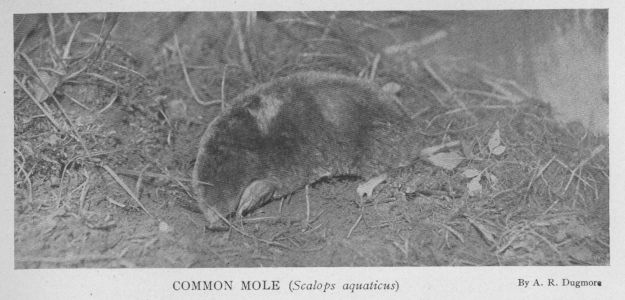
- Length
- 6.40 inches.
- Description
- Hands large and naked with powerful nails, hind feet small and of usual shape, snout long and pointed, tail short and naked. Fur glossy silvery gray, varying in shade when disturbed or placed in different light; often tinged rusty.
- Range
- Southern Canada, southward in the lowlands to Florida, where it is represented in the southern part of the peninsula by the somewhat smaller Florida mole (S. aquaticus floridanus). A browner variety also occurs on Anastasia Island, Fla., the island mole (S. anastasae Bangs).
Our common mole differs but little from the well-known mole of Europe that for centuries has disfigured the rich English lawns to the rage and disgust of the gardener.
Our species is responsible for the little heaps of new earth which, with each recurring summer, are thrown up to deface our own lawns. Morning after morning new hillocks stand out defiantly, extending the line of diminutive earthworks along the turf.
These heaps are not true mole-hills, but just the loose earth thrown up by the little miner as the easiest way of being rid of that which he displaces in digging for worms.
His work being usually carried on at a depth of five or six inches, it is evident that he must dig the earth away with his forepaws until it comes within reach of his hind feet with which he kicks it still further back.
When a certain amount has gathered behind him, judging from observations, I should say enough to fill the tunnel for a space of five or six inches, he manages, somehow, to push the whole along the narrow passage to the last opening made to the surface. It must require a great deal of strength to accomplish this, taking into consideration the tendency lawns have for packing under such conditions. By the time he has attained a distance of a yard or more from his last dumping place, the exertion apparently becomes too great and he opens up a new outlet to the surface, and another heap is started. In this manner and in sleeping the mole spends practically all his time; forcing his unlighted way along with gimlet-like nose and scooping feet, the confining earth crowding in all about him, restricting every movement of his body.
In winter he conducts his labours at a greater depth in order to escape the frost. In spring I have found recently made tunnels in the subsoil four feet or more below the surface.
The American mole is also said to construct true mole-hills similar to those of the more famous Old World species though more deeply submerged.
A real mole-hill is an ingenious arrangement of galleries in the hard-packed earth, surrounding the nest-chamber as a safeguard and a means of escape. Two galleries encircle the chamber at distance of a few inches one above the other, and connected with it and with each other by numerous short passages, insuring a quick and certain means of retreat in any direction. From the lower gallery other passages decend to the main roadway of the colony, which is an extended passage always kept open and free from obstructing roots and earth, and used by all the individuals of a colony in going from their nest to their diggings.
I have never seen much evidence, however, that our common mole works in colonies as the star-nosed and European species do. It seems to me rather that each starts off by himself as soon as he is able to dig alone, burrowing along at random in whatever direction food appears to be most abundant.