Home › The Grasshopper Tribes › The Grasshopper Tribes (John says he is sure)
The Grasshopper Tribes (John says he is sure)
John says he is sure the katydids are first cousins to the grasshoppers and locusts, and so they are. -- They are very closely related to which division of locusts, do you think?
Oh, yes, the longhorned, of course.
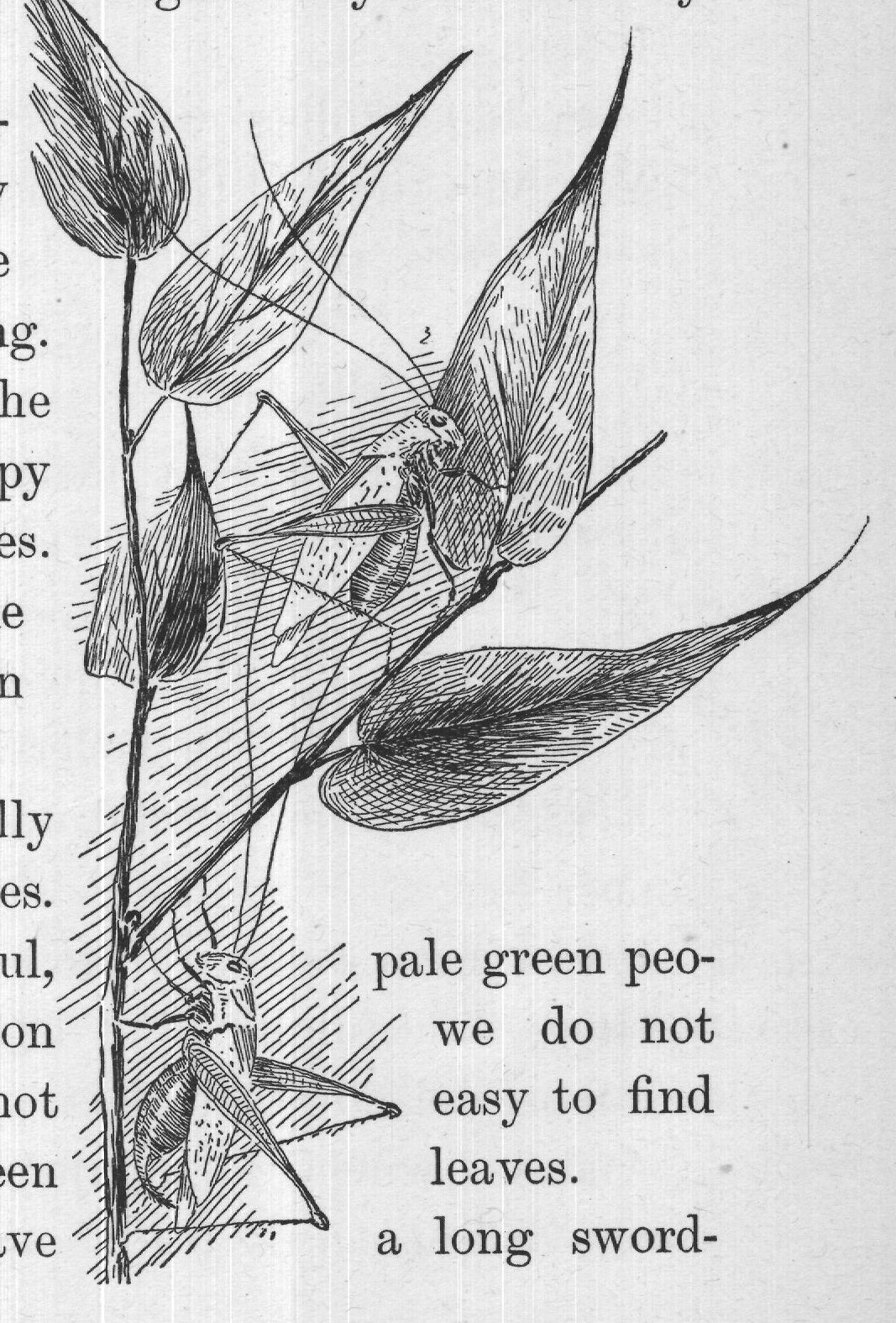
See their long, long antennæ, and the male has the same little musical places on his wings, little membranes that vibrate and make his song of Katy did and Katy didn't.
No, the little lady katydid cannot sing - only the little male, and he keeps it up all night long.
We sometimes wish he would get tired or sleepy and stop, but he never does.
Why do you suppose he likes to sing so well in the night?
The katydids generally live on trees and bushes.
Yes, they are a beautiful, ple, and that is one reason often see them. It is not a katydid among the green The female katydids have Σ pale green peowe do not easy to find leaves. a long swordshaped ovipositor with which they roughen the bark on twigs, and place the eggs there, fastening them with a gummy substance.
The egg is glued fast so it will not fall off.
It hatches into a little dot of a katydid that has no wings, but, like the larvæ of the other insects we know about, it eats and grows and moults, and at last its wings and the rest of its body are full grown.
It casts its skin for the last time; it is no longer a larva, but a full-grown insect.
Yes, May, we call the young of all insects larvæ.
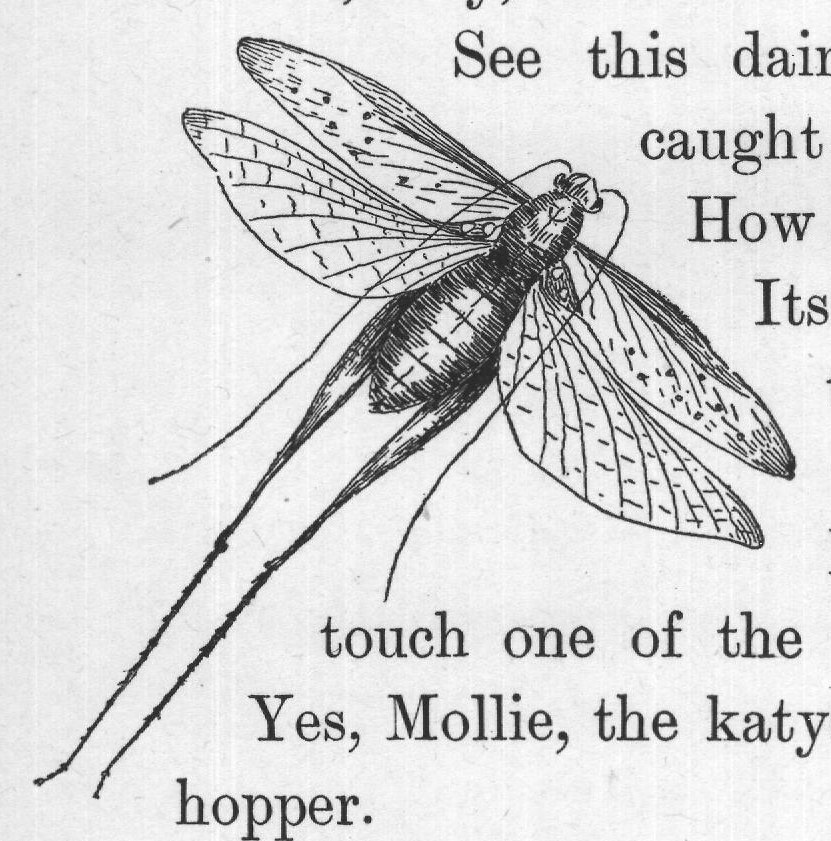
See this dainty katydid that Charlie has caught for us.
How pretty it is!
Its feelers are like long green threads.
And how sensitive they are!
It quickly starts away when we touch one of the feelers.
Yes, Mollie, the katydid walks more than the grasshopper. It can jump well with those long, slender hind legs. How beautiful its hind legs are! They are longer and more delicate than those of the grasshopper.
And its wings, how gauzy and dainty! Its wing covers are not so stiff as those of the grasshopper. They look almost like flying wings, they are so delicate.
See, they open, and fasten themselves open, like the wing covers of the grasshopper; and when they are at rest they overlap like the wings of the grasshopper. The inner wings are like fine lace.
They look too delicate for use, and yet the katydid flies very well indeed with them.
They are a little longer than the wing covers.
Σ When the katydid is at rest you can see the tips of the wings extending beyond the ends of the wing covers.
The part of the inner wing that extends beyond the wing covers is green, like the wing covers, you see. But the rest of the inner wing is not green, it is like very thin glass, or like fine isinglass.
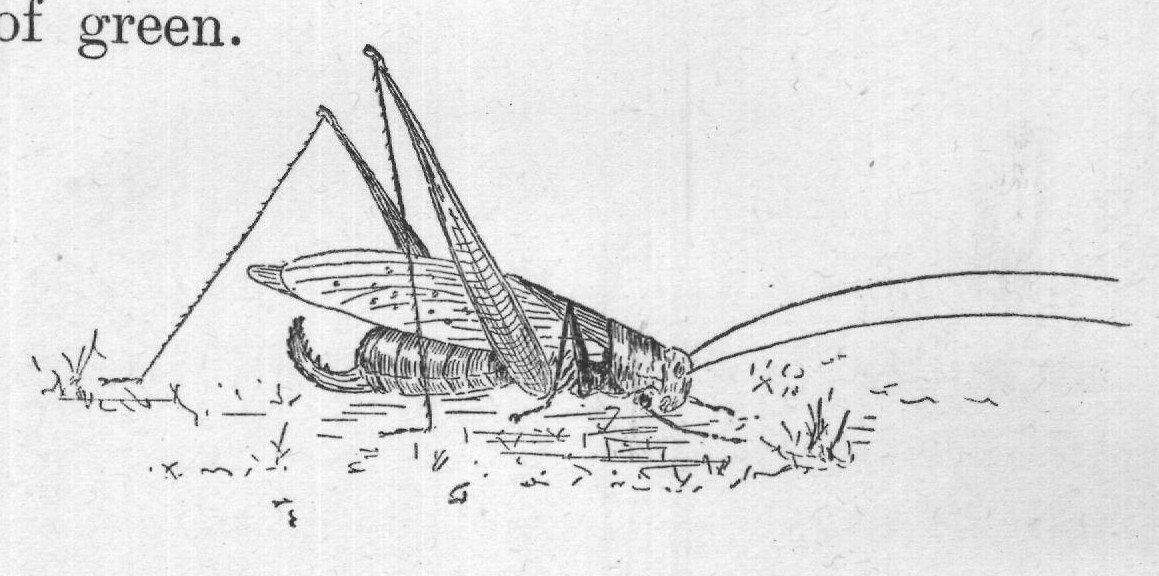
Look for a moment at the long curved ovipositor of the female katydid. saw.
If you look sharp, you will see teeth on it like a little It is with these teeth the little katydid is able to rasp the surface of the twigs, and make a place to fasten her eggs to.
Her wings are wrapped about her form like an ample cloak of green.
Now, my little katydid, you may fly away if you want to.
We are very much obliged to you for letting us look at you, and we hope we have not troubled you too much.
See her go!
How prettily the katydids fly.
They seem almost like little birds.
I am sure they love to fly about in the bright summer-time. Happy katydids.