Home › The Bee's Tongue › The Bee's Tongue
The Bee's Tongue
BOTH ends of the honey-bee have always been of singular interest to us, and this for exactly opposite reasons. It is the "tongue" that supplies the combs with honey, and the sting that never fails to admonish us when we become obtrusive in the affairs of the hive.
Pater Abraham a Santa Clara feelingly describes the bee as "honey before, a lance behind," and this has been expressed in later times by one who epigrammatically denominates the bee "a double-ender; one end the friend, the other end the enemy, of man."
To the humorist the sting is the chief end of the bee. So it is to the popular apprehension. It is the first thing a boy learns about a bee, and the only one he cares for, unless it comes to be a question of mingled fear and hope in robbing the store of the worker.
But we must not accept the opinion of either the humorist or the boy, for the tongue is mightier than the sting, just as in modern life the pen is mightier than the sword. "Through the soft air the busy nations fly, Cling to the bud, and with inserted tube Suck its pure essence, its ethereal soul," sings Thomson in his "Spring," recognizing that mysterious organ, the bee's tongue, which next to the sting has from all time engaged man's interest.
A bee's tongue is very wonderful, and is not at all what it appears to be.
Offer a captive bee a fresh white clover-head, and of a sudden, apparently from nowhere, there appears a long brown tongue that at once finds its way into the clover nectaries, appearing and disappearing in the most astonishing manner as the bee crawls over the head of flowers. One watching this rapid tongue and trying to make out whence it comes and whither it goes is reminded of the peaman's game of "Now you see it, and now you don't." The truth is, it is not easily observable excepting when in use. At other times, it is kept discreetly folded back beneath the head, where it fits into the space between the head and thorax, and offers a satisfactory explanation for the peculiar manner in which these two divisions of the body are attached to each other. The head is fastened near its upper edge to the thorax by its slender "neck," and were it otherwise, were the attachment more generous in size or lower down, when the bee folded back the sharp-pointed "tongue" it would be in danger of cutting its own throat, which would be inconvenient, to say the least!
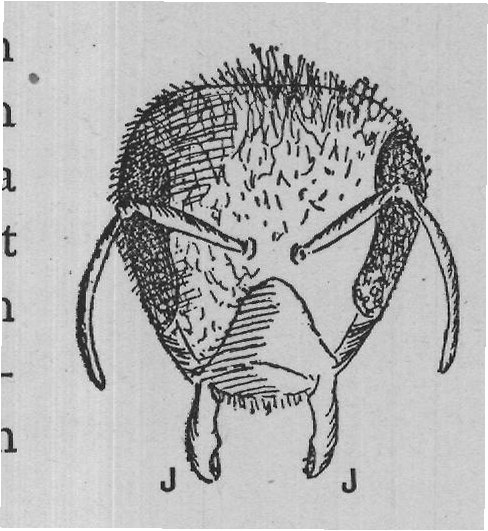
When a bee is about to produce its tongue it first opens its jaws, which are where one would expect to find jaws, at the lower margin of the face.
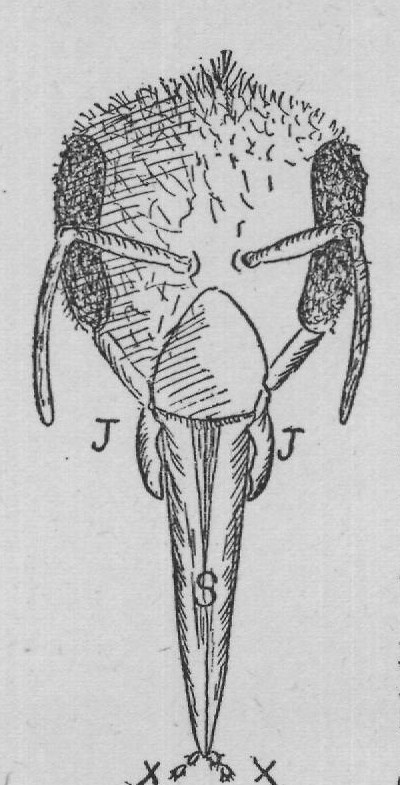
When the bee is at rest, one looking it full in the face would get no hint of a tongue, seeing only these tightly closed jaws (JJ) and above them the upper lip (Z), the lower edge of which is bordered with a row of short, stiff hairs, which are sensitive and act as feelers.
J J Disturb the bee a little and open fly the jaws, not to accommodate the tongue this time, but evidently to strike terror to the heart of the intruder. The Bee's Tongue Bumble-bees are more apt to threaten with their jaws, which are large and powerful, than are honey-bees, the latter being quicker to sting. No doubt a bumble-bee can bestow a very creditable nip with these horny organs, as it will often demonstrate by biting viciously at a pencil-point when disturbed by it. It evidently knows there is no use in wasting good sting power on a pencilpoint, so it expresses its feelings with its jaws.
J J Any bees caught in a net will bite at the meshes, and this is a very good way to watch the play of the jaws, which, as in other insects, work sideways instead of up and down, like those of the higher animals.
The jaws of the bee are somewhat sickle-shaped, are more or less toothed according to the species of bee, are hard and horny in substance, are fastened at either side of the face by a hinge-joint, and meet or overlap in front when not in use.
In this chapter, for the sake of clearness, the complex organ commonly known as the tongue will be called the proboscis.
One approaches it with a fear which even the sting does not inspire, for probably few other organs of its size, in all the world and in all time, have been so much written about and so goodnaturedly quarrelled over as has this same little bee's proboscis.
We will consider, at present, only the proboscis of the worker honey-bee.
When one first looks for it in a resting bee, it is found folded back under the head and out of the way.
When needed, it is let down by a sort of hinge-joint, and brought forward between the jaws, which, as we have seen, open for that purpose. It now has the appearance of a short, stout, sharp-pointed dagger (S) with two little feelers (X, X) at the tip.
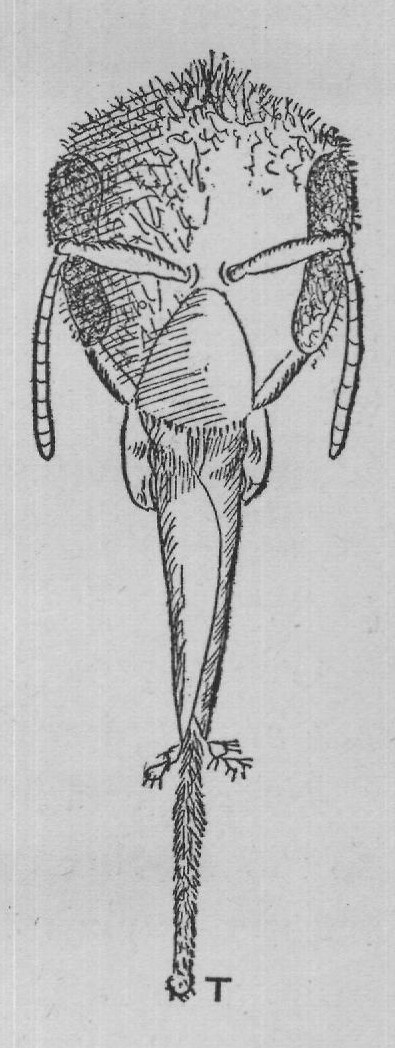
J XX J Instantly there appears, reaching below the point of this dagger, a very active, tiny, thread-like tongue (T) wriggling about in the honey or nectar and licking it up very much as a dog's tongue licks out a dish.
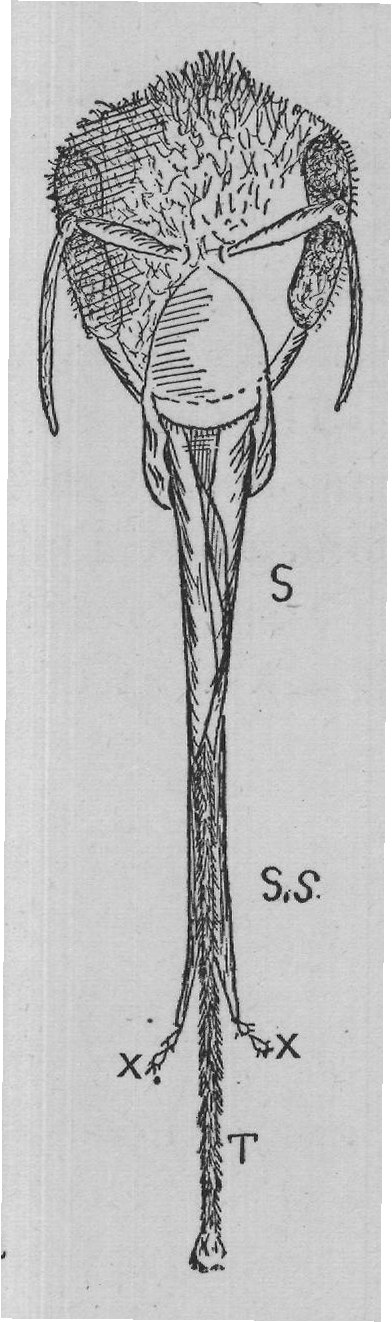
The best way to watch the action of the proboscis is to place a hungry bee near a drop of honey. As long as the honey is abundant and easily reached, the proboscis will probably remain as described; but if the bee wishes to reach a more distant point, the proboscis is suddenly lengthened, an inner portion (S, S) is shot out, reminding one of the manner of lengthening of a telescope. This inner part is seen to bear the feelers (X, X), as they are carried with it. The tongue itself is thrust further out of its hiding-place.
In short, with great rapidity the proboscis can be extended until the tongue is able to reach more than half the length of the bee's body.
T As this interesting exhibition is watched, one discovers that the proboscis is not a closed tube or tubes, but is composed of parts which separate more or less as the bee imbibes the honey.
The Bee's Tongue In fact, the bee's proboscis is not a tube at all, though it can perform the office of one at need. A closed tube would be an inadequate and clumsy possession to a bee, as it could not lick up nectar so quickly and could not free its proboscis without great loss of time in case that instrument became clogged. Any one who has watched a bumble-bee disengage a bit of honey-comb or other foreign substance that had become wedged in its proboscis will appreciate the advantages of an organ that can, so to speak, be taken quickly apart and cleared out.
The proboscis lies behind the upper lip and is formed of the tongue, the lower lip, and two side pieces called maxillæ.
These organs are common to all insects, but in the bees are modified to form a long nectar-gathering instrument.
Mt S S.S.
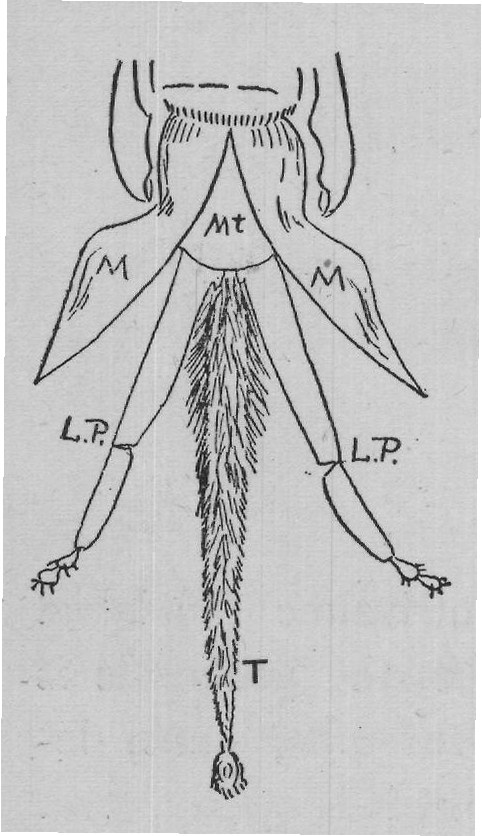
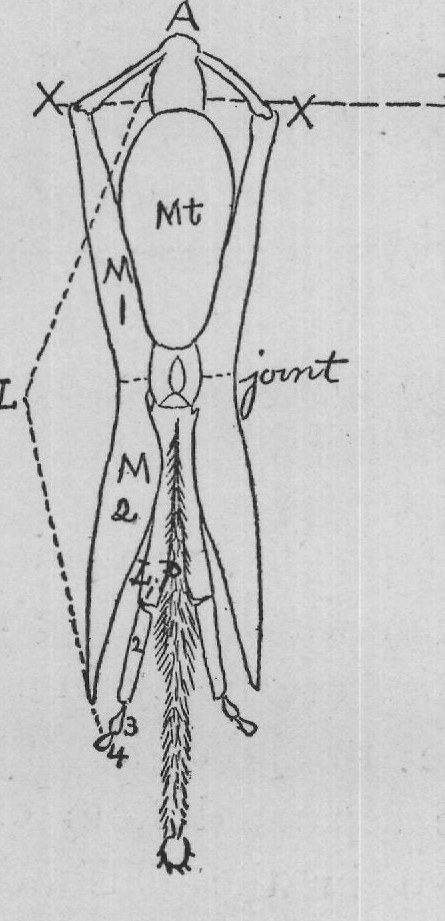
X X T The two maxillæ (M, M) together form the sharp-pointed dagger-like organ which the bee first lets down. They are horny in substance and are two-jointed. They can readily be separated from each other as shown in the illustration, though normally they lie side by side, the thin inner edges of their lower joints (2,2) overlapping above the tongue and forming the top of the proboscis.
LP M T L.P They are hollowed within, thus forming an arched roof to the proboscis, but as they do not meet underneath, they fail to form a perfect tube. Beneath the maxillæ lies the lower lip. This is composed in part of two four-jointed organs, the labial palpi (LP). Like the maxillæ the palpi have two large horny joints (1, 2), but they also have two short joints (3, 4), which possess sensitive hairs, and, in short, are "feelers."
The two palpi lie side by side, their inner edges overlapping underneath the tongue, so that, like the maxillæ, they form a partial tube.
Thus, where the proboscis is let down but not lengthened it is a short tube, closed above by the maxillæ, below by I A II.
X Z Z A Mt M X joint L 2 M 3 III.
X AX the palpi. When by a remarkable contrivance the labial palpi are extended beyond the maxillæ, the proboscis is lengthened but is no longer a complete tube, since, deprived of the roof formed by the maxillæ, it is open above. The Bee's Tongue This, however, does not interfere with the collecting of nectar, as the tongue, or ligula (T), is covered with rows of hairs which make it easy for the liquid sweets to be conveyed up to the complete tube above.
In order to examine the wonderful mechanism by which the proboscis is lengthened and shortened at will, we will now look at the under side of the proboscis with all the parts widely separated.
We have here the maxillæ (M, M), or outer sheath, as before, with both joints (1, 2) plainly distinguishable. Between them we have the lower lip (L) with the upper cylindrical part or mentum (Mt) and below that the two labial palpi (LP, LP), these palpi forming the inner sheath. Between the palpi is the tongue (T) having its roots in the mentum and capable of being withdrawn partly into that portion, by the action of muscles joining tongue and mentum.
The maxillæ are attached to a plate under the bee's head at the points Z, Z, of Figs. II. and III.
In Fig. I. these points are below and behind X, X, and are concealed by the overlying parts.
The proboscis in Fig. I. is not lowered, but is as short as it can be.
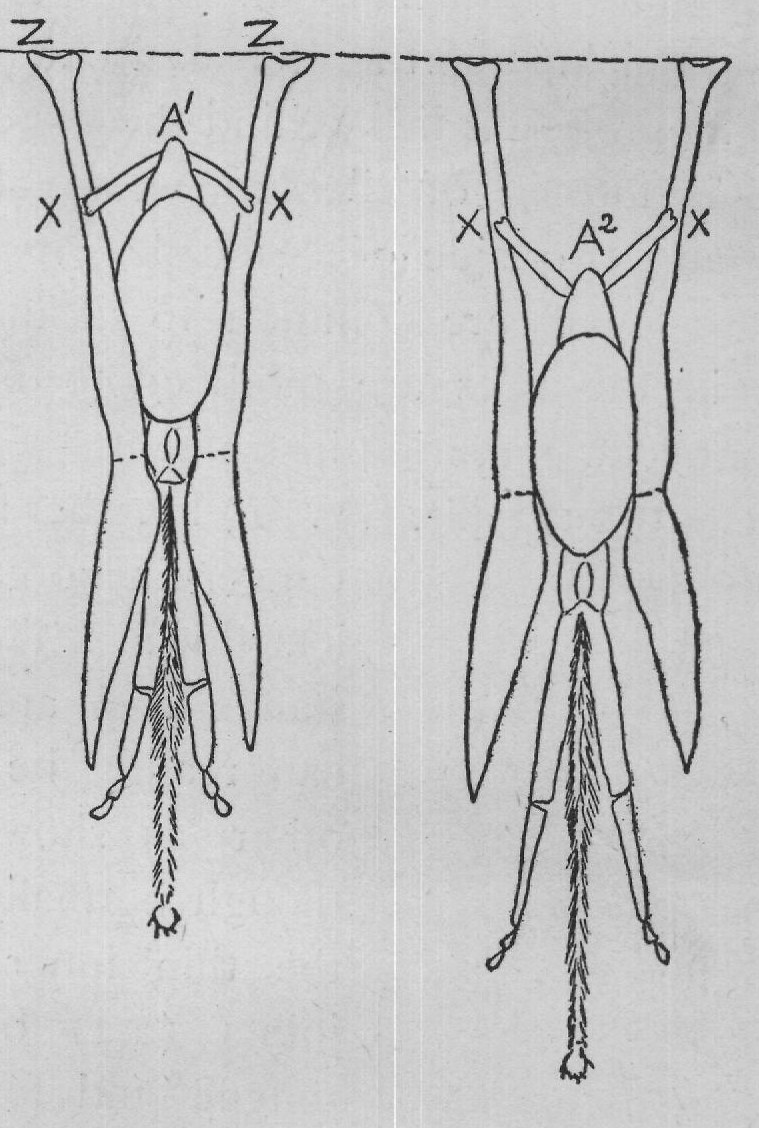
In Fig. II. the bee has lowered its proboscis by opening the hinges at Z, Z, which thus lowers the point A of Fig. I. to A¹ of Fig. II., leaving the points of attachment, Z, Z, exposed to view.
In this way the whole proboscis has been lowered, the inner and outer sheaths retaining their original relative position to each other.
Now the bee desires to extend its tongue still farther, and to this end lowers the proboscis yet more, in order to do this making use of other hinges similar to those already used at Z, Z.
These hinges are at X, X, the point A¹ of Fig. II. being joined to X, X, by the stiff, horny arms A¹, X, on either side. Certain muscles which are attached to the head as well as to the proboscis by contraction depress the arms, as seen at A2, X, in Fig. III., and lower the point A1 to A2, opening the hinges at X, X, and thus lowering the inner sheath. This now projects below the outer, and the proboscis has been extended to its maximum length below the jaws. The final act is to lengthen the tongue to its utmost by withdrawing it as far as possible from the mentum Mt. Thus, by means of springs or hinges or levers, as one may choose to think of them, the proboscis can be quickly lengthened and shortened.
A profile view of the tongue and its motor mechanism is interesting and makes the manner of lengthening the organ clearer.
The proboscis is slightly lowered, otherwise A would be applied closely to the line of the head, the whole apparatus would be tightly closed, and its mechanism concealed.
IV.
N of fo MLP Mt Corresponding to the arm ZA on either A side is a lower parallel arm VK, which is visible only in the profile. This arm, like that at ZA, is tough and horny, though very slender, and it is evident that the parallelogram ZAKV, being jointed at each angle, can, by swinging on these joints, depress or elevate the side AK and with it the attached inner sheath and tongue.
But this parallelogram is divided in two at points X, S, and is also movable at these points, and the parallelogram ZXSV can change its relative position without changing that of the parallelogram XAKS as seen in Fig. V.
Thus, the whole proboscis is lowered the distance from The Bee's Tongue X to X¹, the outer and inner sheaths retaining their relative positions to each other.
But the parallelogram X¹AKS is capable of a similar change of relative position, as Fig. VI. shows, thus lowering the inner sheath and with it the tongue below the point of the outer sheath, and extending the proboscis to its greatest length beyond the jaws.
This really simple and very effective apparatus is worked by an arrangement of muscles reaching from it to the head, and as simple and ingenious as the framework itself, when the work they accomplish is considered.
When not in use the proboscis is doubled back at the joints marked on Figs. I., II., and III., and at O,O, on IV., V., VI., and VII.
The tongue of the bee is a hairy organ, a VI. 0 ZAMA A' V K Mt 0 V. 0 VII. $ A K Mt fortunate circumstance when the very imperfect tube of its proboscis is considered. The hairs are arranged in rings around the tongue, the longest ones being towards the centre, and no doubt act as efficient aids in lifting the nectar through the proboscis to the mouth when there is an abundance of nectar within easy reach. The tongue in such cases licks up the nectar, and one can readily watch a bee gorge itself on a drop of honey, the -0 parts of the proboscis quite widely separated, the active tongue licking in and out, and a band of honey, so to speak, extending from the drop almost to the mouth opening. The greedy little creature is fairly shovelling in the unaccustomed abundance.
An exposed drop of honey, however, is an unusual piece of good fortune for the bee; generally, it has to insert the proboscis into tubular flowers, where the nectar cannot be licked out in this easy way, and if the bee were unable to profit by the more inaccessible nectar of the flowers, starvation would stare it in the face. But the bee has a tongue of resources. When nectar is abundant it can gather it speedily and carelessly, but when distant or scarce sweets are to be reached, it is also equal to the occasion.
There is a groove running lengthwise at the back of the tongue, which is somewhat complicated in structure and which is closed into a tube by means of hairs which are so placed that they cross each other, forming a covering to the groove, but which can easily be moved aside when it is desirable to open or clear the tube. The end of the tongue is a cylindrical disk covered with delicate hairs, which aids in licking and also in starting the nectar into the central groove.
This groove or tube is no doubt used to convey small quantities of nectar to the mouth, so by means of its complicated tongue the bee can gather nectar of any amount or any degree of accessibility.
The root of the tongue, as we know, is in the mentum, and when not extended for use it is withdrawn into the mentum in a manner which the accompanying illustration makes clear.
It is very easy to see the manner in which the nectar starts on its upward course, but concerning its final method of entering the bee's body there is still room for a difference of opinion, one maintaining that the upper part of the proboscis enlarges and contracts successively, thus pumping the nectar into the mouth; another, that the honey stomach, The Bee's Tongue or sac in the abdomen that receives the nectar, is a "sucking stomach" and thus draws the nectar through the tubes. However this may be, we know for a certainty that the honey does reach the honey-sac.
In the act of taking honey, the mouth-opening at the upper front part of the proboscis is firmly closed by a flap or lip of delicate membrane that appears below the edge of the upper lip when needed.
The bee is very quick to discover honey and when confined in a room will soon find its way to the honey provided for it. Where there are flowers it will soon discover them and proceed to rifle them of their nectar.
It is amusing to watch a bee on a cluster of flowers new to it. Its "unerring instinct" does not lead it at once to the best manner of securing the nectar; like the rest of us, it has to live and learn by experiment and gain knowledge through failure.
There is one flower concerning which a honey-bee never seems ignorant, however.
Present the captive with white clover-heads, and it instantly goes to work, putting the proboscis, or tongue, as we shall now call it, since we are done with scientific terms for the present, into flower after flower, always in the right place.
But with other flowers it is less certain.
Having been given a bunch of flat-topped flowers, whose nectary was in the form of a cushion-like disk easily reached, a honey-bee not long since made a most amusing and for a time unsuccessful effort to stay her hunger from this fragrant and all too evident nectar. Like certain unfortunate sentimentalists of the human race, she was trying to get the thing right before her face by aiming at the moon. She was a thoroughbred bee, no doubt, accustomed to maintain her rank and find her sustenance in the aristocratic tubular flowers, and to be requested to take nourishment from a flat-topped flower with no tubes, but holding nectar galore free to the common herd of short-tongued bees, flies, and other plebeian insects, was too much for her philosophy. She could not credit it, and the little brown tongue was repeatedly thrust between the petals of this flower into the outer air, where it vainly waved and wriggled.
She evidently scented the honey, was hunger-distracted, and made frantic efforts to get it - by licking the air! She persisted in trying to find tubular nectaries in midair for so long a time that her captor seriously meditated coming to her assistance, when finally her wayward tongue in its gyrations accidentally slid over the actual nectary. The problem was at once solved. She licked the cushion-like nectary dry, went to another flower, and started aright.
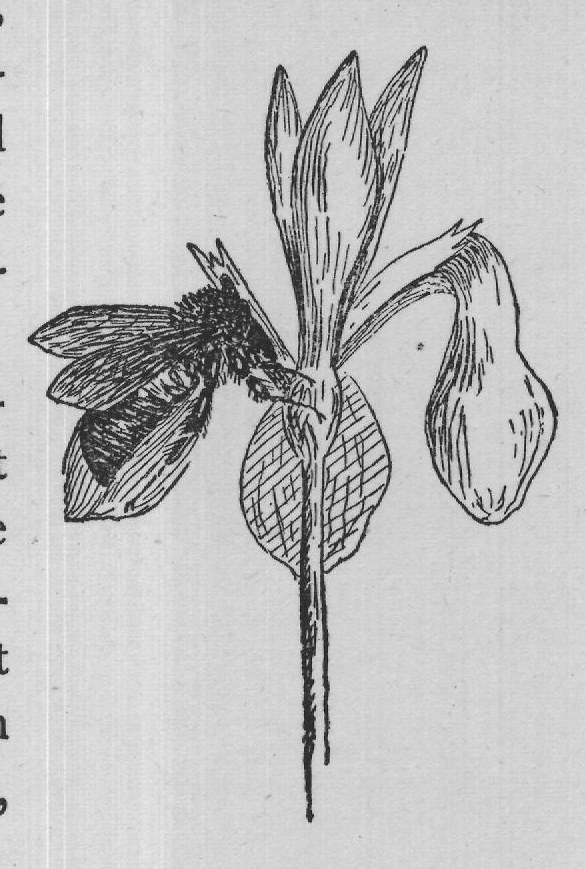
In fact, she licked out every flower in the bunch without making another mistake, proving that though she acquired a new idea with difficulty, she kept it when she got it. Honey-bees presented with different forms of papilionaceous flowers always had to find out by experiment where to find the opening to the nectary and how to get to it. Though when they had finally succeeded with one flower, they profited by their experience and quickly and dexterously rifled all of like form within reach. Perhaps the most amusing of all were the bumble-bees trying to extract honey from the Iris.
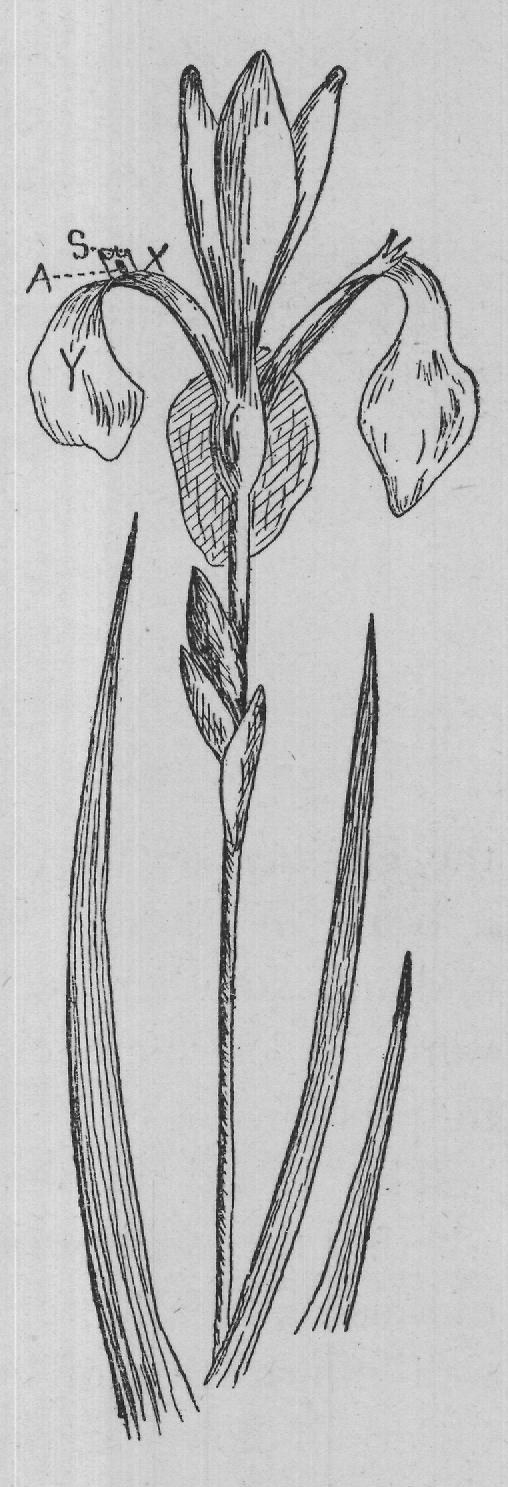
This flower is so formed that the bee cannot get the nectar without creeping under the petal-like style (X), that lies curved against the true petal (Y) and acts as a spring when an insect pushes under it. Beneath this spring at A lies the anther; and the flower's intention evidently is to make the bee pay for its feast of nectar by dusting its back with pollen as it crowds under the style, and carrying the The Bee's Tongue pollen to another plant. When the bee approaches the nectary of an iris flower its hairy back first comes in contact with the stigmatic surface (S) at the outer rim of the style; and if it has recently come from another iris, it will be pollen-dusted and will leave some of the pollen on the stigma. As it passes under the style its back will gather a fresh supply of pollen to be in like manner conveyed to another plant.
A Sex The captive bumble-bee, suddenly presented with a generous supply of iris flowers, evidently had had no experience with them, or if so, it had forgotten. It had been fasting for some time and speedily made its way to the new offering. It landed on a hanging petal - as it ought; but instead of creeping under the style as it ought and thrusting its tongue into the longed-for nectar while it incidentally dusted its back for the benefit of the House of Iris, it clumsily climbed over the top of the style and began to lick the centre of the flower, evidently with little satisfaction, for it moved constantly about as though searching for something. Finally, it discovered the location of the nectar, though not the entrance to it, and made repeated attempts to reach it from above, clinging to the petal and putting in its tongue along the side of the style.
Its tongue was stretched to its limit, the bee stood on its tiptoes, so to speak, and the sympathetic observer could feel if not see the anxiety depicted on its countenance. But all was of no avail. It could not get the nectar that way; it must conform to the law of the flower, or go hungry.
It tried again and again walking over and about the right opening; but the flower, strong and stiff, met its stupidity by an equal obstinacy, until finally Madame Bombus solved the vexing riddle, forced her corpulent person beneath the stigmatic spring, stretched her neck and extracted nectar to her heart's content.
Emerging from the entrance to the emptied nectary, she unhesitatingly, and no doubt with a beam of triumph in her eye, forged across the flower and into another nectary entrance. From that time forward she lost no precious moments when iris blossoms were in question.
This raised in the observer's mind the query as to whether the need of becoming acquainted with the method of ransacking a flower for nectar might not account for the well-known habit of bees in collecting exclusively from one variety of flower during a given time. They find a flower which is abundant and whose nectar pleases them, they know just how to proceed, so it is a time-saving method to hasten from one flower to another like it.
Every observant bee-keeper has noticed the experimental manner in which bees search for nectar.
Their instinct as a rule leads them to seek the flowers for honey, though sometimes they do not seem even to know flowers without first investigating their little world and discovering them. Mr. Root says he has watched bees in the The Bee's Tongue springtime, very likely young ones, examining the "leaves, branches, and even rough wood of the trunk of the tree," as if smelling out the nectar. But when the secret has once been discovered, all who have watched bees know how well it has been remembered. Bees, like all living creatures, control their lives through the exercise of reason. The bumble-bee, although belonging to another genus, is very similar to the honey-bee in structure, and while it differs in many ways in its habits, still its methods of gathering nectar and pollen are the same, and its large size and good nature make it a pleasant house companion.
It is longer lived when in captivity than the honey-bee, and not so likely to get lost when it has the freedom of the room. If one forgets to put it up for the night it crawls away into some self-chosen corner and emerges next day, making a great commotion.
The best way to discover how bees visit flowers is to give the bees a short fast, then introduce the flower to be experimented upon, with no other flowers in the room. In this way the writer enjoyed a very amusing exhibition of the bumble-bee's performances with the moccasin flower or pink lady's slipper, - cypripedium acaule.
A whole afternoon spent in the dim woods with these strange and lovely growths failed to throw any light upon their method of fertilization.
It is reported that the small bumble-bees fertilize them, but at this season June there were no small, or worker, bombuses flying. They had not yet come out.
It was a New England June, one to remember, when a cool and rainy season had made the wild growths of the mountains of western Connecticut even more than usually luxuriant and beautiful.
Through the dim aisles of the hemlock and white birch trees that clothed a certain hillside the forms of the great pink orchids shone with almost unearthly effect.
The single blossom stood at the end of its long stem rising from two large leaves that looked as though they had scarcely yet been fully born from the earth beneath. They stood singly, but in small communities, little settlements of them, and occasionally two would be so close together that they looked like one plant.
It was no hardship to wander through these woods coming ever upon the magic areas where stood the orchids, giving one the feeling that they did not belong to this world, but were here for a time, brought forth by some powerful incantation.
The orchids were alone. The air was still but for the rustling of the hemlock boughs. Hours passed, and no winged messengers came to them.
By its nature the cypripedium is dependent upon winged insects. There is no plant more so.
It is an extremely advanced organization, so highly developed that it is difficult to see how flowers could go much farther along the road of progress.
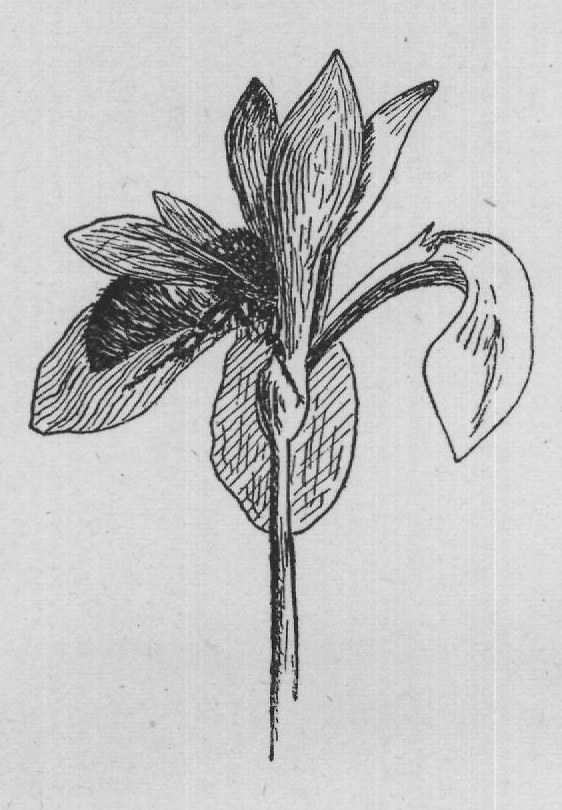
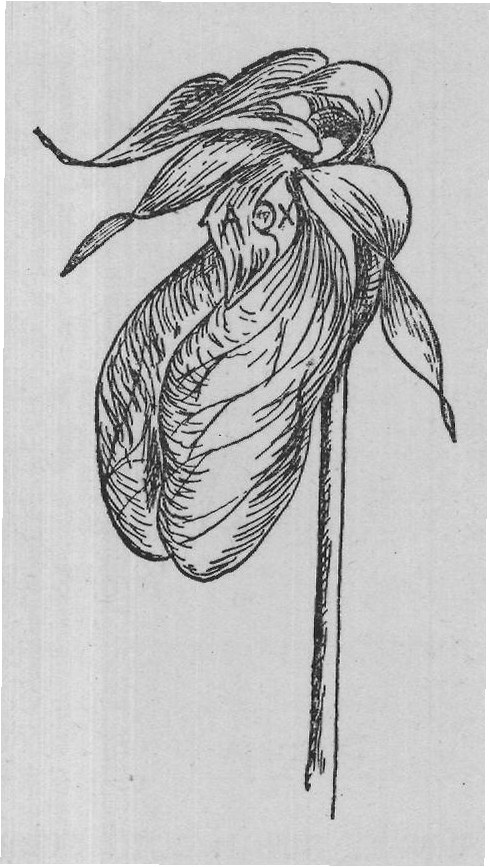
There is one more step it could take, that of having stamens and pistil in different individuals. But it is as secure from self-fertilization as though this were the case. The petal forming its large inflated sac is free along the upper edges, leaving a slit the length of the sac, but this slit is not evident without actually drawing apart the two sides of the sac, so closely do the overarching lips shut together and conceal it. The essential organs are borne on the The Bee's Tongue inner surface of the trap-door A at the top of the sac. The back of the round anther is visible in the illustration, but the stigma within cannot be seen. The space X forms an opening into the upper part of the sac.
One could not remain in that orchid-grown forest indefinitely, so there was nothing to do but to take a number of the mysterious and handsome blossoms home. They were still wonderful in the full daylight, and yet there is no denying they left a part of their charm in the mystery of the woods.
Their color is a beautiful pink, not like that of the rose and yet suggesting it. The full pink sac is adorned with bronze streamer-like sepals that heighten the color effect and increase the charm. There was a large queen bombus to welcome them to their new home, - a splendid creature that may well have held the rank in the insect world that they did in the world of plants.
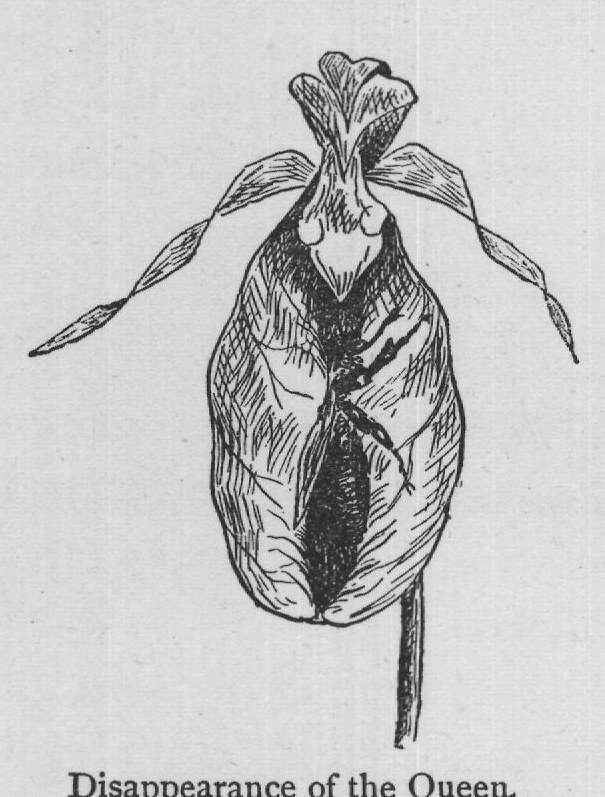
She flew at once to the new flowers, and although her observer had no thought of her entering the orchid, or if so, of her being able to extricate her large body through the proper opening, she scattered theories to the winds by at once introducing her head through the slit in the front part of the sac and licking the inside of the flower as far as her long and flexible tongue could reach.
Then she forced herself in a little farther to reach yet unexplored sweets. Evidently orchid nectar was entirely to her mind, for presently she crowded still farther in, and in a moment more the lips of the sac closed triumphantly over her receding form and the first act in the romantic drama of the love of the orchid had been played.
By holding the flower against the light, the bee could easily be seen, as, all unconcerned as to how she was to escape, she greedily licked clean the inside of the ample sac. When her appetite was satisfied, or more probably the sweets exhausted, she wished to come forth into the wide Disappearance of the Queen.
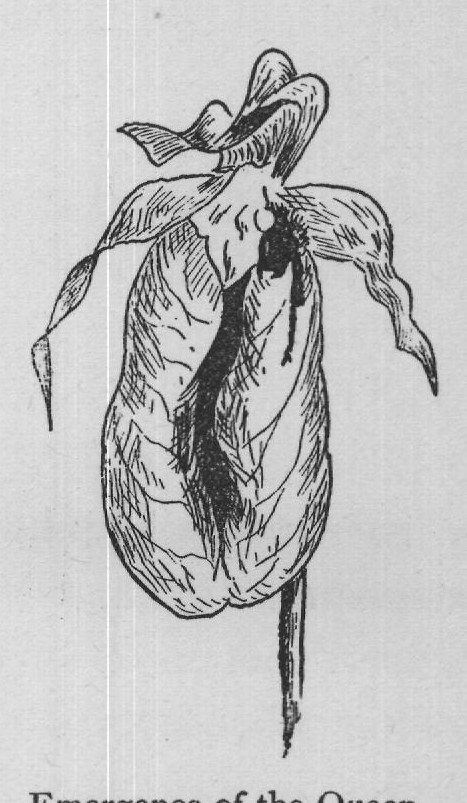
Emergence of the Queen. world again and tried to do so the way she went in, but orchid sacs that open to swallow up queen bombuses do not open to let them out again and her ingenuity was not sufficient to manage the combination that held her locked in prison.
Then, no doubt, casting her eye around she discovered the ray of light at the top of the flower and presently her black head appeared in the window, as one is tempted to call that interesting opening from the orchid prison. The observer, having kindly decided not to let her die there, but to help her out after she had made a reasonable effort to extricate herself, sat and gazed at her black head with sympathy.
Just then she reached out a strong fore leg and firmly grasped the outside of the flower with her toes. Then she The Bee's Tongue reached out another leg. Then she slowly and thoughtfully emerged, whole and unharmed, with the stamp of the orchid on the top of her back in the form of a large round patch of sticky pollen which she had dragged from the anther under which she had squeezed herself.
Once out, she tried, unsuccessfully, to brush the pollen from her back, evidently feeling annoyed by it, and then buzzed her way straight to another of the orchids, insinuated herself into its sac, and when she got ready pulled her plump person successfully through the small opening at the top.
She bore the seal of the orchid all over the top and sides of her thorax before she was through her depredations on that handful of flowers, and of course in passing under the stigma on her way out must have left enough of her gathered pollen to fertilize the flowers.
Thus was forever dissipated the fear in at least one mind that the queen bombus is incapable of fertilizing the cypripedium acaule.
Some of the honey-bees that had the run of the window screen also went into the cypripedium flowers through the slit in the sac, but they came out at the top without touching the pollen masses, being too small to fill the necessary space.