Home › The Bee's Tongue › The Bee's Tongue: Connecticut
The Bee's Tongue: Connecticut
As many of the flowers in the Connecticut woods set no seeds, it is probable that they are not greatly favored by insect visitors in this day and generation, or was this an off season for bumble-bees to favor cypripediums? However that may be, on that particular hillside, in that particular June, the cypripediums were slighted.
But such is the marvellous number of seeds developed in any one pod that does fulfil its destiny that a few mature pods would be sufficient to seed down the whole country side.
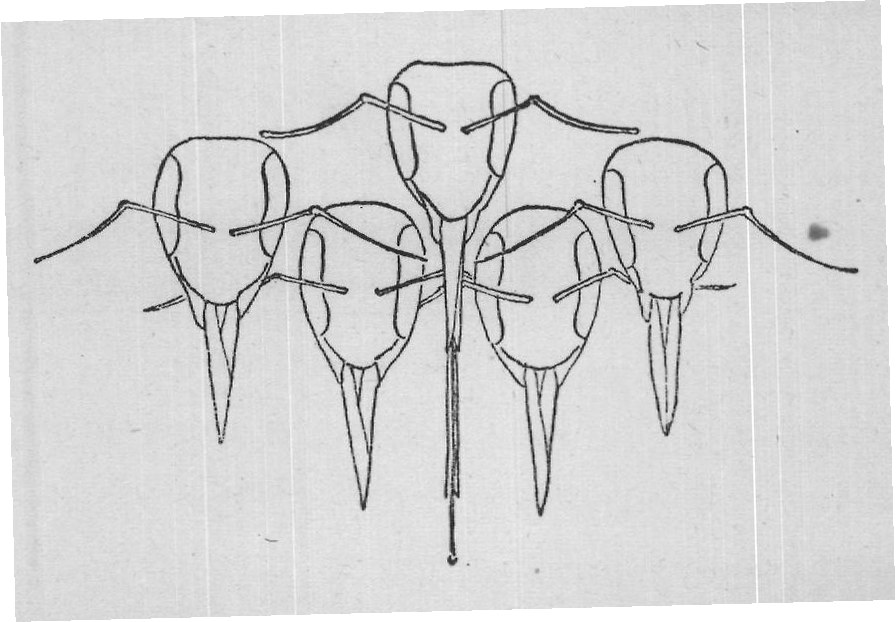
Although Queen Bombus was not observed to visit the cypripediums in the Connecticut woods, she was caught at it next spring in the Blue Ridge Mountains, where by the roadside was seen a splendid specimen of the cypripedium acaule, and from its narrow window a queen bombus triumphantly emerging.
One hears so much of the brightness of flowers as being the result of insect selection, and of the bees in particular as finding flowers by their colors, that one at first unconsciously looks to the showy blossoms when searching for bees. But this seems to be a mistake.
Early in the summer the huckleberries bloom, and over the rocks on the Connecticut hills may be seen clusters of straggling bushes loaded with small, rather inconspicuous red flowers.
These flowers are always alive with bees.
Great queen bombuses, airy honey-bees, and slender black bees of solitary habits are all there busily draining these toothsome blooms, while the vivid houstonia, whitening the earth like a fall of snow, seems to be quite ignored, and the buttercups, daisies, and many another showy bloom has only an occasional bee-visitor.
A little later the wild raspberry-bushes - or brambles blossom with such an excess of delightsome nectar that they have been able almost to dispense with petals. Their narrow white petals soon fall, and at the best are very inconspicuous.
The bees adore these modest blooms, and to come at them will pass the brilliant white blackberry blossoms, or the most gorgeous garden flowers, without a moment's hesitation. Bees could always be found on the brambles when they were to be seen nowhere else.
The mountain laurel, which held high carnival over the pastures and through the woods of Connecticut, piling up The Bee's Tongue crisp masses of bloom in a marvellous manner, did not win the favor of the bees, fortunately for those of us who love honey and do not care to be poisoned. For the honey of the laurel is said not to be good for man.
The honey-bees ignored it entirely, and only an occasional bumble-bee or fly was to be seen paying homage to its opulence - always excepting the yellow papilio butterfly with black bands on its wings.
These brilliant creatures fluttered by the score about the laurels, helping them hold jubilee, and adding their winged beauty to the grace of the floral outburst.
Perhaps in a season when other nectar was scarce, the bees would have turned to the laurel as a last resource, though honey-bees in captivity preferred starvation to laurel nectar.
Bumble-bees were less fastidious, and did not disdain to gather honey from every one of a large bunch of laurel flowers placed near their window.
Wild roses, however seductive in color and fragrance, do not attract bees as do many other less showy flowers; perhaps the bees remember, from ancestral experience, that the roses have no honey, only pollen to offer their guests. All know how fond bees are of linden or lime tree blossoms, the trees when in bloom sounding like a vast bee-hive from the countless honey-gatherers busy in their midst, though the greenish flowers are so inconspicuous that many a one would fail to discover that the tree was in bloom were it not advertised so loudly by its loving friends. From remotest ages the lime has been noted as a tree beloved by bees, and Virgil does not fail to tell us that the limes of his old Corycian bee-master were the first to bloom.
A little time spent in watching the bees in summer is a good tonic for the mind, and also a valuable corrective. From learning of bees and flowers through much reading, one is apt to draw the lines too closely about the methods of nature.
One thinks of flowers and bees as adapted by nature to each other, and as fitting together like the two parts of a machine.
While it is true that flowers no doubt are modified to suit certain insects and to attract them from afar, and the insects are modified to gather sweets from the flowers, still there are very few flowers that allow of but one insect very few insects that visit but one species of flower. And any one who has watched a bee experiment with a flower new to it will be filled with a saving sense of the volition of insects, and of the manifold possibilities of action in the insect world.
There is variety enough in the life of a single bee to afford entertainment to the most exacting, and to show the futility of drawing rigid conclusions concerning the habits and senses of bees without an almost infinite amount of knowledge concerning the habits of all the bees in all parts of the world.
Bees certainly possess individuality, and to foretell the actions of any one from what is known of the habits of of any one from what is known of the habits of its race would be as sensible as to predict the actions of your neighbor from what you believe yourself to know of the habits of the genus homo. کی III