Home › The King's Plate › The King's Plate: George
The King's Plate: George
The height of these salts is sixteen and a quarter inches, and they have a diameter at the base of nine and three-quarter inches. They bear the mark of an unknown maker, an orb and star on a plain shield, which same mark is to be seen on the "Maundy Dish." The date of manufacture is 1660. THREE VARIED SALTS We now come to the three St. George's Salts, each of a different pattern, though two of them are sufficiently alike to serve as a pair. All three have a canopy on top supported by three brackets and surmounted by a mounted knight in armour, presumably St. George. They are all of the same date and by the same maker. The first of these three salts has a trumpet-shape body resting on three lions couchant, the base being ornamented with bold scrolls. Large upright acanthus leaves alternating with plain leaves decorate the body. Near the top is a convex section which is embossed with four rams' heads, with clusters of fruit in the intervals. Above this is a plain circular shallow receptacle for holding salt. The brackets which support the dome make the letter "C," the dome itself being embossed with flowers. St. George, who is riding a very small horse with an exceedingly luxurious tail and mane, has in some previous age lost his sword. ،، This salt is fourteen inches in height; is marked as weighing sixty-one ounces two dwts., and was made in 1660. The maker's mark is T.A., with a mullet between two pellets below, on a plain shield. The second salt of this series is also trumpet-shape, but rests on a broad flat base without lions couchant as legs. The ornamentation is very similar except that on the base are four shaped panels containing faces in high relief. St. George is mounted on a very similar steed, but is here armed with a gigantic sword considerably longer than himself. The height of this salt is thirteen and a quarter inches, and the weight inscribed is 53-1-2. The date and maker's mark are the same as those given for the previous salt.
The third salt by this maker, though in general appearance similar to the first two, has, on examination, several points of difference. The canopy and the effigy of St. George with a huge sword are as in the second salt, but the convex belt below the salt pan is absent, and instead a large convex belt near the base, with THE KING'S PLATE a row of large burnished oval bosses, such as may be seen on challenge bowls for recording the winners' names. Below this comes a domed base embossed, and standing ball feet, each clutched by a lion's paw. The height of this salt is fifteen and a quarter inches, and the marked weight is sixty-six ounces. The date and maker's mark are the same as the first two of this series. THE SALT OF STATE One of the most conspicuous pieces of royal plate at the Tower is the State salt-cellar, presented to Charles II., on his restoration, by the city of Exeter. By some it is supposed to represent the White Tower, whilst others think that the design was taken from the crest on the common seal of the city of Exeter. More probably, however, it was merely a fancy design originating with the goldsmith and his craftsmen.
It may generally be described as a square tower with turrets at each corner, whilst from the roof rises a circular super-structure which in its turn is surmounted by a large crown. The edifice stands on a broad plinth supported by four balled legs. The whole is of silver, richly gilded and encrusted with jewels. This salt occupied the place of honour at the coronation banquets of all the English monarchs from the reign of Charles II. to that of George IV., since which it has ceased to be used. It has frequently been re-gilt, and lost stones replaced or new ones added; amongst other occasions for the coronations of James II., William and Mary, Queen Anne, George I., II., III. and IV.; on the last occasion the charge made by Rundell, Bridge and Rundell being £133 17s. Od. A closer inspection of the salt discloses a mass of detail unobserved from even a moderate distance, which it may be of interest to describe. Taking the main tower; on one face is an entrance gateway of Renaissance design with a circular arch, and having a portcullis. On each side of the door are pillars supporting a scrolled ornament set with a large blue stone and two emeralds. On the opposite face of the tower is another gateway approached by five semi-circular steps, and having an arched summit resting on two pillars. On each side of each of these two gateways may be seen the muzzles of guns projecting from embrasures. The first floor of the tower is lighted by double windows on each face, with a large emerald over each light. In a line below the windows on all faces of the tower is a row of large stones, sapphires, rubies and emeralds. The muzzles of three guns project through those two faces which are not armed with artillery on the ground floor. The usual battlements along the roof are replaced by an ornamental border below which on each face is a large square crystal. On one side of the tower below the windows are two long boxes for holding salt. The turrets at the four corners of the tower which form the flank defence are each armed with five guns, three being close to the base and two at the top. Above and below these the turrets are pierced for bows and arrows and harquebus. The turrets have domed roofs surmounted by pinnacles. These pinnacles cover small circular receptacles for salt, one and five-eighths inches in diameter. Between The massive superstructure which rises from the roof of the main tower is circular in shape, and has four latticed windows with double lights. It has a plain circular pan two and three-quarter inches in diameter for salt. each of the windows is a large emerald. Standing on this circular tower is a row of slender columns through which may be seen clearly three field guns on wheels. The columns support a domed roof set with a ruby, two emeralds and an amethyst, which in its turn is surmounted by more slender columns, on which stands a large royal crown.
The whole edifice stands on a circular domed base to represent the earth, on which may be descried flowers, snails and precious stones, emeralds, sapphires, rubies, amethysts and turquoises. There are also three large lizards and eight frogs. This base rests on four large plain ball feet surmounted by dragons. The height of the tower itself is eighteen and a half inches.
The maker's name is not known, but probably he was a goldsmith of Exeter. His mark is I. H. in a shaped shield, and the date of the work is 1660. THE MACES There are in the Tower of London eight maces, two dating from the reign of Charles II., two from that of James II., three from that of William and Mary, and one from that of George I.
The mace was originally a weapon used by cavalry soldiers, and the general shape of the ancient maces-a short handle with a broad head-is retained in the ornamental maces used at our coronations, in Parliament, by the mayors of towns, and in other cognate cases. The crowned mace indicates the delegation of royal authority, and is a mark of dignity, used on ceremonial occasions, and carried in procession by chosen officials. A policeman's truncheon is really a small mace, and was until lately surmounted by a crown.
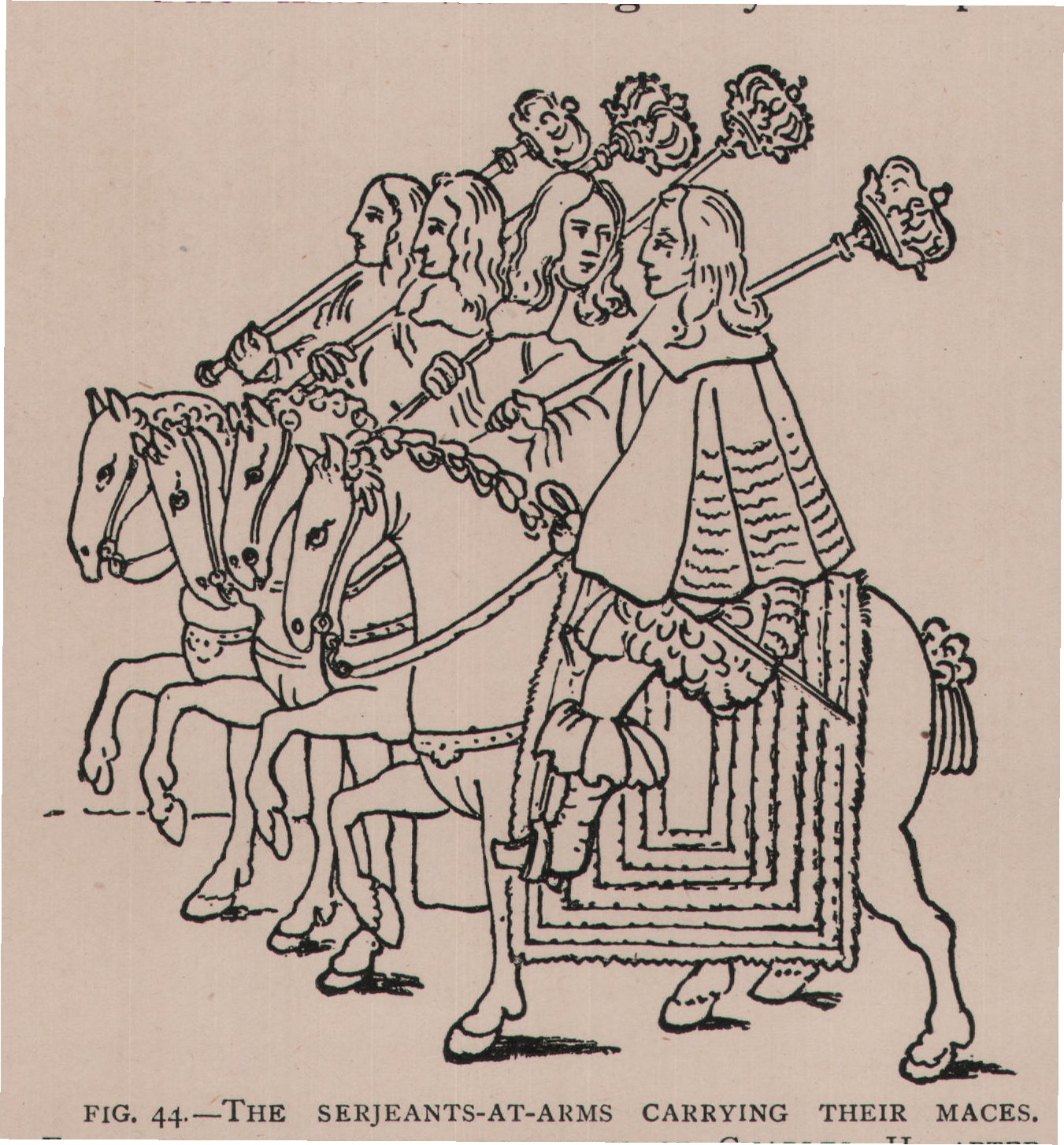
FROM THE CORONATION PROCESSION OF CHARLES II. AFTER WENCESLAUS HOLLAR. a The royal maces are carried at coronations by the serjeants-at-arms, originally a corps of twenty-four knights, or gentlemen of higher degree. This corps, whose duty it was to be in attendance on the king's person, is said to have been instituted Plate XIV THE ANOINTING SPOON THE KING'S PLATE by Richard I. They were mounted at the coronation of Charles II. (Fig. 44), but on foot at that of James II.
Of the eight maces in the Tower, the oldest and finest are two that were most likely made by Sir Robert Vyner for Charles II., whose initials are upon them. They are of silver-gilt, measure a little over four feet in length, and weigh thirty-four lbs.
The head of each of these maces, which have served as models to the other royal maces, consists of a massive rounded bowl, divided externally into four compartments, each bearing a crown flanked by the initials C. R. Under the crowns, in high repoussé-work, finished with chasing, may be seen the emblems of the four kingdoms: the rose, thistle and harp, for England, Scotland and Ireland, and the fleur-de-lys for France. The compartments are marked out by ornamental scroll divisions, on each of which is a conventional female figure. Above this is a crown, the rim of which, widening slightly outwards, bears eight small crosses-patée, and eight small fleurs-de-lys, raised on points, and with pearl points between each. From alternate crosses-patée rise two arches, dipping at the point of intersection, with a row of "pearls" along the centre of each.
From the point of intersection rises a large orb with fillet round the thickest part of it, and an arch crossing it at the top. On the top of the mound is a crosspatée with a "pearl" in the centre, and also one at each extremity of the three upper arms. In many instances these bowls at the top of maces were made to unscrew, and were used as drinking-cups, being provided with a short foot as wellthe ornamental crown at the top also being removable. The handle of the mace is chased and ornamented with a graceful design of superimposed arches, in each of which is either a rose or a thistle. It is divided into three divisions by two broad knops of oblate form, repoussés and chased in a simple design. The upper of these divisions is much the smallest, and is further decorated with three ornamental brackets of open tracery with masks and curves richly designed. The foot widens out into a rounded boss repoussé and chased in a pattern resembling that of the smaller knops, but more ornamentally treated and differently proportioned, and the foot has another smaller thickening decorated in the same way.