Home › The King's Plate › The King's Plate: George II
The King's Plate: George II
THE KING'S PLATE coronation of Queen Anne no less than four hundred and thirty-two ounces of pure gold were used, and again in the reigns of George II. and George IV. rich coatings of gold were added.
The base consists of a large circular dome, resting on four mermaids, each mermaid having a double tail. The dome is embossed with four shaped and scrolled panels, each depicting a cupid riding a dolphin. Between each panel are the outlines of monster faces.
Resting on the dome is a broad dish or basin divided into four large shallow receptacles for wine. Each of the four receptacles shows in repoussé a different subject. These are severally: Neptune and Amphitrite; two tritons riding marine monsters, one spearing the other; mermaids and dolphins; and two sea nymphs riding a dolphin, with a merman holding a bowl of flowers. These four large receptacles are connected by small-shaped oval depressions in which grotesque faces are shown in repoussé. The shaped borders are also decorated with repoussé work.
Rising from this broad basin is a tall octagonal column with four broad faces and four narrow ones. On the broad faces are plain niches, two of which show in high relief figures of Neptune standing with one foot on a dolphin, and the other two show sea nymphs seated and holding conch shells over their heads, also in high relief. Between each of these panels and beneath them is an escalloped shell projecting from the column and so placed as to catch the first flow of wine from above. The four narrow faces of the column as well as the top and bottom are decorated with embossed festoons and garlands of fruit. On the top of the octagonal column is a short vase-shaped ornament, chased and embossed with acanthus leaves, which forms a pedestal for a tall, lightly clothed female figure. The figure which is in classical style is held to represent either Erinnys or Cleopatra, probably the latter. Round her uplifted arms may be seen encircling serpents.
The total height of the wine fountain is thirty inches. The width of the broad basin is twenty-eight and a quarter inches, whilst the diameter of the base is thirteen and three-quarter inches. There are no hall or maker's marks, but from documentary evidence it is known to have been manufactured in 1660. K QUEEN ELIZABETH'S SALT-CELLAR Among the many lists of royal treasure in Rymer's Fædera is one which gives details of the plate which was given to the Duke of Buckingham and the Earl of Holland to sell for Charles I. in 1625 on the occasion of his trouble with Spain. Unfortunately no figures are given, but the descriptions are elaborate enough to show that many of the pieces must have been of great beauty. There are also minute descriptions of many of these treasures given in the Calendars of the Exchequer from Edward II. to Henry VIII. What with one king selling some, and another king losing some, and the Commonwealth making at last a clean sweep of anything royal they could lay hands upon, it is little wonder that there are but few pieces left of the old royal treasure of England. Among the fine collection at the Tower is only one piece that can claim any greater age than the time of Charles II., and this is known as Queen Elizabeth's "Great" Salt-cellar. Salt-cellars, it should be said, were called "Great" in distinction from the "Trencher" salts, the former being used to mark the difference in rank between the guests at table, whereas the latter, which were quite small, were put near each guest for use only.
This salt-cellar is in three divisions-the lower part, which holds the salt in a shallow basin, then four brackets, and the lid raised upon them. This arrangement is peculiar, and it seems as if the lid was at one time fitted in the lower portion, and that it had been lifted up on the brackets by way of improvement. The brackets as they now are do not appear to be of the same workmanship, or to be quite in keeping with the rest, but they may have been substituted for others which originally existed in the same place, or made to match others of Charles II.'s which have the same kind of heightening. The body of the salt-cellar is divided externally into three compartments by grotesque figures with scroll prolongations and flat pieces curving outwards above their heads, terminating in masks.
In each compartment is an allegorical figure of one of the Virtues within a circular wreath, charmingly designed and executed in low repoussé and fine chased work. The foot has two decorated bands: one flat with an elaborate design of cupids and flowers, and the lower one curved outwards and covered with masks, flat scrolls, and conventional flower sprays. There are three feet designed in the form of sphinxes' heads with forepaws. Above the allegorical figures the lip broadens out into a projecting piece ornamented with fruits and flowers in high relief, and over this is the shallow salt basin.
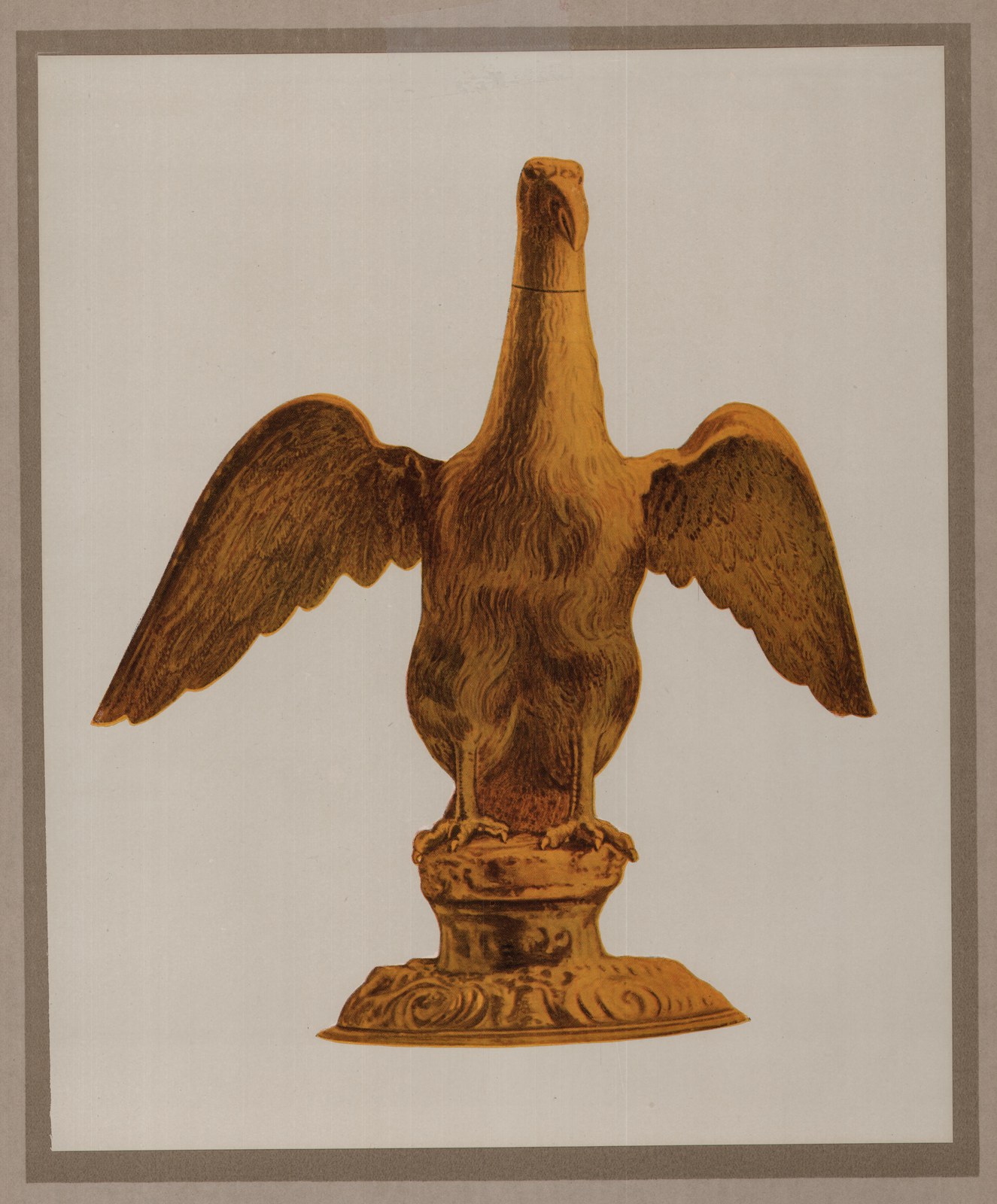
The four scrolls supporting the top are in the form of dolphins with ornamental tails, and the lid itself is a very fine specimen of Elizabethan goldsmith's work. The main part of the lid is ornamented with fruit and flower groups, characteristic strap and cartouche work, and allegorical figures within oval laurel wreaths. Above this comes an urn-like superstructure with three scroll handles having animals' feet and human masks. A smaller urn form supports the figure of a knight in armour with a long sword and a shield. ST. GEORGE'S SALTS There are altogether in the Jewel House at the Tower eleven great salt-cellars known as St. George's Salts. Of these eight are in sets of four, whilst the remaining three are each of different designs. They are all of the same date 1660-61, and Plate XIII THE AMPULLA 1 THE KING'S PLATE form a portion of royal plate which was made for Charles II. to replace that lost and melted down during the last years of the reign of Charles I. and the Commonwealth. A SET OF FOUR These salts, of which there are four, were part of the royal plate made for Charles II. on his restoration. They are of silver-gilt, cylindrical in shape-standing ten inches in height and about six inches in diameter-and are embossed with large flowers and foliage on a burnished ground. At the top is a shallow depression for holding salt, whilst from three points in the rim rise scrolled brackets curved outwards and ending in serpents' heads. These brackets were intended to support a napkin so as to protect the salt from dust. But somehow this origin got lost sight of, the three brackets being mistaken for legs, and the salts turned upside down and stood upon these. a In 1820, when the royal plate was being overhauled for the coronation of George IV., nobody seems to have discovered this error, and there naturally being no receptacle for salt in the bottoms, Rundell, Bridge and Rundell were instructed to make four new shallow dishes for this purpose. These were fitted into the bottoms of the salts and bear the Crest, Garter, and Crown of George IV. The salts thus stood upside down for the space of ninety-eight years, during which time desultory correspondence went on regarding which was the right way up. It was only in 1918 that the matter was finally and definitely decided, and the salts turned over with the brackets upwards. To those who made this decision two things were manifest. Firstly, that the brackets had never been intended for legs, because that position caused the serpents to stand on their heads, an indignity which no goldsmith would impose upon them. And secondly, the floral designs on the cylinder were manifestly upside down, when the salts used their brackets as legs. The shallow salt dishes made for George IV., therefore, are found to be superfluous, and the exchequer of those days might have saved £38 10s. Od., which was the cost of making them.
The salts themselves were made in 1660-61, and bear the maker's mark F.L., with a pellet between the letters and a bird below, in a shaped shield. The weight marked on one of the salts is fifty-four ounces twelve dwts., and it may be taken that the rest are the same.
A SECOND SET OF FOUR These four salts are of the form known as the "hour-glass," on the top of which is a canopy supported by four brackets. These also were made for Charles II., when the royal plate melted down by Charles I. to cover his necessities was being replaced. They bear on the rim the cypher of Charles II. in roman capitals surmounted by a royal crown. The only injury which these have suffered is the loss by one of its canopy. This was replaced by Rundell, Bridge and Rundell, for the coronation of George IV., at a cost of £5 18s.
The upper and lower portions of the salt are boldly embossed with acanthus leaves and plain leaves, whilst at the waist is a large plain depressed knop separated into sections by three concave flutings. The base is slightly domed and embossed with grotesque faces. At the top under the canopy is a small circular depression four and one-eighth inches in diameter for holding salt. The domed canopy is supported by four brackets and is crowned by a knight in armour, with sword drawn, and mounted on caracoling charger.