Home › The Common Skippers › The Southern Cloudy-Wing
The Southern Cloudy-Wing
Thorybes bathyllus (Thor'y-bes ba-thyllus) PLATE XLIV, FIG. 8 There are two common skippers representing the genus Thorybes and popularly known as the Southern cloudy-wing and the Northern cloudy-wing respectively that resemble each other closely. They differ from the preceding species of Hesperiinæ in lacking the long tails of the first and the yellow bands of the other three, and from the following species in having the club of the antennæ hooked. The wings are dark brown; the fore wings are flecked with small or very small irregular white spots, and the hind wings are crossed beneath by two rather narrow, parallel, inconspicuous darker bands.
In the Southern cloudy-wing the white spots are larger than in the following species, almost forming a continuous band. Expanse of wings nearly or quite one and one-half inches. This species has been found from West Virginia to Florida, and westward to Kansas and New Mexico. The larva feeds on wild bean and other herbaceous Leguminosæ.
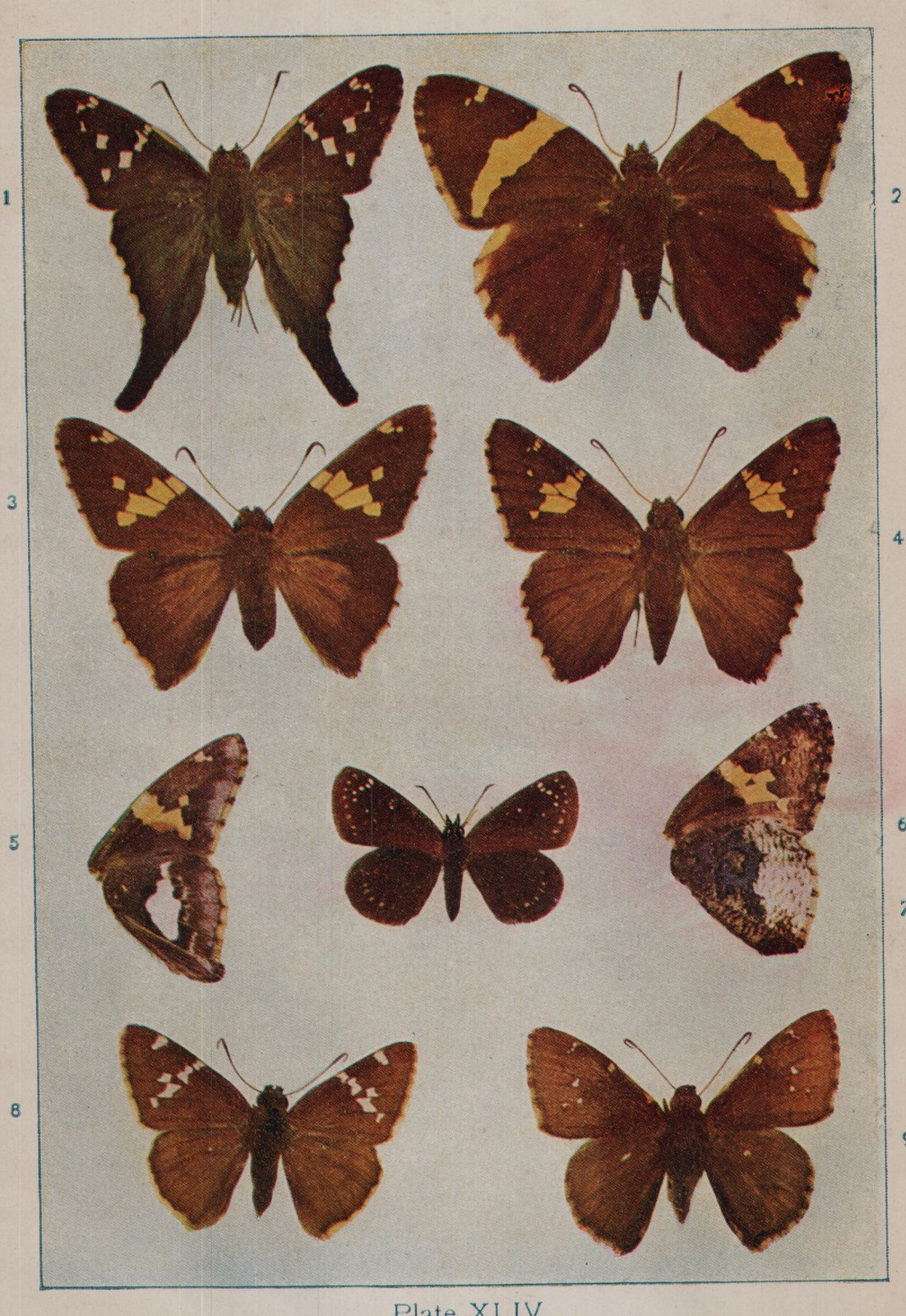
This and the following species, which it closely resembles, were named after two rivals. Bathyllus was a very celebrated pantomime of Alexandria, and a favorite of Mæcenas. Thorybes pylades (Thor'y-bes pyl'a-des) PLATE XLIV, FIG. 9 In the Northern cloudy-wing the white spots on the fore wings are usually mere points, although their number and size vary. For other characteristics see description of the preceding species. This species is found in nearly all parts of the United States. The larva commonly feeds on clover.
Pylades was a celebrated pantomimist from Cilicia, under Augustus. See preceding species. 3 4 6 5 8 Plate XLIV. 7 6