Home › The Nymphs › The Red Admiral (Vanessa atalanta Va-nes'sa)
The Red Admiral (Vanessa atalanta Va-nes'sa)
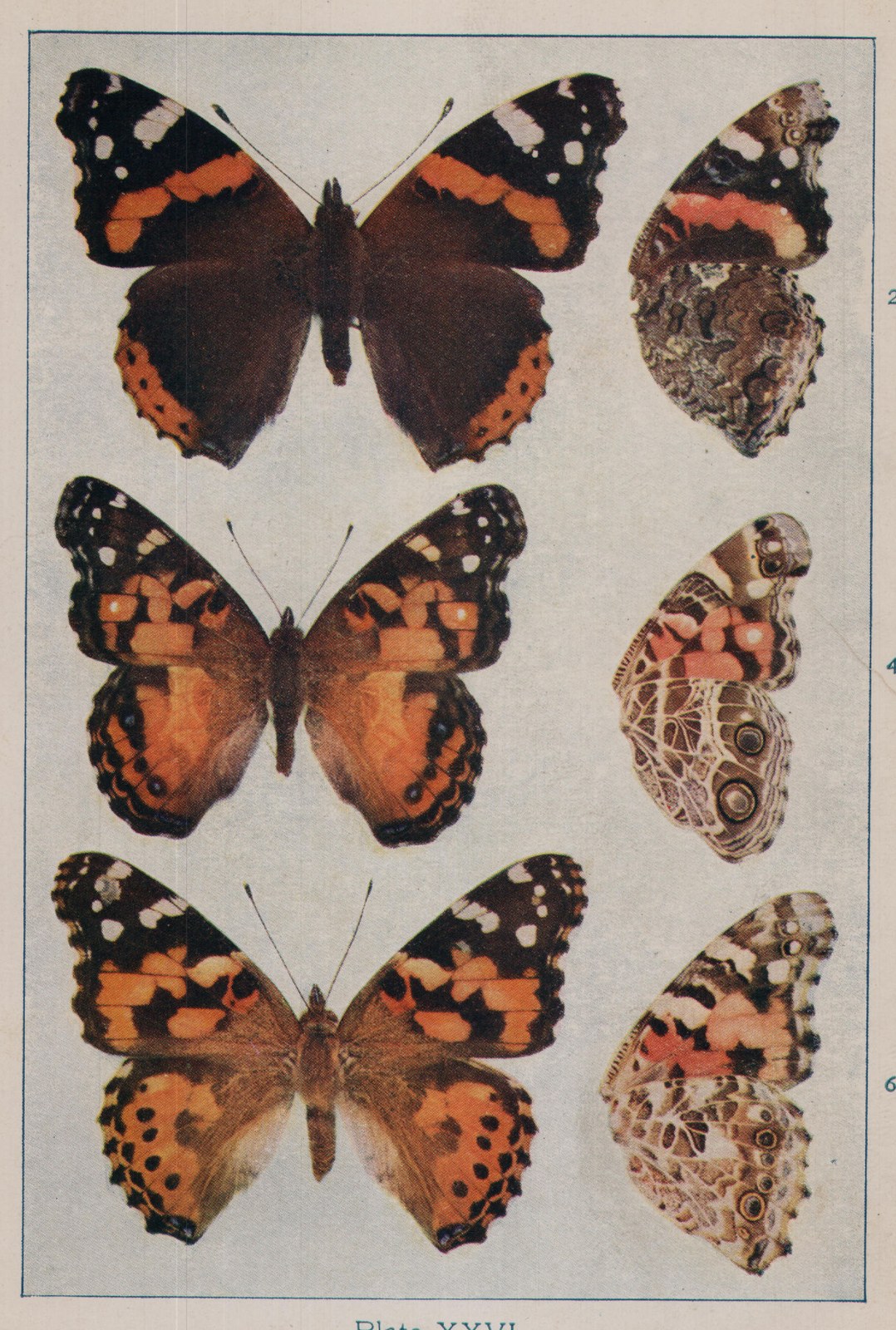
Vanessa atalanta (Va-nes'sa at-a-lan'ta) PLATE XXVI, FIG. 1, 2 The wings are purplish black above. On the fore wing there is a bright orange-colored band beginning near the middle of the costa, and extending nearly to the anal angle; between this and the apex of the wing are several white spots; on the hind wing there is an orange band on the outer margin enclosing a row of black spots. The lower surface of the wings is shown on the plate. Expanse of wings two and onefourth to three inches. CATERPILLAR.-Length one and one-fourth inches; it varies much in color, being usually dull yellow mottled with black, and with a yellow stripe along the side. The head has no spines, but the body has both branching spines and hairs. Food-plants. Nettle, hop.
This most striking butterfly has a cultivated taste and is a frequenter of sunny gardens on both continents. Its blue-black wings, the front ones spotted with white and with a "bias" band of orange red and the hind ones margined with red, make it so conspicuous that even those who are acquainted with only three or four butterflies know the red admiral. However, the lower side of the wings is the more beautiful, the "bias" 3 4 5 Plate XXVI. 6 band being of exquisite deep rose color shading off at each end to pale pink, and between it and the large white spot is an irregular oval outlined in blue purple. The hind wings have an elaborate peacock-feather border wrought in browns varying from dark to pale wood color. In fact the under side of the red admiral's wings is wonderful both in color and pattern. It is unfortunate that after death the rose color disappears, leaving only the copper red of the upper side, so that this insect shows its real color only when it is alive.
When we wonder what nettles were made for we had best ask the question of the red admiral caterpillar. If we ask it with diligence, we will get the answer from a baby caterpillar in a new leaf at the top of the plant which it has lined and drawn together for protection and food; or from a larger caterpillar under a leaf lower down which has been gnawed at the midrib near its base and made to droop and thus fashioned into a tent. Each time it molts, this caterpillar turns civil engineer and architect and constructs a new abode of a leaf. These tents are covered above but open below, and may be easily found because of the wilting leaf. The chrysalis is often hung in the last tent and is an exquisite little object, brown and ashen with golden spots.
There are two broods; both butterflies and chrysalids hibernate, but the wintering butterflies remain long in their winter quarters, being seldom seen before the second week in May.
This butterfly occurs over nearly the whole of the European and North American continents.