Home › The Pierids › The Nymphs (Family Nymphalid Nym-phal'i-d)
The Nymphs (Family Nymphalid Nym-phal'i-d)
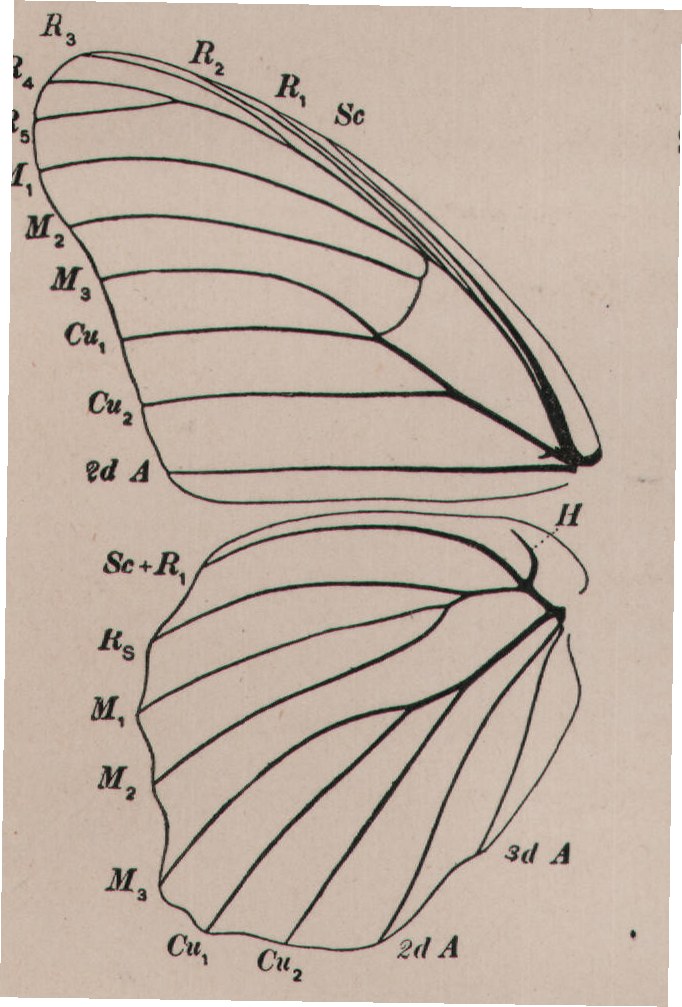
Family Nymphalidæ (Nym-phal'i-dæ) The family Nymphalidæ, or Nymphs, includes chiefly but terflies of medium or large size; but a few of the species are R R M1 R3 M 2 M 3 Cu Cu 2 ed A R2 Sc+R Rs M M 2 M3 3 R. Sc 2d A Cu, Cu2 H 3d A FIG. 30.-Venation of the wings of Basilarchia astyanax. small.
This family is the first of a series of four families in which the front legs are very greatly reduced in size in both sexes.
So great is the reduction that these legs cannot be used for walking, but are folded on the breast like a tippet.
The nymphs can be distinguished from the other three families of four-footed butterflies as follows: the veins of the fore wings are not greatly swollen at the base as in the meadowbrowns; the fore wings are not so long and narrow as in the heliconians; and the antennæ do not appear to be naked as in the milkweed butterflies.
The venation of the wings of a characteristic species is shown in Figure 30.
The larvæ are nearly or quite cylindrical, and are clothed to a greater or less extent with hairs and sometimes with branching spines.
The chrysalids are usually angular, and often bear large projecting prominences; sometimes they are rounded. They always hang head downward, supported only by the tail, which is fastened to a button of silk. (Plate II, Fig. 2.) This is the largest of the families of butterflies. It not only surpasses the other families in number of species, but it contains a greater number and variety of striking forms, and also a larger proportion of the species of butterflies familiar to every observer of insects. There may be in any locality one or two species of yellows or of whites more abundant, but the larger number of species commonly observed are nymphs. In order to facilitate the study of the family our genera have been separated into five groups, which are known respectively as the Fritillaries, the Crescent-spots, the Anglewings, the Sovereigns, and the Emperors. The structural features distinguishing these groups are in some cases difficult to observe, and consequently are not available here; but by means of the following somewhat artificial table, our Eastern species can be placed in their proper groups:
A. Eyes hairy, p. 131.
AA. Eyes naked.
THE ANGLE-WINGS (in part).
B. Club of the antennæ long and slender, increasing in size gradually, as a rule hardly more than twice as broad as the stalk.
C. Hind wings with tail-like prolongations (the Goatweed Butterfly), p. 173. THE EMPERORS (in part). CC. Hind wings not tailed.
D. With a row of eye-spots near the outer margin of the upper surface of the hind wings, p. 173· THE EMPERORS (in part).
DD. Wings without eye-spots, p. 162.