Home › The Nymphs › The Meadow-Browns (Family Agapetid Ag-a-pet'i-d)
The Meadow-Browns (Family Agapetid Ag-a-pet'i-d)
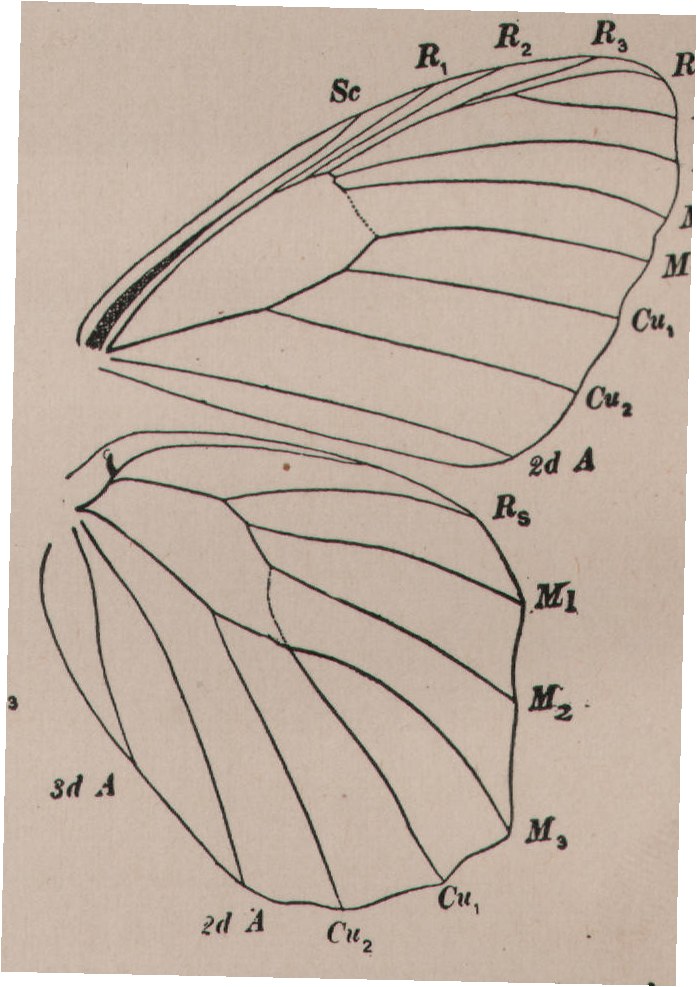
Family Agapetidæ (Ag-a-pet'i-dæ) This family includes chiefly brown butterflies whose markings consist almost entirely of eyelike spots. Some Western R-M R, R2 R3 Sc R R2 R3 R R R Sc R5 M M M2 M3 M2 M3 RM Se+R 2d A Cu2 Cu Rs 3 M M2 M Cu, Cu, 3d A Cu 3d A 2d A Cu Cu2 2d A Rs M1 M2 M Cu 2d A Cu2 FIG. 36. Venation of the wings of Cercyonis alope.
FIG. 37. Venation of the wings of Enodia portlandia. species, however, are bright-colored. Our forms can be easily recognized by their having some of the veins of the fore wings greatly swollen at the base (Fig. 36).
The larvæ are cylindrical, tapering more or less toward each end. The caudal segment is bifurcated, a character that distinguishes them from all other American butterfly larvæ ex. cepting those of some of the emperors (Chlorippe).
The chrysalids are rounded; in some cases the transformation takes place beneath rubbish on the ground without any preparation of cell or suspension of the body.
Nearly fifty species have been described from America north of Mexico. The more common species of the East are described below and can be separated by the following table : A. Eyes very hairy; veins M. and Cu, of the hind wings arising together at the apex of cell R + M (Fig. 37). 3 3 B. Outer margin of hind wings angled at the end of vein M, (Fig. 37). (E.portlandia), p. 189. THE PEARLY Eve.
BB. Outer margin of hind wings evenly rounded. (S. canthus), p. 191.