Home › The Pierids › The Great Southern White (Pontia monuste Pon'ti-a)
The Great Southern White (Pontia monuste Pon'ti-a)
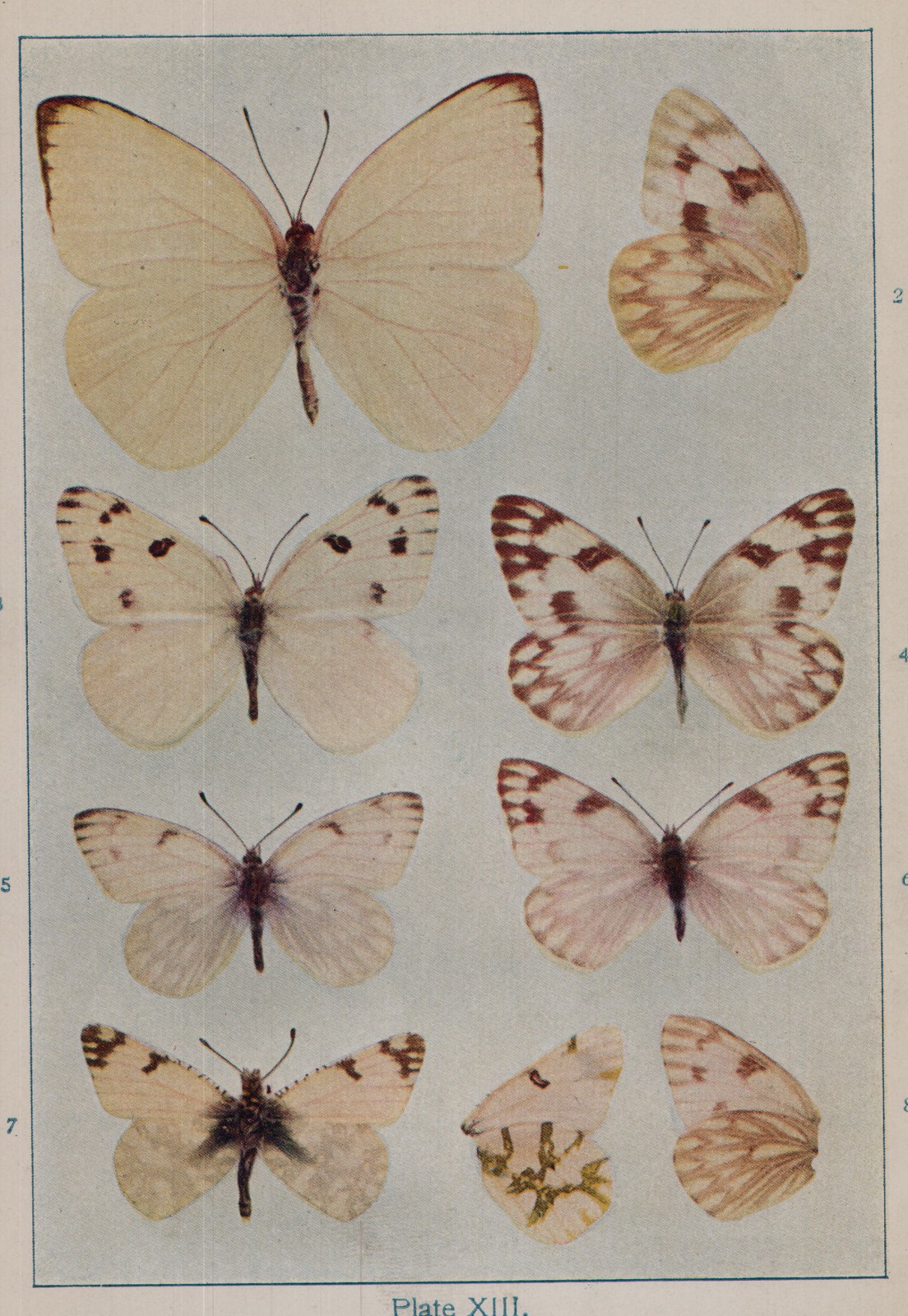
Pontia monuste (Pon'ti-a mo-nus'te) PLATE XIII, FIG. I This species is the largest of our Eastern pierids, expanding from two to three inches. In the male the wings are almost entirely white except a very narrow black border on the costal and outer margins of the fore wings. In the female the black margins are wider, and the outer margin of the hind wings is marked with a series of black triangular spots; there is also on the fore wings a bowed black band bordering cell R+M in front and at the outer end.
CATERPILLAR.-Length a little over one and one-half inches; head large; general color of the body lemon yellow with purple stripes.
Food-plants. Cabbage, lettuce, and turnip.
A very interesting note has been made on the migratory habits of this species by Dr. Mellichamp, of Bluffton, S. C. He says: "Thousands of these white butterflies have been steadily pass- 7 5 er 3 Plate XIII. 8 9 6 4 ing over this place from west to east apparently against the wind for two days. Being white, they can be seen at a long distance, and they come along in twos, threes, and fours, and sometimes in greater numbers, seldom stopping, going steadily fifteen or twenty feet above the earth. A colored man stated that they came into his field like a swarm of bees, and he was so frightened at this that he dropped his hoe and came home."
The great Southern white is widely distributed in the Gulf States; it occurs also in the greater portion of the southern continent as well as in the West Indies; it is a common species over a large extent of territory.