Home › The Pierids › The Gray-Veined White (Pieris napi Pi'e-ris na'pi)
The Gray-Veined White (Pieris napi Pi'e-ris na'pi)
Pieris napi (Pi'e-ris na'pi) PLATE XIV, FIG. 6-9 3 In the most common form the wings are white above and below, with a scarcely perceptible tinge of greenish yellow. Sometimes there is a dark spot in cell M. of the fore wings, but usually the wings are immaculate. The base of the wings, however, and the basal half of the costal margin of the front wings, are powdered more or less with dark scales, and the veins of the wings, especially on the lower side, are grayish. Expanse of wings one and seven-tenths inches to two inches. This species occurs throughout Canada and the more northern portions of the United States. It appears in many different forms; eleven named varieties are now recognized in the United States, and still other forms are known in Europe. This polymorphism is partly seasonal and partly geographical. Thus, to illustrate a seasonal polymorphism, in the State of New York the butterflies emerging from pupæ that have passed the winter are of two distinct forms: first, P. napi virginiensis, which is smaller than the other, and with more delicate wings, which are always white below; and second, P. napi oleracea, a larger form, with stronger wings, which are usually tinged with yellow below. These two forms also differ in the remarkable fact that oleracea gives rise to other broods which appear later in the season, and are of a different form, while virginiensis is single-brooded. The summer broods, the offspring of oleracea, represent a third form, P. napi cruciferarum, which is larger than the spring form from which they have descended, with thinner wings, which are of a purer white on the upper side.
In the extreme North and in the far West other forms of this species occur which differ so greatly from our common forms that they were long considered as distinct species, but they have been shown to be merely geographical races. CATERPILLAR.-Two-thirds of an inch long; body small cylindrical, and downy. In color it is green finely dotted with black except along the back.
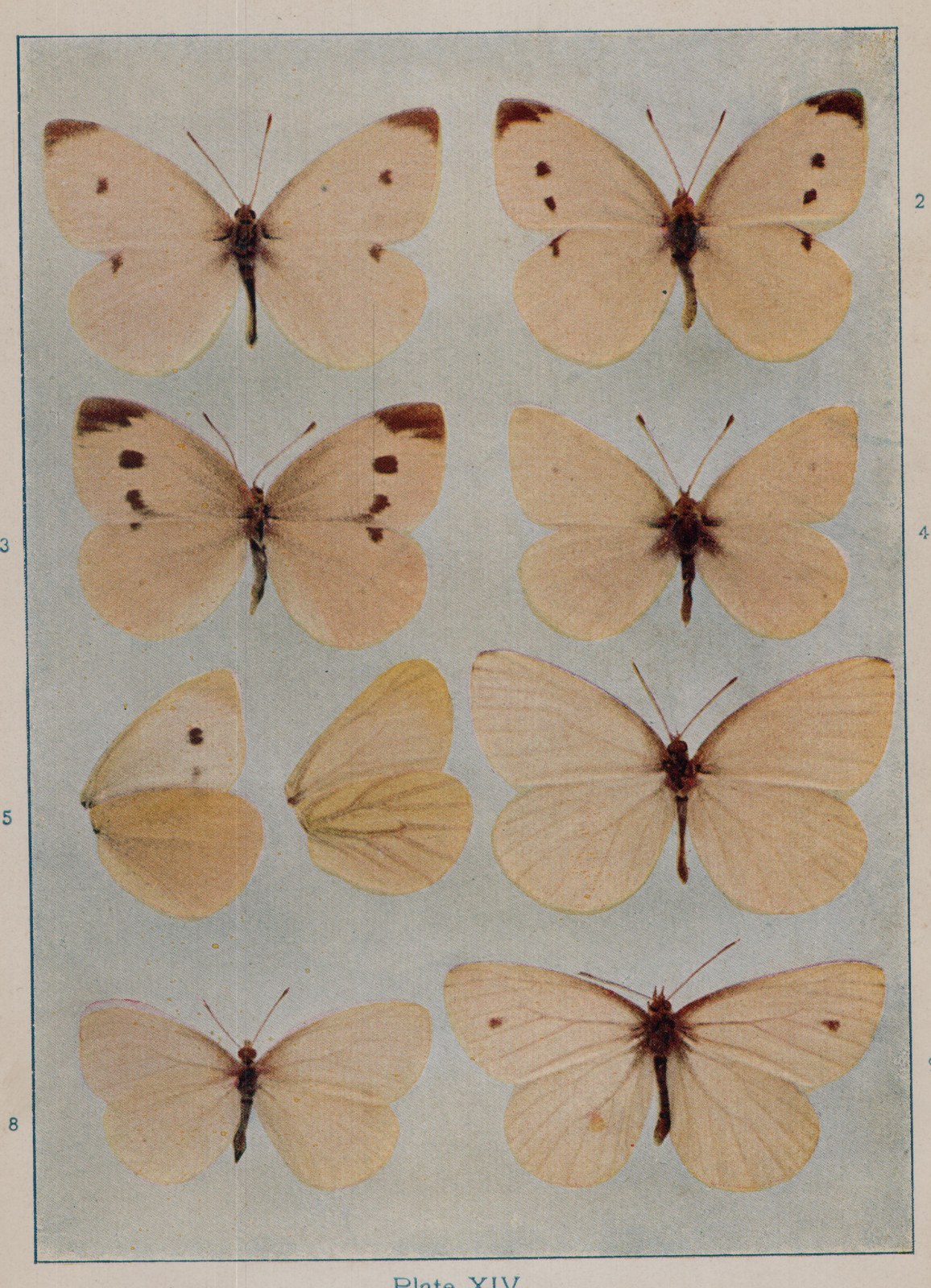
Food-plants. Cabbage, horse-radish, and other Cruciferæ. Evidently this species has not concluded whether it will in its final form be all white; or have the front margins and tips of the front wings blackish; or have one spot on each front and 1 3 4 5 8 Plate XIV. 9 7 hind wing; or have one black blotch along the wings outside the middle; or if it will have the veins of both wings above penciled with gray.
All the varieties above mentioned occur; and to work out the history and different forms of the successive broods and of the several varieties requires a mind trained to mathematical precision in methods of thought. To one not thus trained this innocent white butterfly is a source of dire confusion, because its history is so intricate and it masquerades in so many guises. The caterpillar feeds upon the outer leaves of cabbage, eating holes in them rather than feeding along the margins. It resembles the caterpillar of P. rapa, except that the dorsal stripe is indistinct and only marked by the absence of the black dots.
The species is essentially northern, but it spread far south when Pieris rapæ was introduced. In some way the European species has greatly reduced its numbers; it has literally taken to the woods as a result of this invasion and is seldom found elsewhere. In most of its varieties the gray-veined white is triple-brooded, and winters as a chrysalis.