Home › The Pierids › The Dainty Sulphur (Nathalis iole Na-tha'lis)
The Dainty Sulphur (Nathalis iole Na-tha'lis)
Nathalis iole (Na-tha'lis i'o-le) PLATE XV, FIG. 4, 6 This little butterfly can be distinguished from all others described here by its small size, as it expands only from less than here by its small size, as it expands only from less than one inch to one and one-fifth inches. It is of a pale canaryyellow color, with dark-brown markings. There is a large apical patch on the fore wings, and a broad band parallel with the inner margin ;' on the hind wings there is a stripe on the basal two-thirds of the costa, and spots on the ends of the veins; these are more or less connected on the margin of the wing, especially in the female.
CATERPILLAR.-Length, one-half inch; body covered with stiff hairs ; color, dark green with a broad purple stripe down hairs; color, dark green with a broad purple stripe down the back and a double stripe of yellow and black along the side. The segment next to the head has a pair of cone-shaped bristly tubercles, reddish in color and projecting forward.
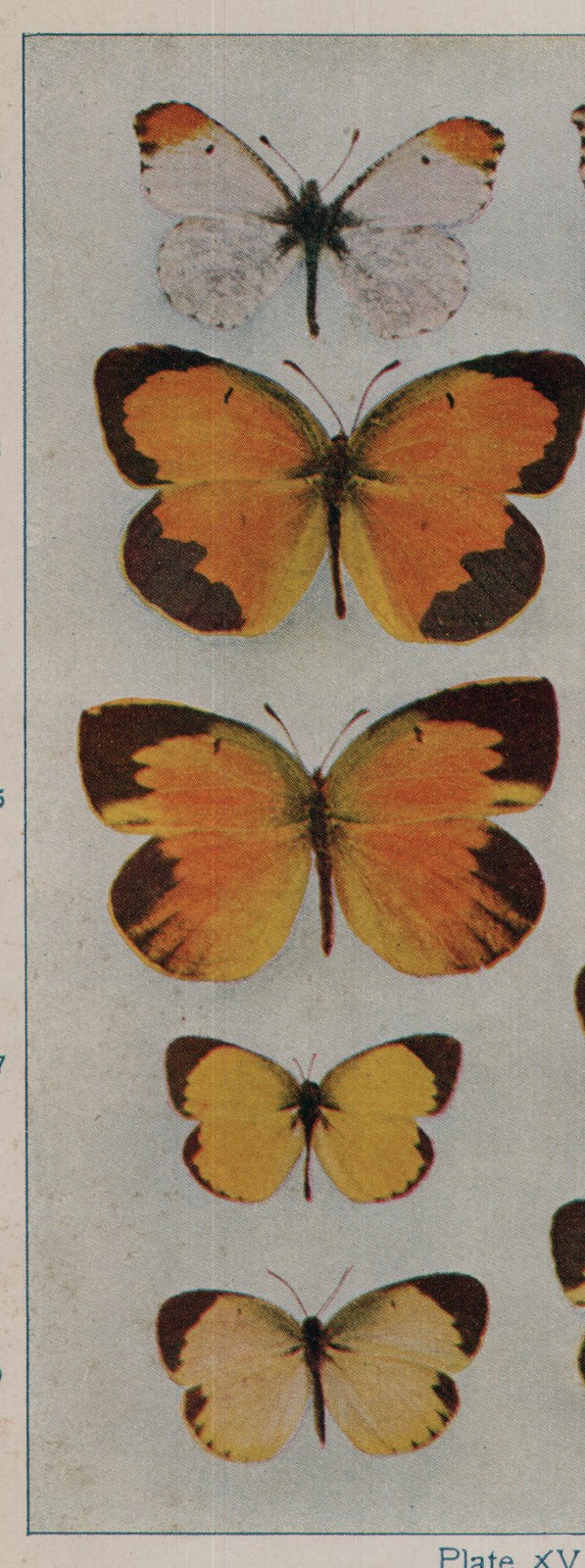
Food-plants . The fetid marigold and garden marigold.
The dainty sulphur may have been called so just naturally by the first person who ever saw naturally by the first person who ever saw these little black and yellow beauties. In the case of the female the yellow deepens to orange, and she and she flits about on wings that show the liv- Baltimore and emulate the brilliant color contrasts of the oriole. The species is at 6 8 10 **88 3 4 5 7 6 Plate XV. home in the southwest United States and Mexico, and is found in the Colorado Mountains at the height of eight thousand feet. However, it has not yet adapted itself sufficiently to the climatic condition of Colorado to belong to the successful of that great State; for very often the first frosts kill the food-plant when the caterpillars of the last brood are not more than half grown and they die the ignoble death of the great unfit; and for two years thereafter no more dainty sulphurs gladden that region. "Those old days when the balancing of a yellow butterfly over a thistle bloom was spiritual food and lodging for a whole forenoon."
LOWELL.