Home › The Pierids › The Cloudless Sulphur (Callidryas eubule)
The Cloudless Sulphur (Callidryas eubule)
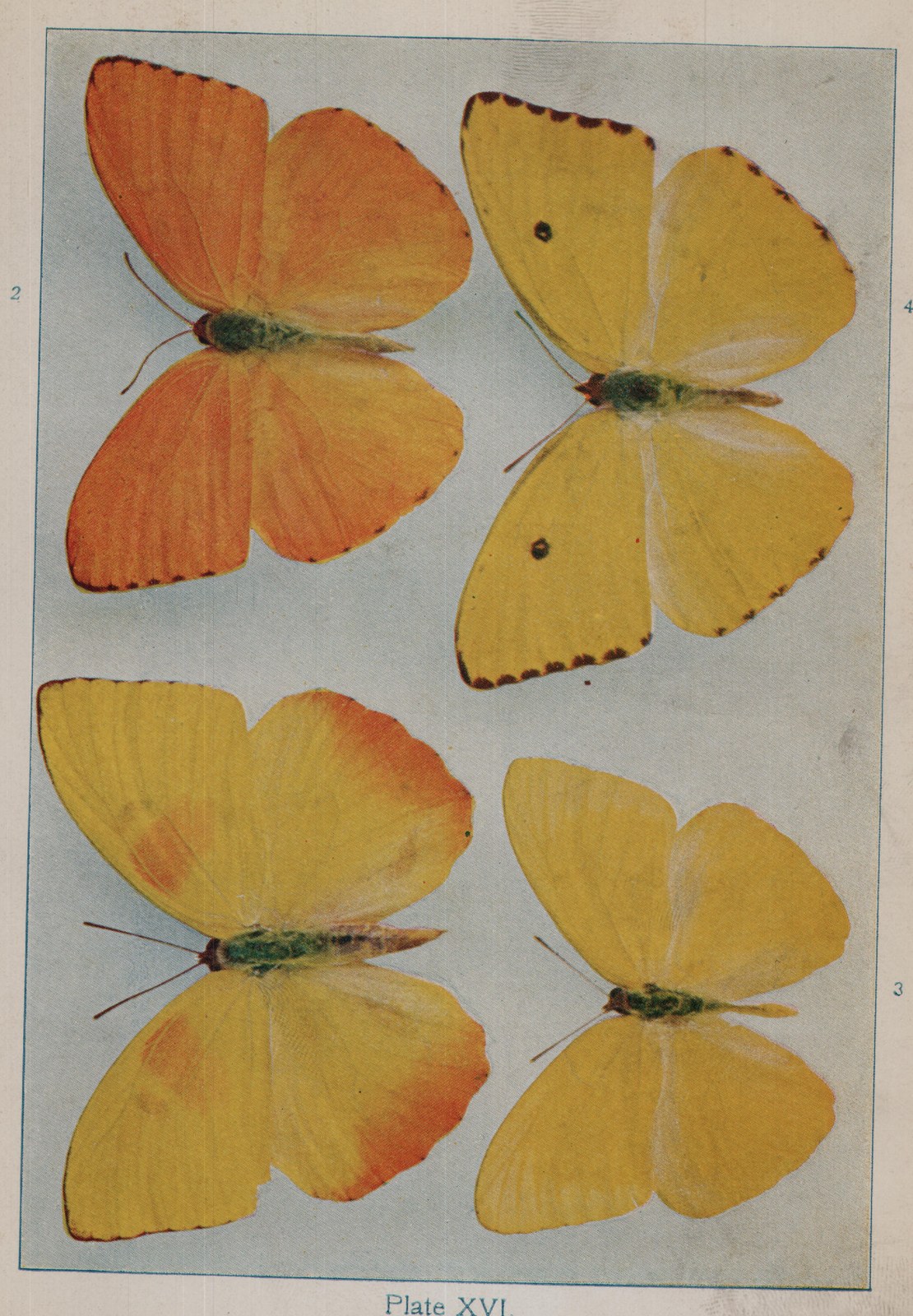
Callidryas eubule (Cal-lid'ry-as eu-bu'le) PLATE XVI, FIG. 3, 4 This large butterfly expands two and one-half inches. The wings above are of uniform bright canary-yellow. In the male they are without spots, except frequently an inconspicuous brown dot at the tip of each vein, and a lilac-brown edging of the costal border. In the female there is a discal dot on fore wings and a marginal row of brown spots at the ends of the veins.
CATERPILLAR. -Length, one and two-thirds inches; color, pale yellowish green with a yellow band along each side. The segments are dotted with black in crosswise rows.
Food-plants. Cassia and other legumes.
Thus says that classic book, Smith and Abbot (1797), opposite the page whereon the cloudless sulphur is depicted in all its canary-colored glory near a flowering branch of cassia: "It is curious to obſerve the conformity of colours between the flowers of this plant and the fly bred upon it. We fhall have occafion to note other inftances of the fame kind, and there are many of them throughout nature. In fome cafes thofe refemblances feem to anfwer the purpofe of protection; as 1 Plate XVI. 3 when a chryfalis refembles the bark to which it is fixed; or a caterpillar the flower or leaf it feeds upon ; but that purpofe feems not to be anfwered here. Do fuch fimilarities of appearance, in ferving to exerciſe the attention and powers of difcrimination of animals deſtined to devour the fly, or of others that feed upon the flower, thus increafe the general fum of happinefs in consequence of the employment of intellect and the fuccefs of its exertion?"
The cloudless sulphur is most socially inclined, congregating in great numbers on flowers and forming a moving mass of brilliant yellow under the rays of the hottest, brightest sunshine. But the most interesting of its habits is that of migrating in flocks from southeast to northwest in the spring and from northwest to southeast in the autumn. A stream of them "six or eight yards wide and about as many high" was once observed near Charleston. Another record in Georgia mentions "a half a dozen visible all the time pursuing an undeviating course, flying over and not around houses and obstructions."
Another observer has witnessed the autumn migration for twenty-six consecutive years. The species is double-brooded, and is usually abundant in the Southern States and migrates each season up the coast to New England and up the Mississippi Valley to Wisconsin. The chrysalis has a very peculiar form, being concave in the back, and having the wing cases fan-shaped so that it looks like a fading flower of the cassia attached to the branch. The male butterfly has a perfume which Miss Murtfeldt describes as resembling that of violets.