Home › The Gossamer-Winged Butterflies › The Brown Elfin
The Brown Elfin
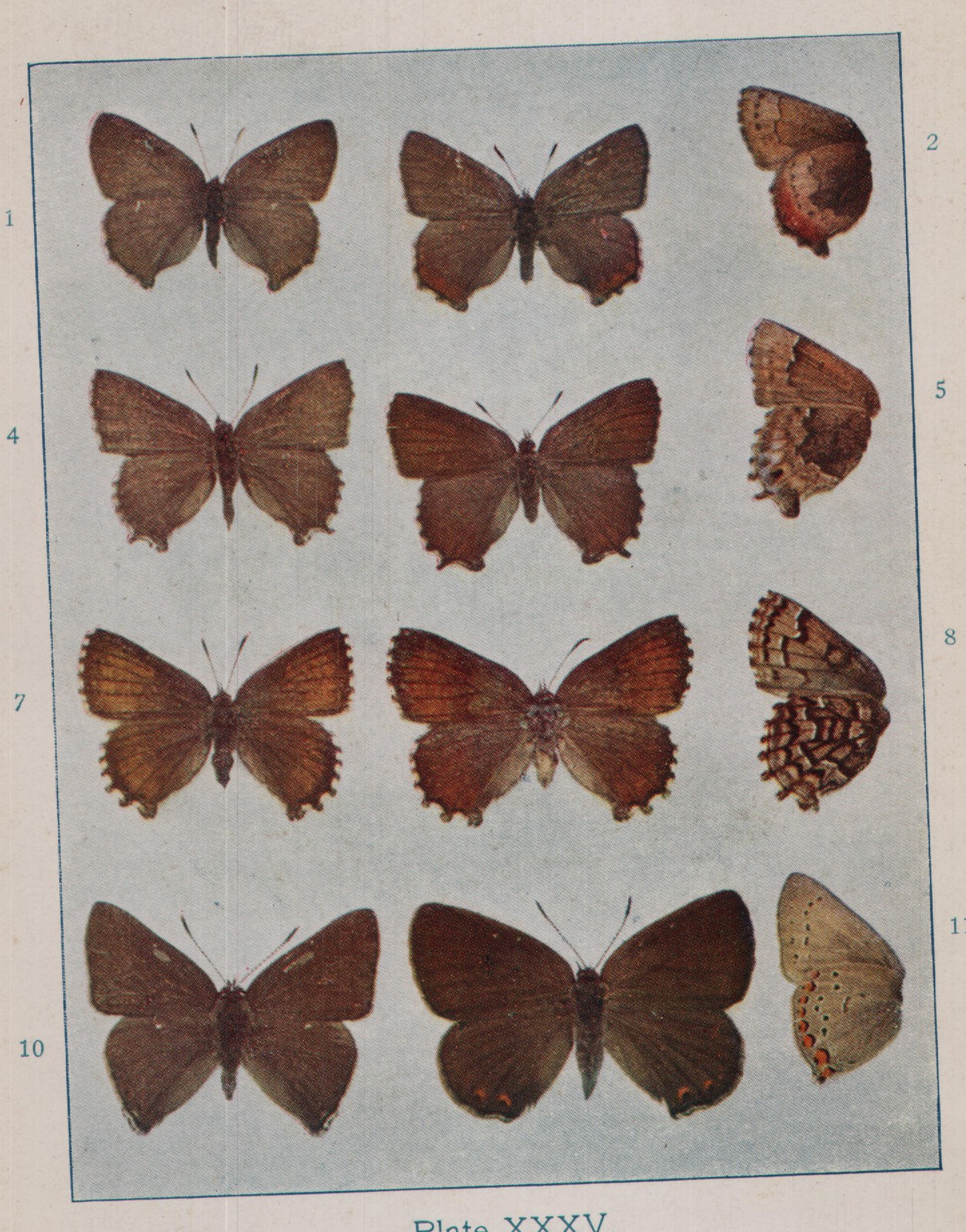
Incisalia augustus (In-ci-sa'li-a au-gus'tus) PLATE XXXV, FIG. I, 2, 3 Three of our Eastern hair-streaks represent the genus Incisalia. These are dark brownish butterflies, in which the fringe of the outer margin of the hind wings is slightly prolonged at the end of each vein, giving the wings a scalloped outline; but there are no prominent taillike prolongations of the wings as in all the hair-streaks described above. In the outer third of the inner margin of the hind wings there is a deep rounded excision, producing a conspicuous lobe at the anal angle. 4 The discal stigma of the fore wings is present in the males, but is unusually inconspicuous. The under surface is nearly as dark as the upper, especially on the basal half, which is separated from the outer half by a wavy line; there are no orange-colored spots on this surface. These are among the earliest of our butterflies, appearing in the Northern States in April and May; they usually fly but little more than a month. The three species can be separated by the characters given in the table above. They are similar in size, expanding about one inch.
CATERPILLAR.--About one-half an inch long, and slugshaped; head very small; color of the body carmine red. Food-plant.-Unknown.
It is strange that the food-plant of a carmine red caterpillar should escape the attention of our keen-eyed entomological observers of the East.
The one caterpillar described seems to have been a specimen from Nevada, and it is quite possible that the larvæ of this species in the East may have a different color. The brown elfin likes a rocky hillside covered with blueberry, and is likely to alight upon the rock or dead twigs where its wings, brown above and below, protect it from observation. It occurs in New England and southward to Virginia. It is single-brooded, and hibernates as a chrysalis. This species, like the other elfins, has no taillike processes on the hind wings, but has a graceful in- 1 4 7 10 XX Plate XXXV. 5 8 11 3 6 9 12 ward turning scallop at the tip of the anal angle of the hind wing.