Home › The Common Skippers › Skippers with a Costal Fold and Their
Skippers with a Costal Fold and Their
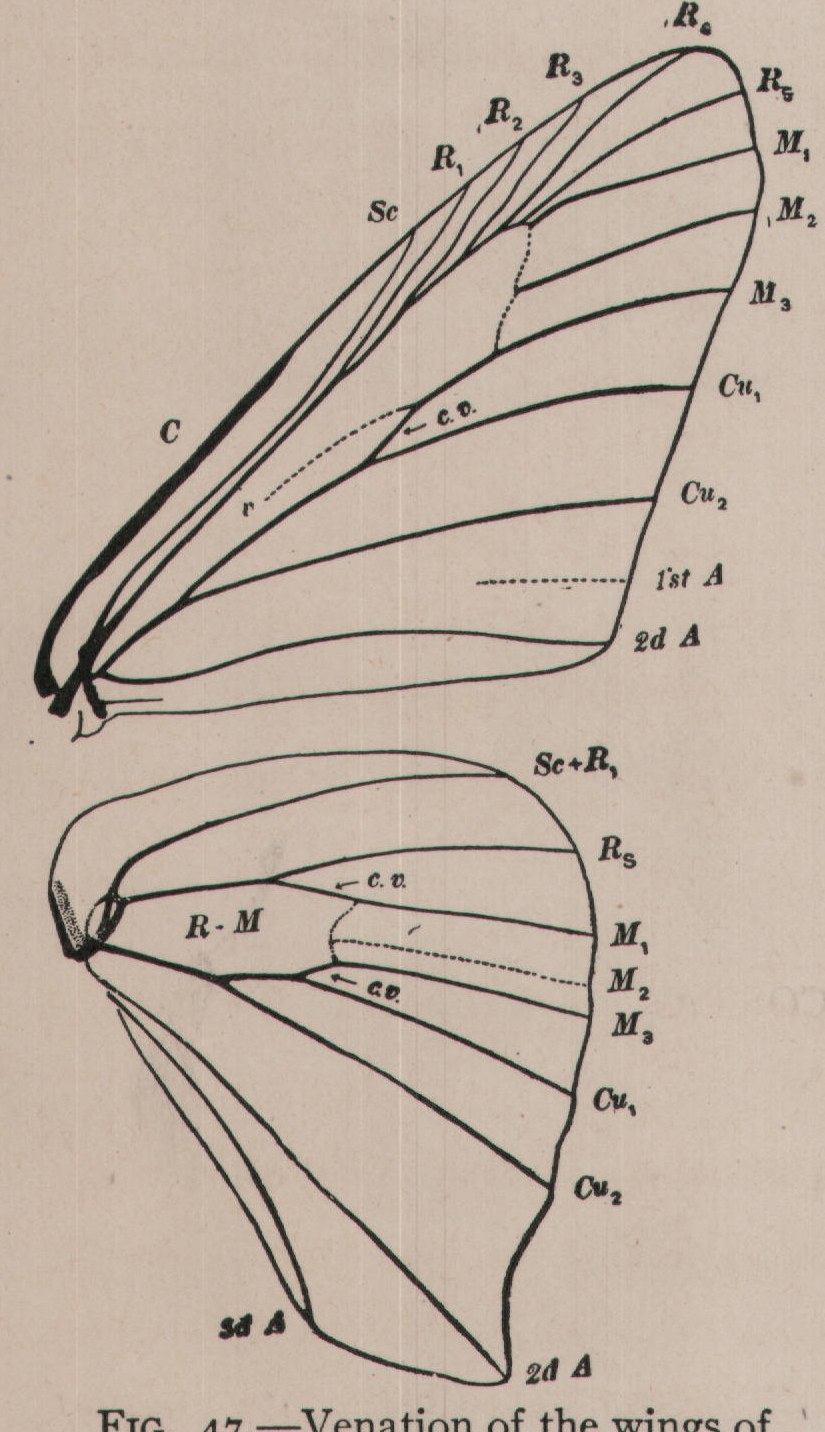
ALLIES Subfamily Hesperiinæ (Hes-pe-ri-i'næ) This subfamily includes the larger of the common skippers, as well as some that are of moderate size. Most of the species are dark brown, marked with white or translucent, angular spots. The antennæ usually have a long club, which is bent at a considerable distance from the tip (Fig. 46), and vein M, of the fore wings retains its primitive position midway be- 2 tween veins M, and M or is nearer 3 to vein M1 than to M3 at base (Fig. 47). But the most distinctive feature of the subfamily is exhibited by the males alone, and is lacking in some species. It consists of a fold in the fore wing near the costal margin, which forms a long, slit-like C r R-M Sc C. V.
CO.
R C.D.
R2 R3 Sc+R, Rs M R Cu2 1st A 2d A 1 M2 M3 Cu C2 M M2 Ma Cu sd A 2d A FIG. 47. Venation of the wings of Epargyreus tityrus. 3 FIG. 46. Martial's duskywing. pocket, containing a sort of silky down. This, like the brand of the males of the preceding subfamily, is a scent-organ, tubular scales, the androconia, that are the outlets of scent glands, opening into it.
When the pockets. are tightly closed it is difficult to see them; Plate XLV, Fig. 6, represents a specimen in which they are open.
Nearly eighty species belonging to this subfamily have been found in America north of Mexico. Those that occur in the East, except a few rare ones and a few Southern forms, are described below, and can be separated by the following table :
A. The hind wings furnished with long tails. (E. proteus), p. 292.