Home › Pelargonium Stories › Pelargonium Stories (We are apt to think)
Pelargonium Stories (We are apt to think)
We are apt to think of the whole Pelargonium Family as being ornamental rather than useful, but in that wonderful South African country where so many of them live, there is actually a pelargonium that produces edible tubers!
The next time you go to Cape Colony you must be sure and eat potatoes gathered from a geranium plant!
Down in Algeria, where the walls are so white and the sun shines so hot, the people express an oil from their geraniums and sell it. Other geraniums also yield this fragrant oil, but nowhere is it so largely used as in sunny Algeria.
Pelargoniums love to grow. You need only break off a twig and stick it in the ground, and it will grow as merrily as though nothing had happened.
One day a double-flowered crimson pelargonium blew away in a gale of wind. It broke off just above the root and away it went. It was rescued, stuck back into the pot of earth, abundantly watered, and continued to open its flowers as though such an escapade were an everyday occurrence!
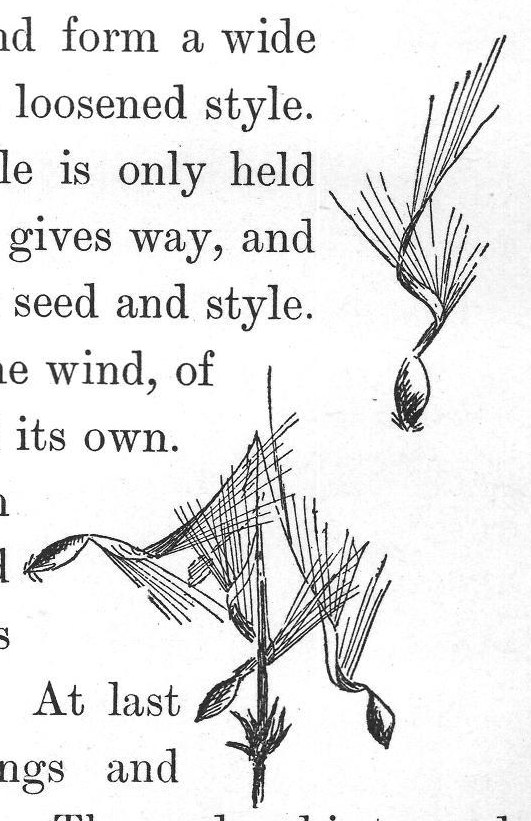
Now about its beak. The pelargonium has a beak, no doubt, but it does not put it to the same use the stork does, for its beak is made up of the long styles of the pistil which cling fast to a central column. The whole fruit looks a little like a long bird's beak. This beak opens, but not to swallow little fishes as a stork's beak does.
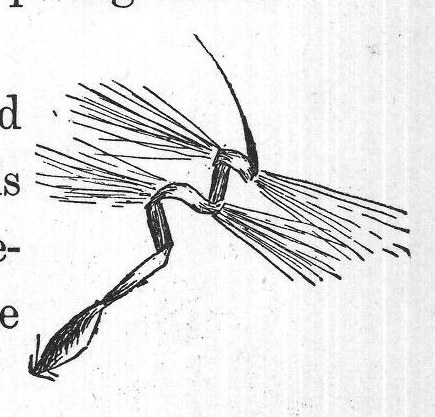
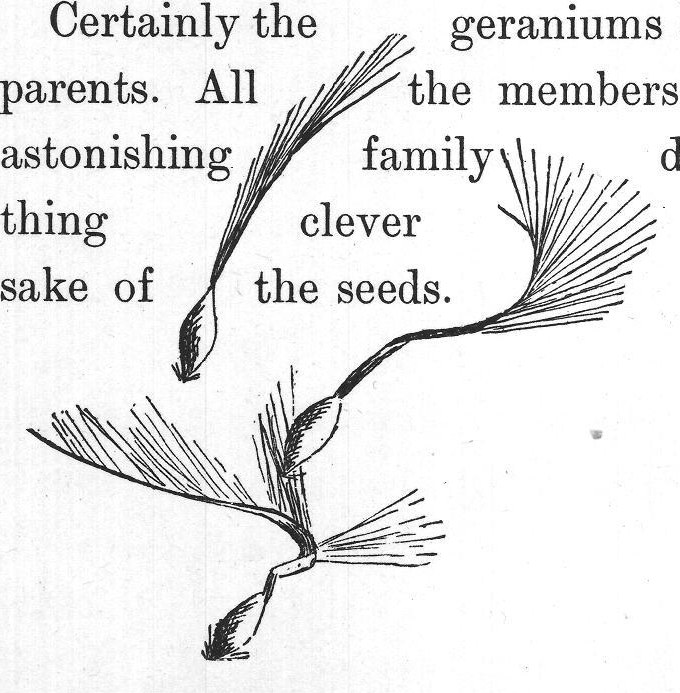
It opens to let out a feather! When the seed gets ripe, the case in which it lies at the bottom of the pistil breaks away, and the style curves up and breaks loose from the central support. As soon as the style loosens, out comes the feather. Not a real ード feather, of course, but a tuft of silvery white hairs that grow along the inside of the style and are packed close as can be until the style lets them out; then they separate and form a wide fringe along the loosened style.
Finally, the style is only held by the very tip; then this gives way, and the feather flies away with seed and style.
It flies on the wings of the wind, of course, since it has none of its own.
In this way the geranium seeds are sometimes carried long distances. But this is not the end of the story. At last the seed with its coverings and feather rests on the ground. The seed end is towards the ground, and the very tip of the pod is provided with a few short, stiff hairs, that point backwards like the barbs on a fish hook or a bee sting.
Now what do you suppose these hairs are for? Do you think their being there is a mere accident? Not at all. When the weather is damp, the style, with the feather attached, curls up. Then it acts like a gimlet and forces the pointed end of the seed into the ground. When it becomes dry, the style straightens out. But the seed cannot be pulled out of the ground when this happens, because the barbs on the tip of the seed-case hold it fast! So it does time and again. When it is damp, the seed is forced deeper into the earth. When it is dry, the style straightens out so as to be ready to curl up again.
You see how it is, do you not? The pelargonium is planting its seed.
Certainly the parents. All astonishing thing geraniums are good the members of this family clever do somefor the sake of the seeds.