Home › Contents › Evening Primrose
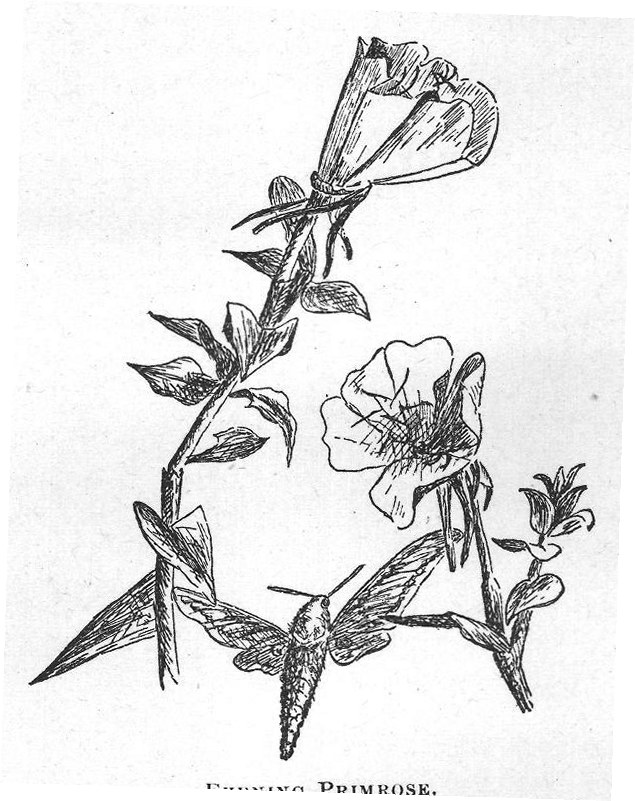
Evening Primrose
South America. But in our country the bees answer very well. The bumblebee is fond of Tropæolum honey and fertilizes the flower, while an occasional rubythroat may be seen taking a sip.
Jewelweed's horn is a humming bird tube and a bee tube, too. The flowers are so delicately balanced on tiny stalks that wingless insects would not find an easy entrance.
Pelargonium, too, has a tube suited to some long and slim-tongued visitor. In her own native land in far-away Africa she probably loves the butterflies that live there, who also love her, and so they have grown tongue and tube to fit each other. For the flower is not the only one to change: the insect changes to suit the flower at the same time that the flower changes to suit the insect. They grow to fit each other.
Wherever you see a flower tube you may be sure there is somewhere a tongue to fit it.
GLOSSARY.
L. Latin. A.-S. = Anglo-Saxon.
A.
Acheloüs, n. A river god with whom Hercules wrestled. Like Proteus, Acheloüs could change his shape; he became a serpent and a bull, but Hercules vanquished him nevertheless and tore off his horn, which became the horn of plenty.
Alternate, a. L. alter, another; one following another. Said of leaves standing singly at the nodes of a stem; also of stamens that stand between the petals, and of petals that are placed between the sepals.
Amalthea, n. In Greek mythology, the nurse of Jupiter, probably a goat.
Amœba, n. From a Greek word meaning "change"; the name of one of the lowest forms of life; a bit of living protoplasm capable of existing as a single cell and of changing its form at will. Ancestors, n. L. antecessor, a foregoer; forefathers; those from whom animals or plants are descended.
Animal cells, n. The cells or minute divisions which make up the animal body.
Animals, n. All living things which are not plants are animals. In the lower forms of life it is impossible to decide whether certain living things are animals or plants.
Anther, n. From a Greek word meaning "flower"; that part of the stamen containing the pollen.
Anther cells, n. The hollow spaces in the anther where the pollen is kept.
Aristocrat, n. From two Greek words meaning "best" and "rule"; one belonging to the best in a community; one among those fit to rule.