Home › Ring Superstitions › Ring Superstitions: Melchior
Ring Superstitions: Melchior
A magic ring was found a few years ago at Dunwich, with this inscription :- 'Jasper fert myrrham; thus Melchior; Balthasar aurum, Hæc tria qui secum portabit nomina Regum, Solvitur a morbo, Christi pietate, caduco.' Bishop Patrick, in his 'Reflections on the Devotions of the Roman Church,' 1674, asks, with assumed naïveté, how these names of the Three Wise Men-Melchior, Balthazar, and Jasper-are to be of service, 'when another tradition says they were Apellius, Amerus, and Damascus; a third, that they were Megalath, Galgalath, and Sarasin; and a fourth calls them Ator, Sator, and Peratoras; which last I should choose (in this uncertainty), as having the more kingly sound.' three potent names have continued as a charm even to a late period; for, in January 1748-9, one William Jackson, a Roman Catholic, and a proscribed smuggler, being sentenced to death at Chichester, had a purse taken from his person, containing the following scrap :- Sancti tres Reges, Gaspar, Melchior, Baltasar, Orate pro nobis nunc et in hora Mortis nostræ.
The paper on which this invocation was written had touched the heads of the Three Kings at Cologne.
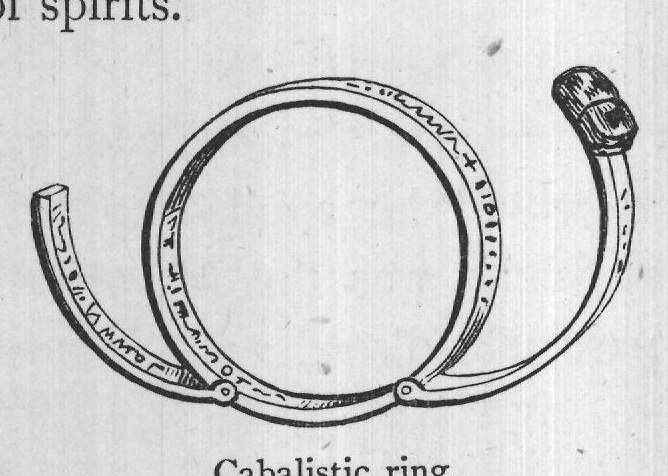
In 'Reynard the Fox,' the hero of that satirical work, describing the treasure he pretends to have discovered for the sole benefit of his royal master and mistress, says: 'Oon of them was a rynge of fyne gold, and within the rynge next the fyngre were wreton lettres enameld wyth sable and asure, and there were three Hebrew names therein, y coude not myself rede ne spelle them, for I onderstand not that language, but mayster Abryon of Tryers, he is a wise man, he onderstandeth wel al maner of langages, and the virtue of al maner of herbes. And yet he byleveth not in God, he is a Jewe, the wysest in conynge, and specyally he knoweth the virtue of stones. I shewed him thys ryng, he sayd that they were the thre names that Seth brought out of Paradys, when he brought to his fader Adam the oyle of mercy. And whomsoever bereth on hym thyse thre names, he shal never be hurte by throndre ne by lyghtning, ne no wytchcraft shal have no power over hym, ne be tempted to doo synne; and also he shall never take harme by colde though he laye thre wynters long nyghtes in the felde though it snowed, stormed, or froze never soo sore, so grete myghte have these wordes.' The stone set in the ring and its wonderful properties are then enumerated, and the conclusion is: 'I thought in myself that I was not able ne worthy to bere it, and therefore I sent it to my dere lord, the Kyng, for I knew hym for the moost noble that now lyveth, and also all our welfare and worship lyeth on hym, and for he shold be kepte fro al drede, nede, and ungeluck.' While the names of saints were employed for the prevention or relief of bodily ailments, those of 'devils' were made the agency for criminal objects; thus we read in Monstrelet's 'Chronicles,' that in the plea of justification made by the Duke of Burgundy for the assassination of Louis, Duke of Orleans, in 1407, he accused the latter of having conspired against the King of France by means of sorcery. Among other things a ring was made use of 'in the name of devils.' A monk undertook this 'who performed many superstitious acts near a bush, with invocations to the devil.' Two evil spirits appeared to him in the shape of two men, one of whom took the ring, which had been placed on the ground, and vanished. After half an hour he returned, and gave the ring to the monk, 'which to the sight was the colour of red, nearly scarlet,' and said to him: 'Thou wilt put it into the mouth of a dead man in the manner thou knowest,' and then vanished. The monk obeyed these instructions 'thinking to burn the lord our King.' Mr. Fairholt describes a mechanical ring, of mystic signification, as one of the most curious rings in the Londesborough Collection. The outside of the hoop is perfectly plain, and is set with a ruby and amethyst. Upon pressing these stones a spring opens, and discovers the surface covered with magical signs and names of spirits; among them Asmodiel, Nachiel, and Zamiel occur, a similar series occupying the interior of the hoop. Such a ring might be worn without suspicion of its true import, looking simplicity itself, but fraught with unholy meaning. It was, probably, constructed for some German mystic philosopher, at a time when students like Faust devoted themselves and their fortune to occult sciences, believing in the philosopher's stone, the elixir of life, and the power given to man to control the unseen world of spirits.
M Cabalistic ring.
Among the charges brought against Joan of Arc were that she had charmed rings to secure victory over her enemies.
The ancient physicians and empirics employed numerous charms for the cure of diseases, and the practice was common among the medical professors of the middle and lower Roman empire. Marcellus, a physician who lived in the reign of Marcus Aurelius, directs the patient who is afflicted with a pain in the side to wear a ring of pure gold, inscribed with some Greek letters, on a Thursday, at the decrease of the moon. It was to be worn on the right hand if the pain was on the left side, and vice versa. Trallian, another physician, living in the fourth century, cured the colic and all bilious complaints by means of an octangular ring of iron, on which eight words were to be engraved, commanding the bile to take possession of a lark! A magic diagram was to be added. He tells us that he had great L2 experience in this remedy, and had considered it extremely foolish to omit recording so valuable a treasure, but he particularly enjoined keeping it a secret from the profane vulgar, according to an admonition of Hippocrates, that sacred things are for sacred persons only. He recommends also a cure for the stone by wearing a copper ring with the figure of a lion, a crescent, and a star, to be placed on the fourth finger; and for the colic in general a ring with Hercules strangling the Nemæan lion.
Michaelis, a physician of Leipsic, had a ring made of a sea-horse's tooth, which he applied to all diseases indiscriminately, but jasper was the favourite substance employed when a particular disorder was in question.