Home › Ring Superstitions › Ring Superstitions: Alexander
Ring Superstitions: Alexander
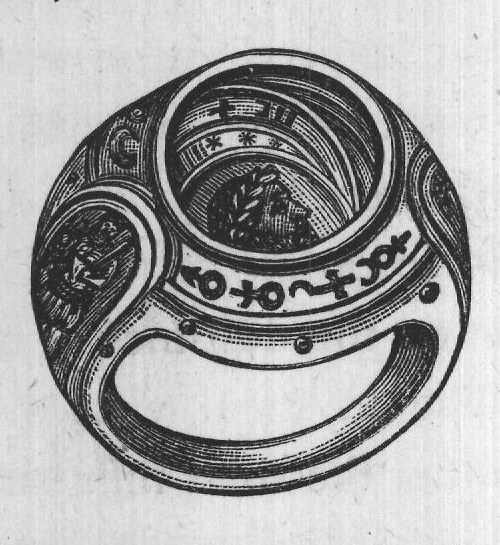
A portrait of Alexander the Great, set in a gold or silver ring, and carried about on the finger, was supposed by the Greeks to ensure prosperity to the wearer; as a reverse, one of the omens announcing the fall of Nero was the presentation to him of a ring engraved with the Rape of Proserpine, being a symbol of death.1 Spartian includes among the omens of Hadrian's coming death the falling off from his finger of his ring, 'which bore a likeness to himself,' as he was taking the auspices on a New Year's day, and so obtaining a foreshadowing of the events of the coming year. 1 The superstitious custom of carrying the medals of Alexander the Great, as if they had some salutary virtue in them, was frequent among the Christians of Antioch, as is evident from St. John Chrysostom's declamation against the practice :- What shall we say of those that use enchantments and ligatures, and bind upon their head and feet brass medals of Alexander of Macedon? Are these our hopes? And shall we, after the passion and death of our Saviour, place our salvation in an image of a heathen king?' A portrait of Hadrian, engraved with Mercury in a magic ring (Gorlæus) :- ** Amulet ring: bust of Hadrian.
Heliodorus describes a precious stone as set in the King of Ethiopia's ring, one of the royal jewels, the shank being formed of electrum and the bezel flaming with an Ethiopian amethyst, engraved with a youthful shepherd and his flockan antidote to the wearer against intoxication. Philostratus relates how Chariclea escaped unharmed from the funeral pyre on which she was condemned to be burnt by the jealous Arsace, from having secreted about her the espousal-ring of King Hydaspes, 'which was set with the stone called Pandarbes, engraved with certain sacred letters' and antagonistic to fire.