Home › Memorial and Mortuary Rings › Memorial and Mortuary Rings: Mayence
Memorial and Mortuary Rings: Mayence
Stukeley (Abury, p. 45) records the finding of a flat gold ring in a barrow at Yatesbury. Douglas, in his discoveries of a later date (' Nenia Brit.' p. 117), says 'rings to the finger seldom occur of any ponderous metal, like the Roman ones of gold, silver, and bronze.' In the museum at Mayence (the Roman Maguntiacum, or Mogontiacum), so exceedingly rich in antiquarian remains, there are some fine specimens of finger-rings found in Franconian graves. The following illustration represents a gold ring, set with a coin, which is probably the copy of a Roman one :- Mortuary ring at Mayence.
In the second cut the inscription of the reverse, excepting a few letters, is erased in the process of fastening the ring to it, by the melting of the metal.
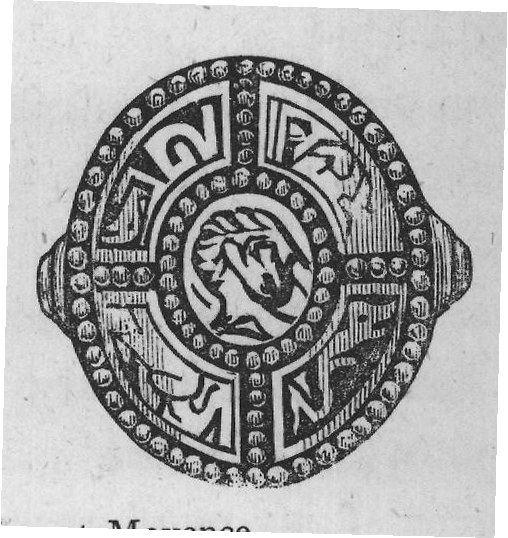
A metal ring with inscription translated In Dei nomine, Amen.' A gold finger-ring with a figure in the centre of the shield; the INDT Mortuary ring at Mayence. ornaments of dragons on the outer panels are inlaid with dark blue enamel :- 2 Mortuary ring at Mayence.
In ancient times rings were burnt with the corpse. When Cynthia's shade appears to Propertius, he remarks: 'Et solitam digito adederat ignis ;' 'a fact (remarks the Rev. C. W. King) which fully accounts for the number of fine intagli partly or wholly calcined which every collector meets with not unfrequently, and often with the greatest regret at the destruction of some matchless specimen of the skill of the engraver.' At the burial of Cæsar we are told that, among the tokens of grief exhibited by the Romans, the matrons burned on his funeral pyre their personal ornaments , the robes and even the rings of their sons. 'The Greeks and Romans,' observes Mr. Fairholt, 'literally revelled in rings of all styles and sizes. Nothing can be more beautiful in design and exquisite in finish than Greek jewellery; and the custom of decorating their dead with the most valued of these ornaments has furnished modern museums with an abundance of fine specimens.' The two rings next represented are copied from originals found in the more modern Etruscan sepulchres, and are probably contemporary with the earliest days of the Roman Empire.
In one of these rings the hoop is not perfected, 'each extremity ending in a broad, leaf-shaped ornament, most Gold rings from Etruscan sepulchres. delicately banded with threads of beaded and twisted wire, acting as a brace upon the finger.
Lord Braybrooke purchased in 1849 a Roman gold finger-ring, set with an intaglio in ribbon onyx, which was found in a Roman stone coffin at York: subject, a Fortuna Redux. In the same collection is a very curious and massive gold mourning-ring formed of two knotted withes twisted together; the knots are hollowed to receive enamel. The inscription inside the hoop is, in old English characters: 'When ye loke on thys, thyncke on hym who gave ye thys.' This ring was found in the Thames at Westminster. In the Londesborough Collection is the representation of a ring found upon the hand of a lady's skeleton, who was buried with her child in a sarcophagus discovered in 1846 in a field near Amiens, called 'Le Camp de César;' on two of her fingers were rings, one of which was set with ten round pearls, the other, represented in the collection mentioned, is of gold, in which is set a red cornelian, engraved with a rude representation of Jupiter riding on the goat Amalthea. The child also wore a ring, with an engraved stone. The whole of the decorations for the person Ring found at Amiens. found in this tomb proclaim themselves late Roman work, probably of the time of Diocletian.
It is customary in Russia on the death of a sovereign to distribute mourning-rings to those connected with the imperial court. A writer in 'Notes and Queries' (4th series, vol. iii. p. 322) remarks: 'When I was at St. Petersburg, I saw one of the rings given on the death of the late Emperor Nicholas. They were in the form of a serpent, enamelled black. Attached to the head and within the body of the ring was a narrow band of metal inscribed with the name of Nicholas, and the date of his death. This band was held within by a spring, in the same way as a spring measuring-tape. The serpent's head was mounted with two diamonds for eyes. The ring I saw was presented to the gentleman in whose possession it then was by reason of his official appointment of dentist to the imperial family.' In early times it was usual to bury sovereigns with their rings. During some repairs at Winchester Cathedral in 1768 a monument was discovered containing the body of King Canute. On his forefinger was a ring containing a very fine stone.