Home › Memorial and Mortuary Rings › Memorial and Mortuary Rings: Egyptians
Memorial and Mortuary Rings: Egyptians
The custom of decorating the dead with their jewellery (including rings) has been traced in a remarkable manner to the earliest periods of the world's history. In Genesis xli. 56, 57, we read: 'The famine was over all the face of the earth, and Joseph opened all the storehouses, and sold unto all the Egyptians; and the famine waxed sore in the land of Egypt. And all countries came into Egypt for to buy corn, because that the famine was so sore in all lands.' But Joseph could not empty the storehouses of Egypt to satisfy the cravings of all lands, nor sell away the bread of Egypt at any price when money became less precious than bread.
Such was the state of things when an Arabian princess in Yemen wrote, or when in her name were written, to be inscribed on her sepulchre, some impressive lines. Ebn Hesham relates that a flood of rain had laid bare a sepulchre in Yemen, in which lay a woman having on her neck seven collars of pearls, and on her hands and feet bracelets and armlets, and ankle-rings, seven on each, and on every finger a ring in which was set a jewel of great price, and at her head a coffer filled with treasure, and a tablet with an inscription thus translated by Mr. Forster :- In thy name, O God, the God of Himyar, I, Tajah, the daughter of Dzu Shefar, sent my servant to Joseph, And he delaying to return to me, I sent my handmaid, With a measure of silver, to bring me back a measure of flour : And not being able to procure it, I sent her with a measure of gold : And not being able to procure it, I commanded them to the ground: And finding no profit in them, I am shut up here.
Whosoever may hear of it, let him commiserate me; And should any woman adorn herself with an ornament From my ornaments, may she die with no other than my death. Inexorable with the Arabian princess, severe with his own brethren, proof against the blandishments of Potiphar's wife, yet susceptible of every pure and generous affection, this saviour of Egypt was ever consistent with himself.1 This Biblical monument confirms in a remarkable manner the truth of the Old Testament history.
In opening ancient sepulchral barrows plain or jewelled rings have in many instances been found, which, perhaps, a widowed wife or widower took from their fingers, and flung, in the intensity of their grief, into the graves of those they mourned. A modern instance of this is given in the 'Times' of October 28, 1865, when, at the funeral of Lord Palmerston in Westminster Abbey, the chief mourner, the Rev. Mr. Sullivan, as 'a precious offering to the dead,' threw into the grave several diamond and gold rings. Small rings are frequently met with on the breasts of mummies. At the excavations at Veii and Præneste, by Padre Raffaele Garucchi, a great quantity of tiny rings of yellow and blue enamel were found, of a similar character to those mentioned.
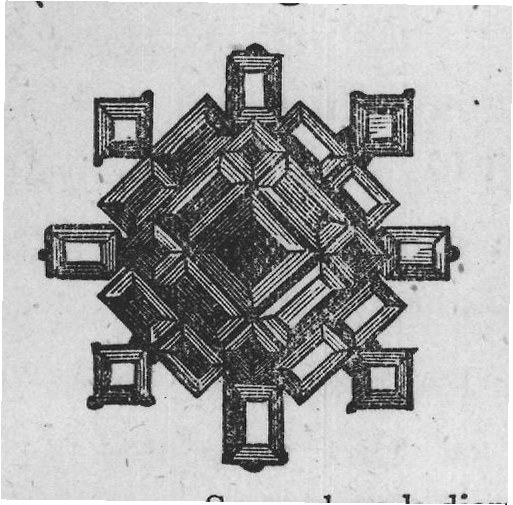
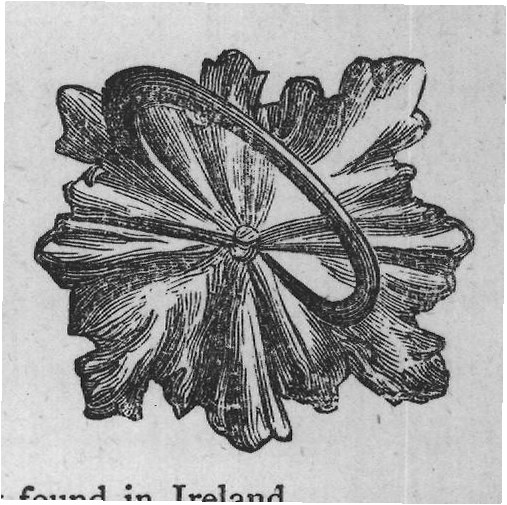
It was customary among the Anglo-Saxons to place rings and other ornaments in the grave: an early Anglo- Saxon poem, recounting the adventures of the chieftain Beowulf and his burial, states 'they put into the mound rings and bright gems.' The custom of burying corpses with a ring on the finger continued for ages, as I have remarked in several chapters of this work. Annexed is an illustration, from the 'Archæologia' (vol. ii. p. 32, 1773), of a ring with seventyfive table-diamonds, set in gold, found in 1748 in a grave at Carne, seven miles west of Mullinghar, in the county of Westmeath, Ireland.
Biblical Monuments, by William Harris Rule, D.D., and J. Corbet Anderson; 1871, 1873.
In the antiquarian researches in the Ionian Isles in 1812 ('Archæologia,' vol. xxxiii.) some rings were discovered Squared-work diamond ring found in Ireland. in tombs at Samo and Ithaca. One of these appears to have been a silver finger-ring, or signet, bearing on the upper part an elliptic piece of glass or crystal, in a state of decomposition, turning on the wire that passes through it. The other is a gold ring of solid fabric, having for device the figure of a female with a bare head; one arm is enveloped in the folds of her dress, while the other hand is pouring incense on a slender altar. A zigzag garland surrounds the verge of the field. The locality would suggest that it may represent Penelope sacrificing to some tutelar deity, and invoking it to conduct Ulysses home in safety-a conceit which might hold good, even were the work decided to be Roman.
There are some remarkably fine specimens of rings in the Royal Danish Museum, which have been discovered in Scandinavian graves, and some of which are represented in the chapter on 'Rings from the Earliest Period' (p. 68). On the opening of some barrows on the wolds of Yorkshire in 1815, 1816, and 1817, among other disinterments was the skeleton of a female, and some of her ornaments; amongst others, a ring of red amber, in exterior diameter 1 in., in interior diameter half an inch. Also a small ring scarcely one inch in diameter, and a ring of very nearly standard gold, weighing 3 dwts. 21 grs. In front this ring is clasped in a kind of rose, or quatrefoil, and it is an ornament by no means of despicable workmanship. The era of this interment is supposed to be prior to a general extension of Christianity in Britain.