Home › Giant Sloths and Armadillos › Giant Sloths and Armadillos: Megatherium
Giant Sloths and Armadillos: Megatherium
A bony shield (or carapace) of a great armadillo was found with one of the specimens described by Mr. Clift, and Buckland and others thought it belonged to the Megatherium; but Owen afterwards showed, by most clear and convincing reasoning from 1 This word, which means toothless, is misleading. All the Pleistocene and existing edentata, however, agree in having no front, or incisor, teeth. Some forms from Santa Cruz have front teeth.
PLATE LI.
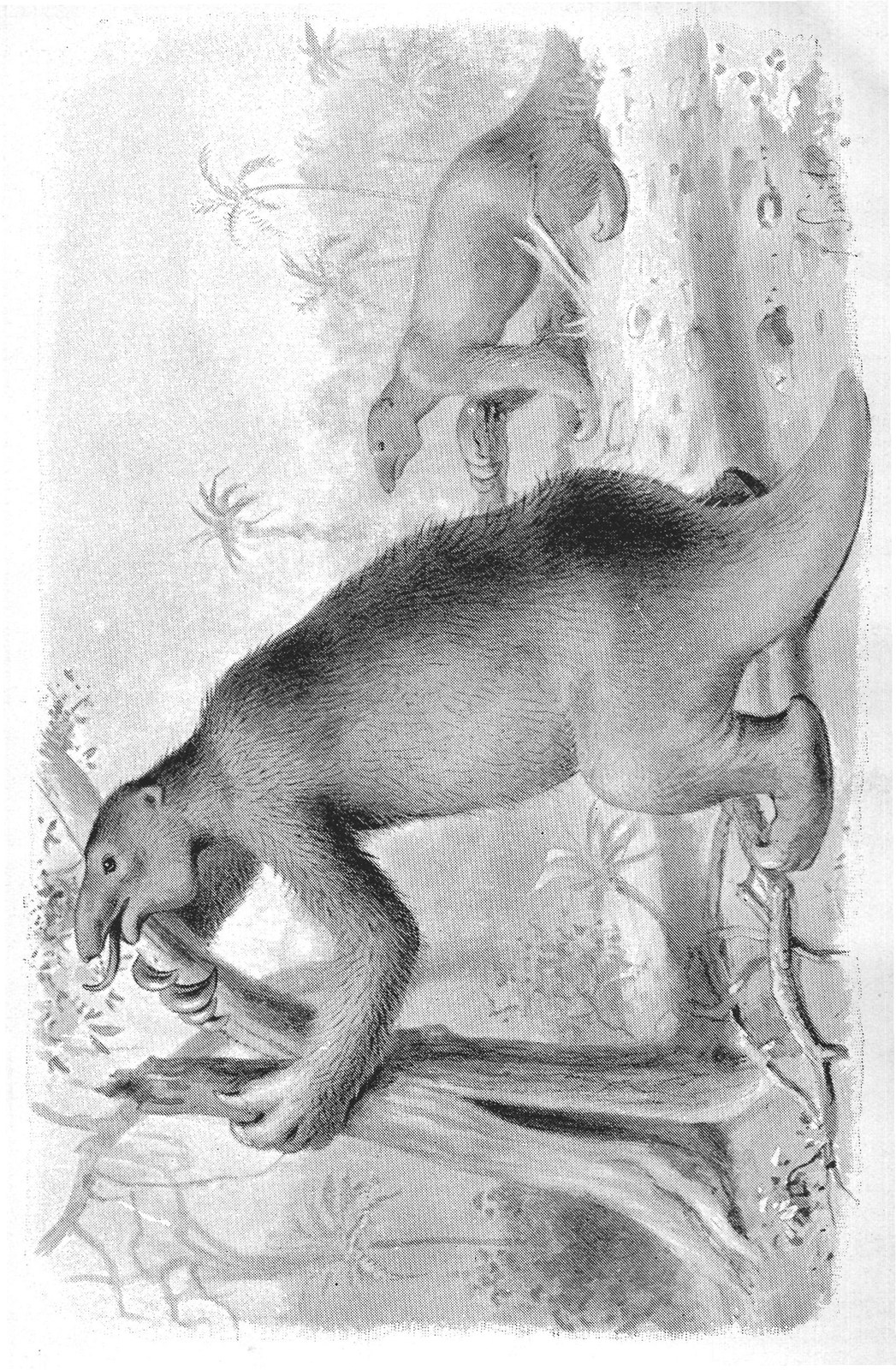
GREAT GROUND SLOTH OF SOUTH AMERICA, MEGATHERIUM AMERICANUM. Length 18 feet. the skeleton, that the Megatherium could not have been protected as armadillos are by such a shield (see p. 291).
And now we come to the question how it obtained its food. The idea of digging round trees with its claws in order to uproot them, must be partly, if not entirely, given up; for Owen has proved, by a masterly piece of reasoning, that this cumbrous creature, instead of climbing up trees as modern sloths do, actually pulled down the tree bodily, or broke it short off above the ground by a tour de force, and, in order to do so, sat upon its huge haunches and tail as on a tripod, while it grasped the trunk in its long powerful arms! Marvellous as this may seem, it can be shown that every detail in the skeleton agrees with the idea. Of course there would be limits to possibilities in this direction, and the larger trees of the period must have been proof against such Samson-like attempts on the part of the Megatherium; but when the trunk was too big, doubtless it pulled down some of the lower branches. Plate LI. is a restoration, by our artist, of the South Kensington skeleton.
Sir Woodbine Parish thought that the Megatherium fed on the Agave, or American aloe.
Another form of extinct sloth found in the same region is the Mylodon. Though of smaller size, it was much bigger than any living sloth, and attained a length of eleven feet. It has the same general structure, but the head and jaws are somewhat different, and more like the recent forms. A nearly perfect and original skeleton of Mylodon gracilis has been set up beside its huge relative's cast in the same gallery at the Natural History Museum. The crowns of its molar teeth are flat instead of being ridged; hence its name, which signified "mill-toothed." Yet another was the Scelidotherium 1 with its long limbs. 1 Greek-scelis, limb; therion, beast.
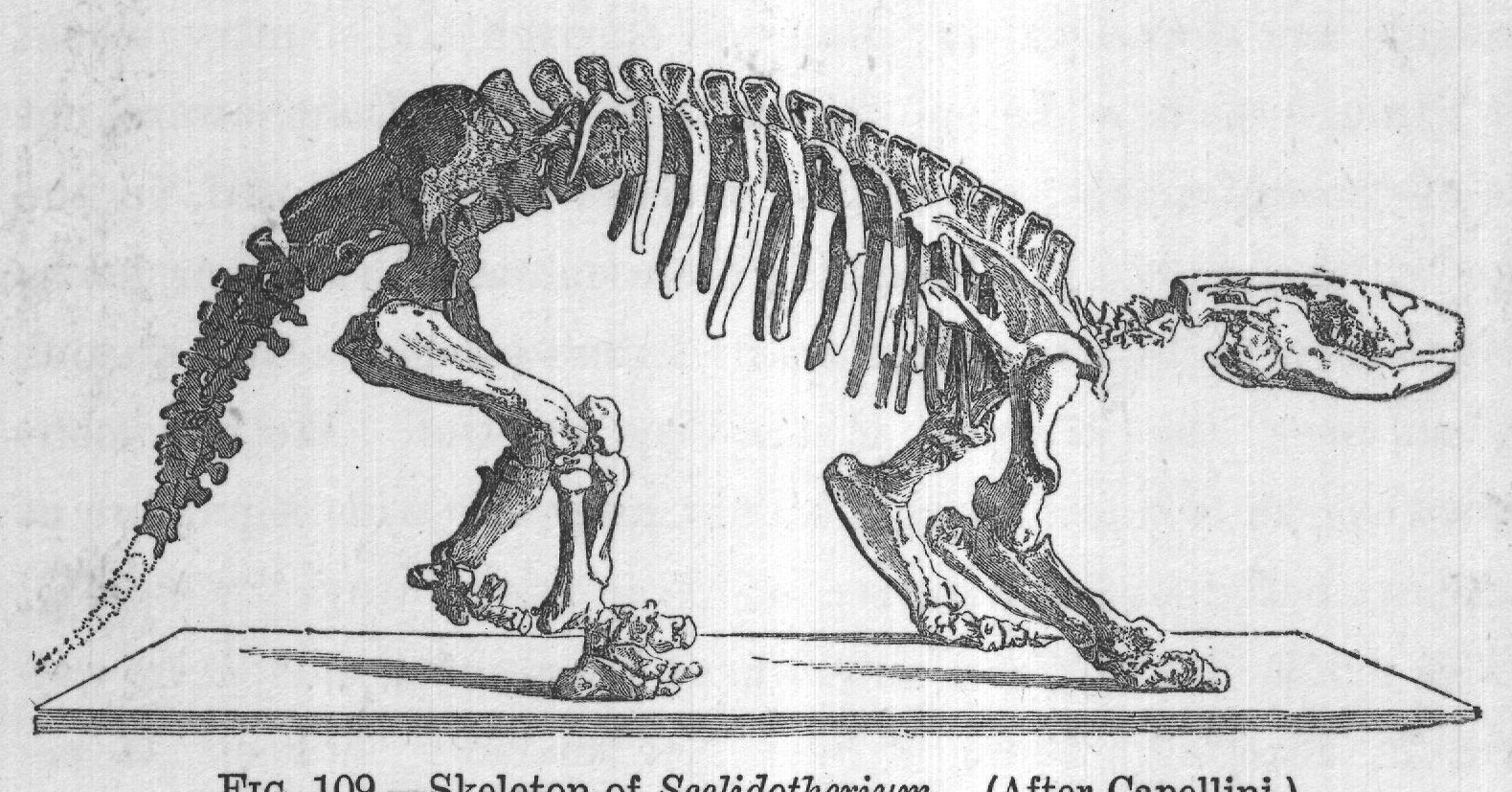
Darwin obtained an almost entire skeleton of one of these. It was as large as a polar bear. Speaking of his discovery, he says, "The beds containing the fossil skeletons consist of stratified gravel and reddish mud; a proof that the elevation of the land has been inconsiderable since the great quadrupeds wandered over the surrounding plains, and the external features of the country were then very nearly the same as now. The number of the remains of these quadrupeds embedded in the vast estuary deposits which form the Pampas and cover the granitic rocks of Banda Oriental must be extraordinarily great. I believe a straight line drawn in any direction through the country would cut through some skeleton or bones. As far as I am aware, not one of these animals perished, as was formally supposed, in the marshes or muddy river-beds of the present land, but their bones have been exposed by the streams intersecting the subaqueous deposit in which they were originally embedded. We may conclude that the whole area of the Pampas is one wide sepulchre of these extinct gigantic quadrupeds." 1 The genus Scelidotherium comprises a number of species and presents characters more or less intermediate between Megatherium and some other genera. The skull is low and elongated, and shows an approach to that of the modern ant-eater. The feet also are different from those of Megatherium (see Fig. 109). These monster sloths inhabited South America during the latest geological period, known as the Pleistocene. During part of that time North America, as well as Northern Europe and Asia, were invaded by a great ice-sheet, and an arctic climate prevailed. It is therefore very probable that while the mammoth and the mastodon were roaming over North America, giant sloths and armadillos were monarchs of the southern continent. What 1 Journal of Researches. cause, or causes, led to the extermination of the giant sloths and armadillos is still a matter of speculation. One writer suggests an explanation that seems to deserve consideration. The southern parts of this great continent are even now subject to longcontinued droughts, sometimes lasting for three years in succession, and bringing great destruction to cattle. In fact, the discoveries related above were rendered possible by several successive dry seasons. It is argued that the upright position of most of the skeletons found in situ seems to suggest that the creatures must have been mired in adhesive mud sufficiently firm FIG. 109. Skeleton of Scelidotherium. (After Capellini.) to uphold the ponderous bones after the flesh had decayed. A long drought would bring the creatures from the drained and parched country to the rivers, reduced by want of rain to slender streams running between extensive mud-banks; and it is possible that, in their anxious efforts to reach the water, they may have only sunk deeper and deeper in the mud until they were engulfed. This idea is strengthened by information supplied to Mr. Darwin when in these parts (recorded in his Journal). An eye-witness told him that during the gran seco, or great drought, the cattle in herds of thousands rushed into the Parana, and, being exhausted U by hunger and thirst, were unable to crawl up the muddy banks, and so were drowned.
In the last great drought, from 1830 to 1832, it is probable (according to calculations made) that the number of animals that died was over one million and a half. The borders of all the lakes and streamlets in the province were long afterwards white with their bones.
It does not seem probable that the small sloths of to-day are descended from these big ones; but it may be that some of the arboreal forms forsook their trees and took to the ground. But nobody can say why they became so enormous.