Home › Extinct Whales and Wombats › Extinct Whales and Wombats: Owen's
Extinct Whales and Wombats: Owen's
In 1863 our late distinguished friend, Dr. George Bennett, wrote from Sydney to Owen, saying that his son, then in Queensland, had written home to say that he found a place where a whole skeleton lay: the bones were immense; the head, he said, had been sent to Sydney some years previously (this may be the one now in the Natural History Museum). Owen wrote to Sir Henry Parkes, in 1867, suggesting that his administration should send an exploring party to the limestone caves in Wellington Valley, discovered in 1832, and from which fossil remains were brought sufficient to show that the marsupial type of mammal formerly prevailed in that country as it does now. Consequently, a vote of two hundred pounds was passed, and a most valuable collection of fossils obtained.
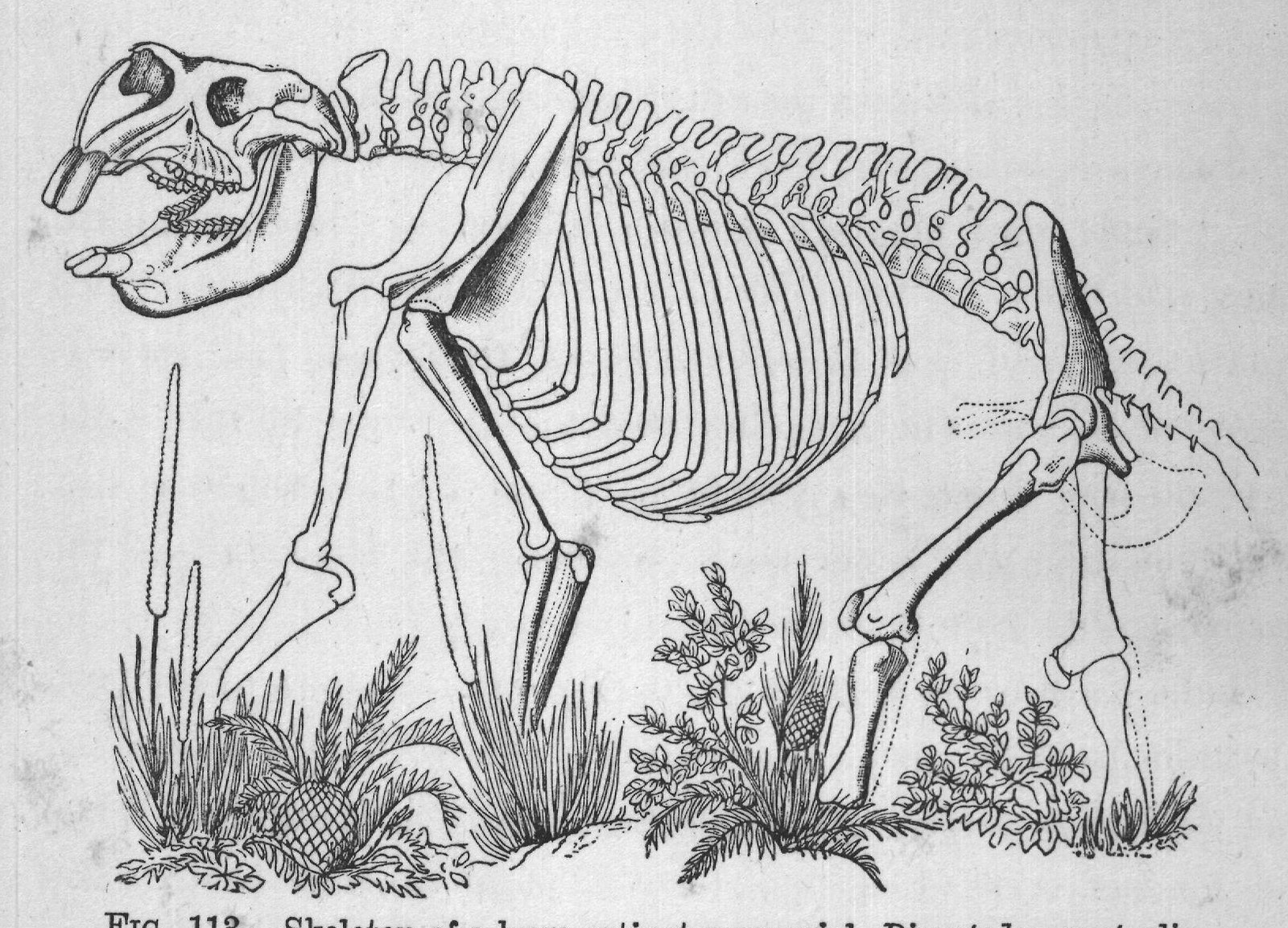
The following passage, from a now historic paper by Sir R. Owen, will serve to show with how great enthusiasm he pursued his most fruitful researches in palæontology. Of no existing animal," he says, "of which a passing glimpse, as it were, had thus been caught, did I ever feel more eager to acquire fuller knowledge than of this huge Marsupial. No chase can equal the excitement of that in which, bit by bit, and year after year, one captures the elements for reconstructing the entire creature of which a single tooth or fragmentary bone may have initiated the quest; in the course of which one fully realises, with more or less exactitude, the picture which the laws of correlation had led one to frame of an animal which may have passed out of existence long ages ago." 1 Owen's restoration, published in the FIG. 113. Skeleton of a huge extinct marsupial, Diprotodon australis. (Restored after Owen.) above paper, is shown in Fig. 113. But, in the year 1893, a wonderful find was reported from Australia, which will, doubtless, in time lead palæontologists to a complete and thorough knowledge of this great and mysterious marsupial. The first announcement was a brief telegram in The Times; but, later on, a letter appeared in The Scotsman, of September 14th, from Mr. William Kinmont. In the same enterprising newspaper 1 Philosophical Transactions of the Royal Society, vol. 160 (1870), p. 519. EXTINCT WHALES AND WOMBATS 305 appeared a few days afterwards (September 25th), extracts from an Australian account of the matter, the South Australian Register of August 12th. It seems that only a small portion of the area known to contain fossil remains has as yet been explored, and there is little doubt that a complete examination will yield results even surpassing those already made.