Home › Contents › Cliff Swallow
Cliff Swallow
While the Barn Swallows usually have their homes within barns, Cliff Swallows almost as frequently fasten theirs to the outsides of such structures, on which account they are very generally known as "Eave Swallows." These Swallows are more gregarious than Barn Swallows; even in the East, where they build under the eaves of buildings, they nest in colonies varying from two or three nests to sometimes as many as fifty on one building. In the West where they have not so fully learned the ways of civilization, they nest in colonies of thousands, attaching their homes to the faces of cliffs.
Their nests are constructed in the same manner as those of Barn Swallows but are of a much different shape. The typical Cliff Swallow nest is flask-shaped; it is attached to the building or cliff by one side of the rounded bottom, which is slightly flattened, and the entrance is through an opening in the short neck that protrudes from the upper side; again the nest may have no neck but simply a round hole in the upper part of the mud dome. The outside has a very granular appearance caused by the large pellets of mud that are plastered on it. The inside is, of course, lined with feathers or grasses.
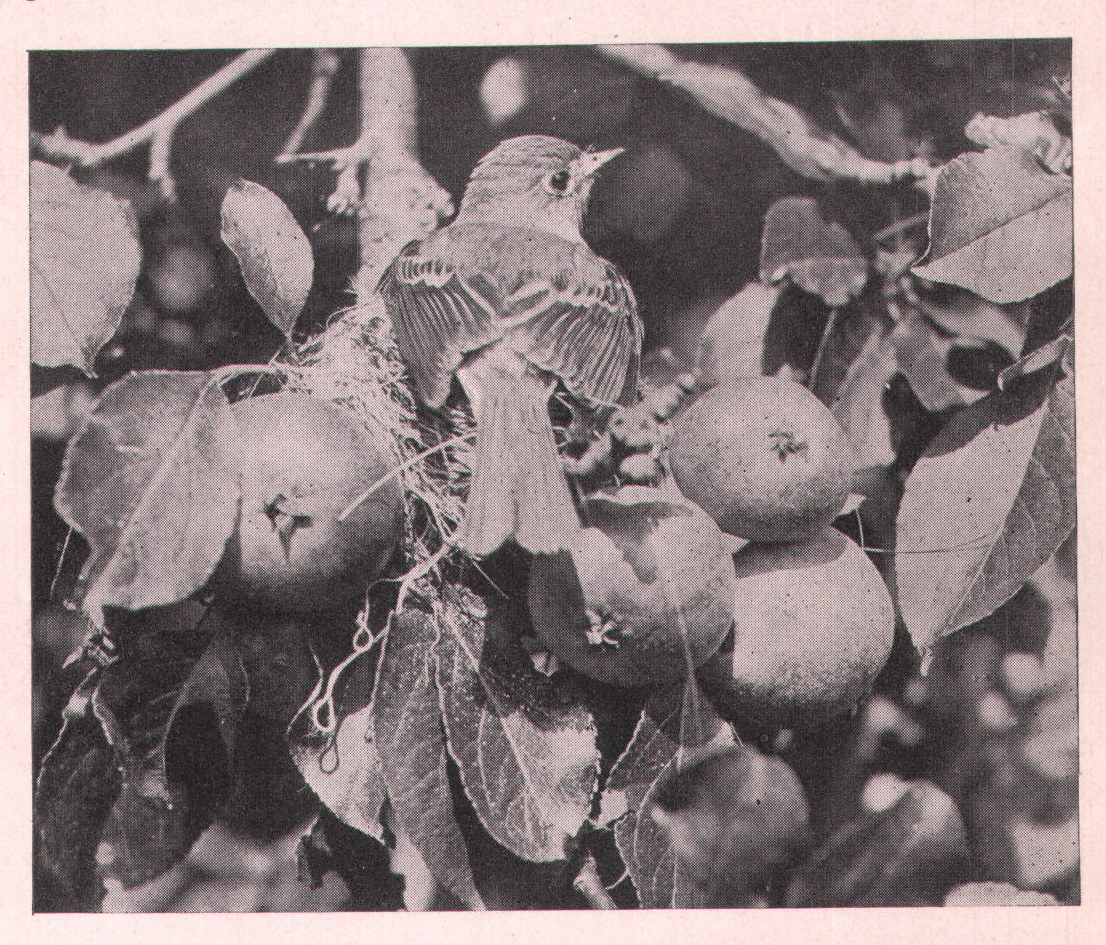
Many persons confuse this bird and the latter one, but they are very different and easily recognized. This species has no swallow or forked tail and has a light patch on the rump and one on the forehead, both of which are very easily seen even during flight.
Although I have seen and know of a great many of their nesting sights my photographic experiences with these birds are limited to one attempt. The nests were under the eaves of a large barn, fully thirty feet above ground; time and conditions forced me to hold the graflex camera out of a tiny window and make exposures in a most awkward attitude. The eggs of this species are precisely like those of the Barn Swallow, -creamy white, profusely spotted with reddish-brown. The nests are most commonly located on buildings near water; I have found them very commonly plastered to the sides of ice houses.
Brooding her little ones.