Home › Contents › Black and White Warbler
Black and White Warbler
Woodpeckers are very expert at climbing up trees; Nuthatches are equally expert at clambering down. Black and White Warblers or Black and White Creepers, as they were formerly called, are more versatile and agile than either; they can climb in any position with the greatest of ease. In this respect, their habits are so different from most warblers, that early naturalists were inclined to class them in a separate family.
After hearing the long-drawn, wiry song of a Black and White Warbler coming from about the same spot for sev eral consecutive mornings, I decided to investigate. Climbing over the wall, I went in the direction of his voice and soon found him climbing nimbly about in a young chestnut tree in search of his breakfast. Every few moments the little climber would pause, lift his head and sing out his unmusical notes. I was not particularly interested in the male bird at this time, but I knew that somewhere near him I would find his mate and, that having located her, it would be a comparatively easy matter to find their nest.
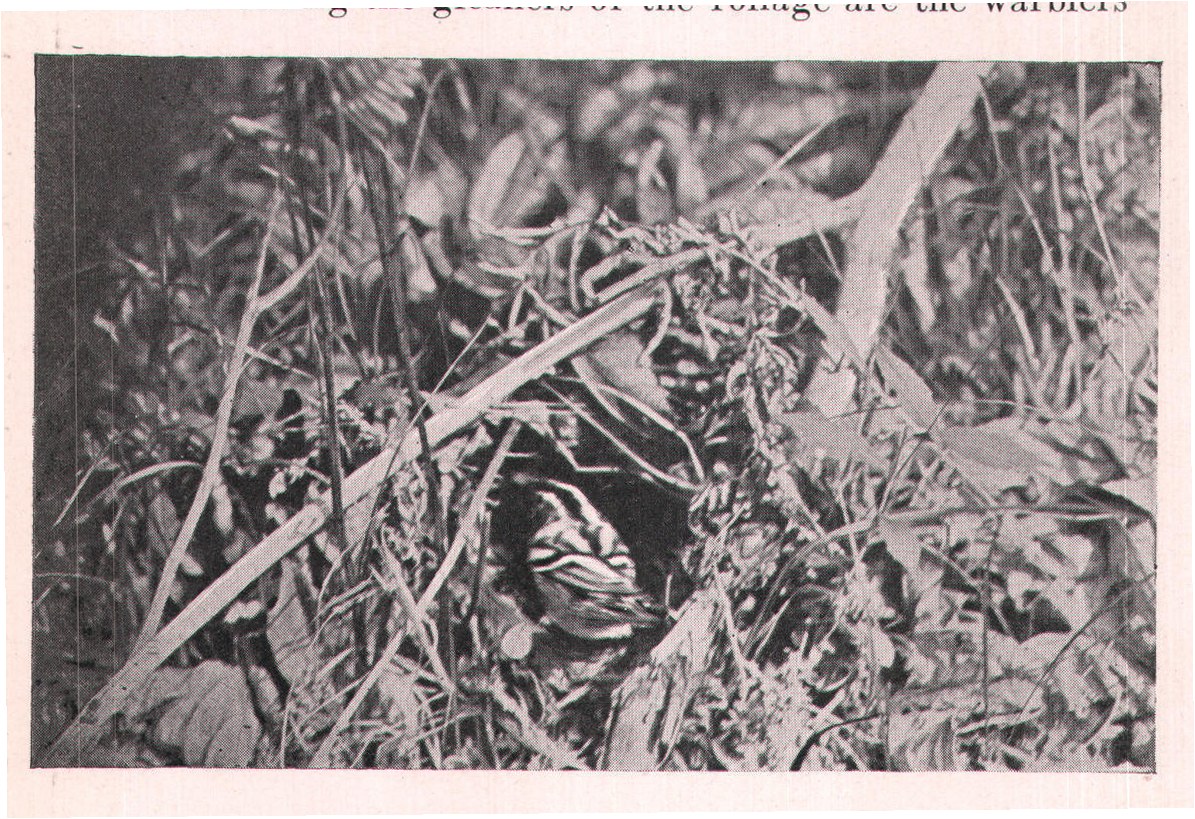
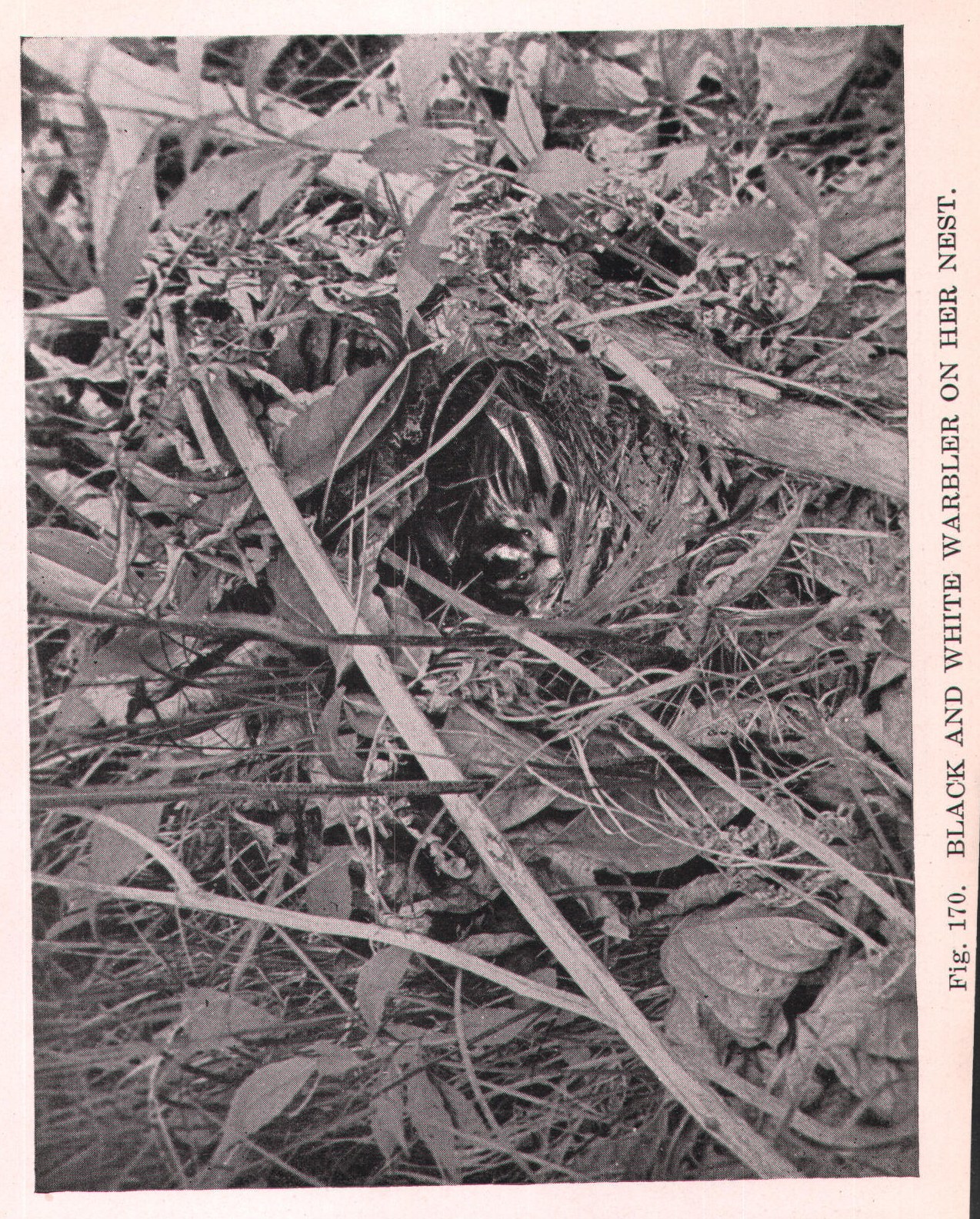
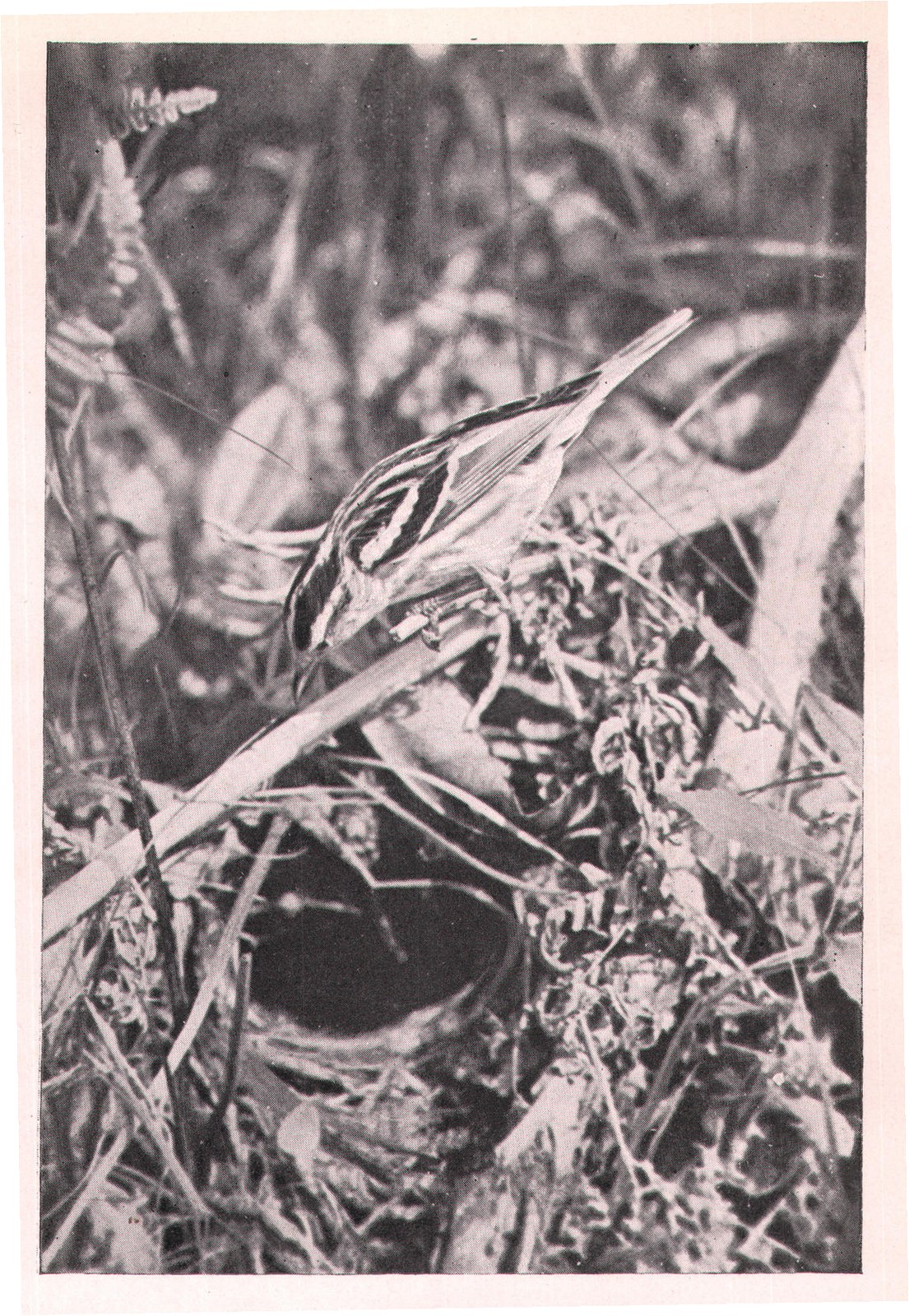
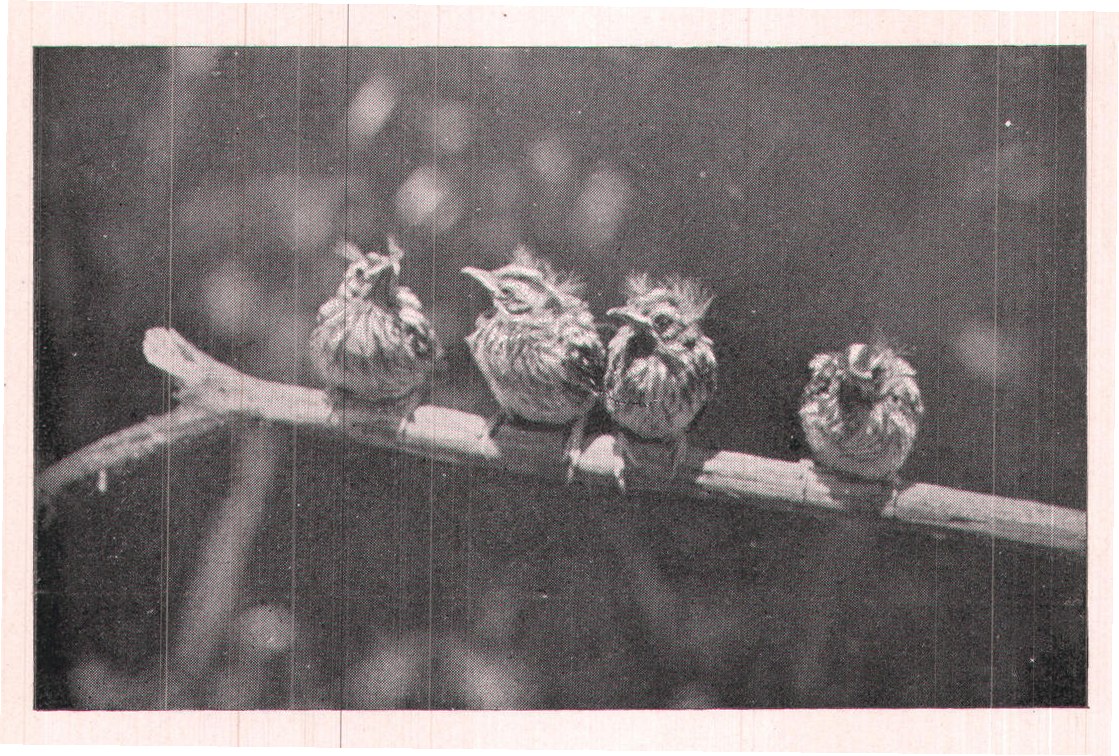
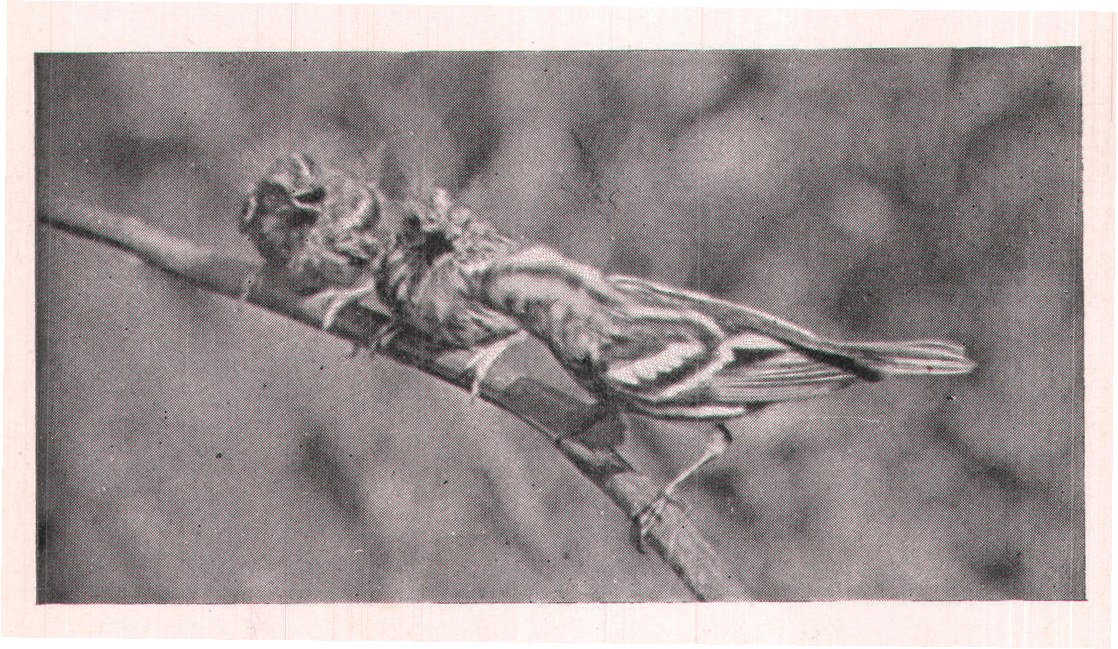
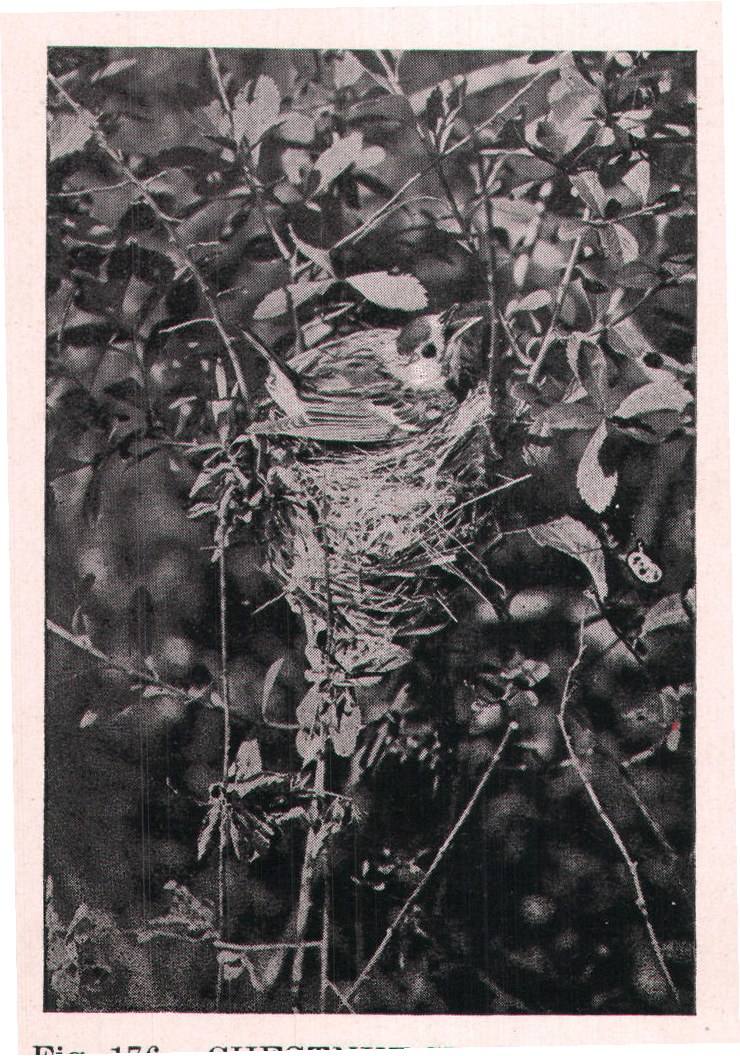
I soon discovered her in a tree beyond her mate, and was delighted to see that she had a long shred of bark in her beak. As usual with birds of this species, she was very careful and wanted to make sure that no one should see her building the nest. I kept perfectly still for fully fifteen minutes before she went to its site, which proved to be at the base, on the opposite side, of the very stump behind which I was concealed. As these warblers are very apt to desert a nest if they know it to be discovered, I went quietly away without even looking at it. The next time I saw the nest it contained one dainty little warbler egg and a larger one of a Cowbird; the latter egg was removed because it would have either prevented the warbler from laying her full number of eggs in the nest or else, when hatched, the young Cowbird would probably have crowded some of the smaller birds to death. I saw neither of the warblers on that morning and feared that they might have already deserted the nest because of the imposition Fig. 171. She always returned the same way,--down a dead limb to a tiny twig; dropping from the latter to her doorway. to a tiny twig; dropping from the latter to her doorway. of the Cowbird. A week later I returned and, when at a distance of about ten feet, I could see her little bead-like eyes and black and white striped face. The nest was sunk among the leaves at the base of the stump and was well arched over so that it was very difficult to see even when the exact location was known. She sat perfectly still and I approached very, very slowly carrying a camera, already Fig. 172. Four of the five little ones; the other could not be found. set on its tripod, before me. I managed to plant it so that the lens was but three feet from her without causing her to leave. Then still more slowly, at the same time trying to reassure her with bird-like chirps (that perhaps did not sound much like a bird), I leaned forward and removed some objectionable grasses that were between the lens and her and finally lifted the arch a trifle so that she could be seen to better advantage. She was frightened, for she breathed faster than normal but she made no move to get away and even opened her bill as though to pick my fingers when I touched the nest.
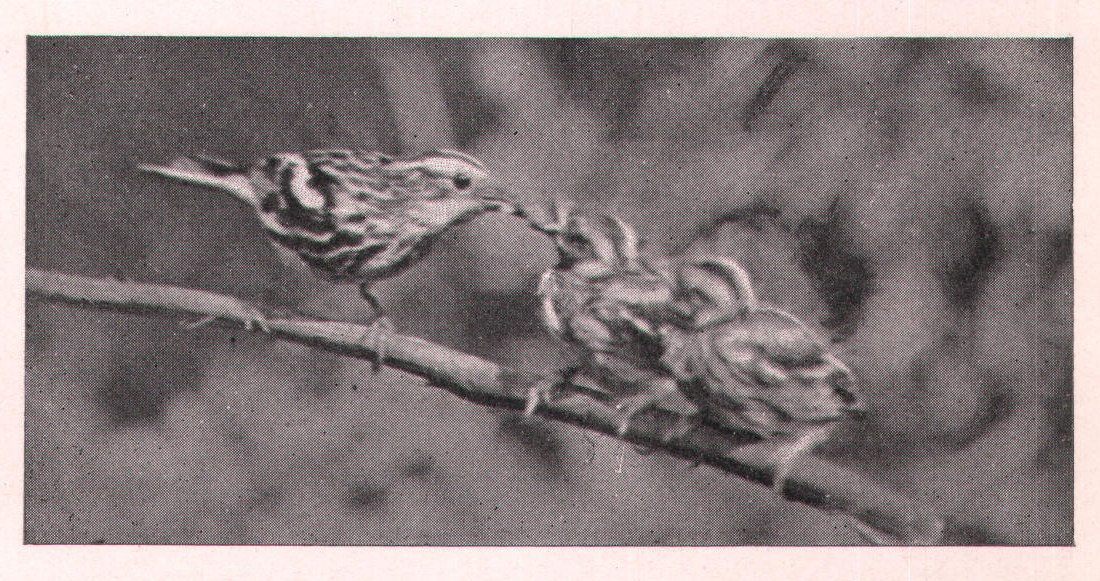
Her confidence and courage were amazing, considering that it was the first formal visit I had made. With a small stop in the lens, I made two pictures of her as she sat on the nest. As I did not wish to frighten her away, I simply Fig. 173. I managed to keep two of them on a twig long enough to get his picture, feeding them; they were so active that this was almost a hopeless task. wound my coat and focussing cloth about the tripod legs and went to another part of the woods, leaving the camera there. As I had hoped, when I returned an hour later she had left her nest, which, I now saw, held five eggs, and gone after food. So I stretched myself on the ground with just my head and shoulders concealed under the small tent formed by the covered tripod legs and, with bulb in hand, awaited her return.
It was a very clear, sunny day in the middle of June. The sun's rays were very warm, in fact I never before realized that they were so red hot. In spite of the discomfort, I had to laugh as I likened myself to a turkey in the oven; the worst of it was I was being baked only on one side; I could not turn over because my warbler had returned and was watching me closely before going to the nest. At the end of about fifteen minutes, by which time I was "well Fig. 174. They moved so rapidly that the picture is blurred although it was made in 1-200 of a second. done", she got in just the position I wanted and I snapped the shutter. One such roasting as that was sufficient so I gathered my outfit and retreated.
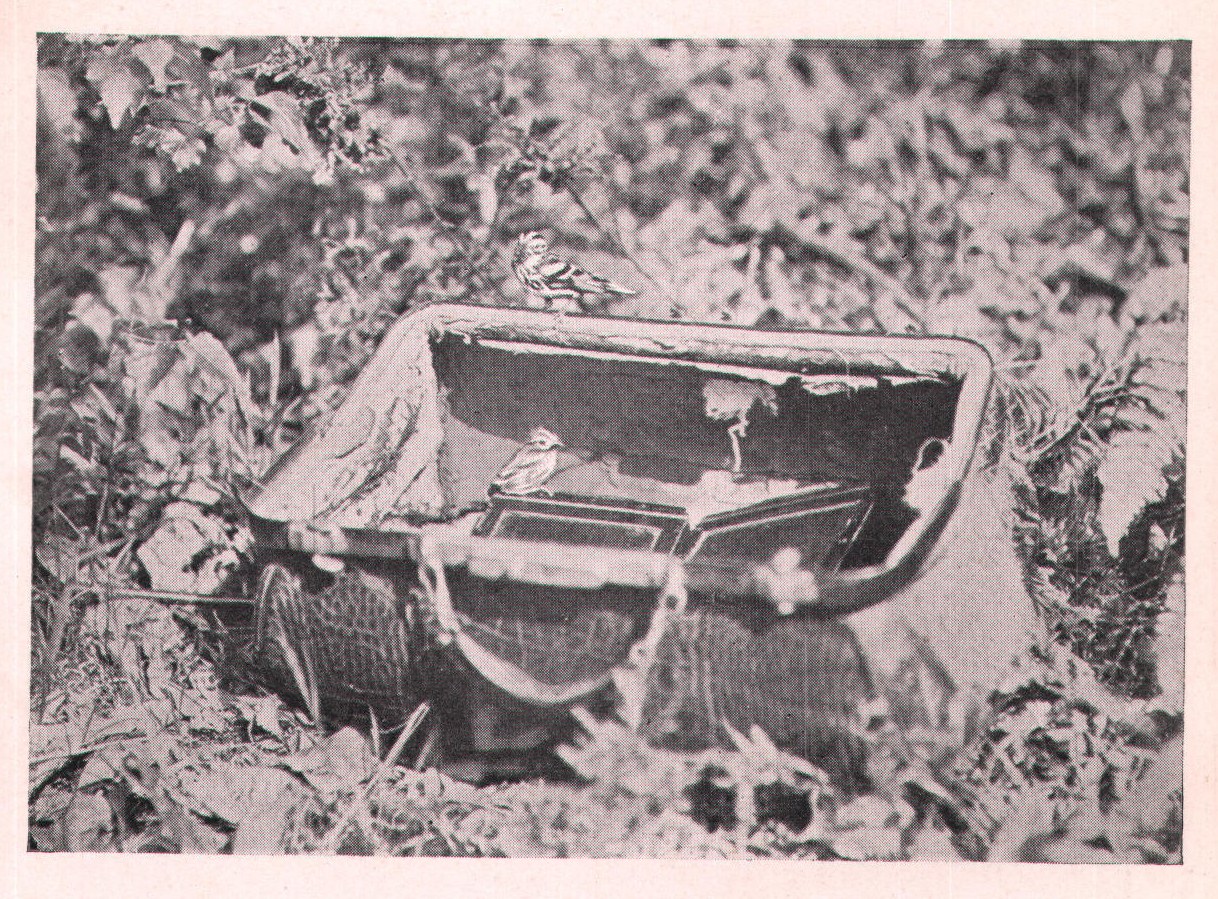
It was fortunate that I took the pictures as I did, for when I next returned with my whole battery of cameras and tent, I found that I was a day too late. I no sooner touched the nest than the little black and white fellows slid out in all directions. I think that, possibly with the exception of some little Maryland Yellow-throats, they were the liveliest lot of little birds I have ever handled. I never needed an Fig. 175. The male bird even went into the valise to feed the little ones. Notice that he is now standing on the edge and one youny is inside. assistant as much as I did at just that time. After much running, dodging and climbing I managed to corral four of them but I could find no trace of the fifth; its mother had led it away and left the father bird to look out for the ones I had.
If human children would obey their parents as beautifully as these little birds did, we would have a perfect world. As soon as I got them perched on a branch he would tell them to get off, and off they would go, every one of them, in four different directions. I did manage to get a few pictures but not the ones that I wanted most to secure. male warbler was the most courageous little feathered mite The I have ever seen. He was everywhere almost at once, climbing all over my head, shoulders and hands, but never still for an instant. He pleaded so earnestly for me to let his little ones go, that I soon turned them loose.