Home › Impressions Of The Past › Impressions Of The Past: England
Impressions Of The Past: England
There is an interesting parallel between the history of footprints in England and America, for they were noticed at about the same time, 1830, in both countries; in each case the tracks were in rocks of Triassic age, and, in both instances, the animals that made them have never been found. In England, however, the tracks first found were those ascribed to tortoises, though a little later Dinosaur footprints were discovered in the same locality. Oddly enough these numerous tracks all run one way, from west to east, as if the animals were migrating, or were pursuing some well-known and customary route to their feeding grounds.
For some reason Triassic rocks are particularly rich in footprints; for from strata of this same age in the Rhine Valley come those curious examples so like the mark of a stubby hand that Dr. Kaup christened the beast supposed to have made them Cheirotherium, beast with a hand, suggesting that they had been made by some gigantic opossum. As the tracks measure five by eight inches, it would have been rather a large specimen, but the mammals had not then arisen, and it is generally believed that the impressions were made by huge (for their kind) salamander-like creatures, known as labyrinthodonts, whose remains are found in the same strata. Footprints may aid greatly in determining the attitude assumed by extinct animals, and in this way they have been of great service in furnishing proof that many of the Dinosaurs walked erect. The impressions on the sands of the old Connecticut estuary may be said to show this very plainly, but in England and Belgium is evidence still more conclusive, in the shape of tracks ascribed to the Iguanodon. These were made on soft soil into which the feet sank much more deeply than in the Connecticut sands, and the casts made in the natural moulds show the impression of toes very clearly. If the animals had walked flat-footed, as we do, the prints of the toes would have been followed by a long heel mark, but such is not the case; there are the sharply defined marks of the toes and nothing more, showing plainly that the Iguanodons walked, like birds, on the toes alone. More than this, had these Dinosaurs dragged their tails there would have been a continuous furrow between the footprints; but nothing of this sort is to be found; on the contrary, a fine series of tracks, uncovered at Hastings, England, made by several individuals and running for seventy-five feet, shows footprints only. Hence it may be fairly concluded that these great creatures carried their tails clear of the ground, as shown in the pictures of Trachodon, the weight of the tail counterbalancing that of the body. Where crocodilians or some of the short-limbed Dinosaurs have crept along there is, as we should expect, a continuous furrow between the imprints of the feet. This is what footprints tell us when their message is read aright; when improperly translated they only add to the enormous bulk of our ignorance.
Some years ago we were treated to accounts of wonderful footprints in the rock of the prison-yard at Carson City, Nev., which, according to the papers, not only showed that men existed at a much earlier period than the scientific supposed, but that they were men of giant stature. This was clearly demonstrated by the footprints, for they were such as might have been made by huge moccasined feet, and this was all that was necessary for the conclusion that they were made by just such feet. For it is a curious fact that the majority of mankind seem to prefer any explanation other than the most simple and natural, particularly in the case of fossils, and are always looking for a primitive race of gigantic men.
Bones of the Mastodon and Mammoth have again and again been eagerly accepted as those of giants; a salamander was brought forward as evidence of the deluge (homo diluvii testis); ammonites and their allies pose as fossil snakes, and the "petrified man" flourishes perennially. However, in this case the prints were recognized by naturalists as having most probably been made by some great ground sloth, such as the Mylodon or Morotherium, these animals, though belonging to a group whose headquarters were in Patagonia, having extended their range as far north as Oregon. That the tracks seemed to have been made by a biped, rather than a quadruped, was due to the fact that the prints of the hind feet fell upon and obliterated the marks of the fore. Still, a little observation showed that here and there prints of the fore feet were to be seen, and on one spot were indications of a struggle between two of the big beasts. The mud, or rather the stone that had been mud, bears the imprints of opposing feet, one set deeper at the toes, the other at the heels, as if one animal had pushed and the other resisted. In the rock, too, are broad depressions bearing the marks of coarse hair, where one creature had apparently sat on its haunches in order to use its fore limbs to the best advantage. Other footprints there are in this prison-yard; the great round "spoor" of the mammoth, the hoofs of a deer, and the paws of a wolf (?), indicating that hereabout was some pool where all these creatures came to drink. More than this, we learn that when these prints were made, or shortly after, a strong wind blew from the southeast, for on that face of the ridges bounding the margin of each big footprint, we find sand that lodged against the squeezed-up mud and stuck there to serve as a perpetual record of the direction of the wind. REFERENCES Almost every museum has some specimen of the Connecticut Valley footprints, but the largest and finest collections are in the museums of Amherst College, Mass., and Yale University, although, owing to lack of a Museum building, none of the Yale specimens are now on exhibition. The collection at Amherst comprises most of the types described by Professor E. Hitchcock in his "Ichnology of New England," a work in two fully illustrated quarto volumes. Other footprints are described and figured by Dr. J. Deane in "Ichnographs from the Sandstone of the Connecticut River." They have been carefully re-studied by Dr. R. S. Lull who has gathered much new information in regard to the animals represented. The results of his studies are recorded in a book entitled "Triassic Life of the Connecticut Valley," published by the State of Connecticut.
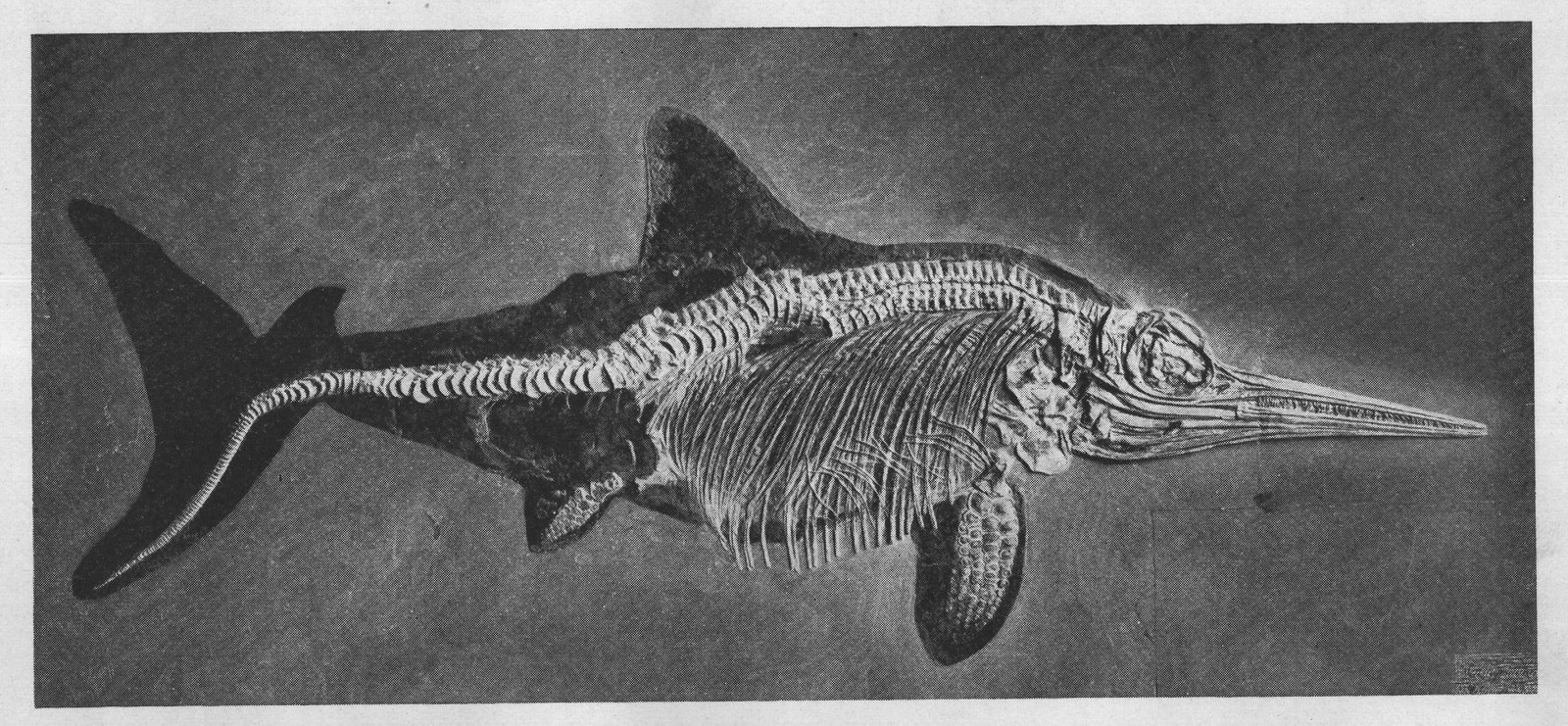
The Track of a Three-toed Dinosaur AN ICHTHYOSAUR OR SEA LIZARD From a specimen in the American Museum of Natural History. 32