The American Museum
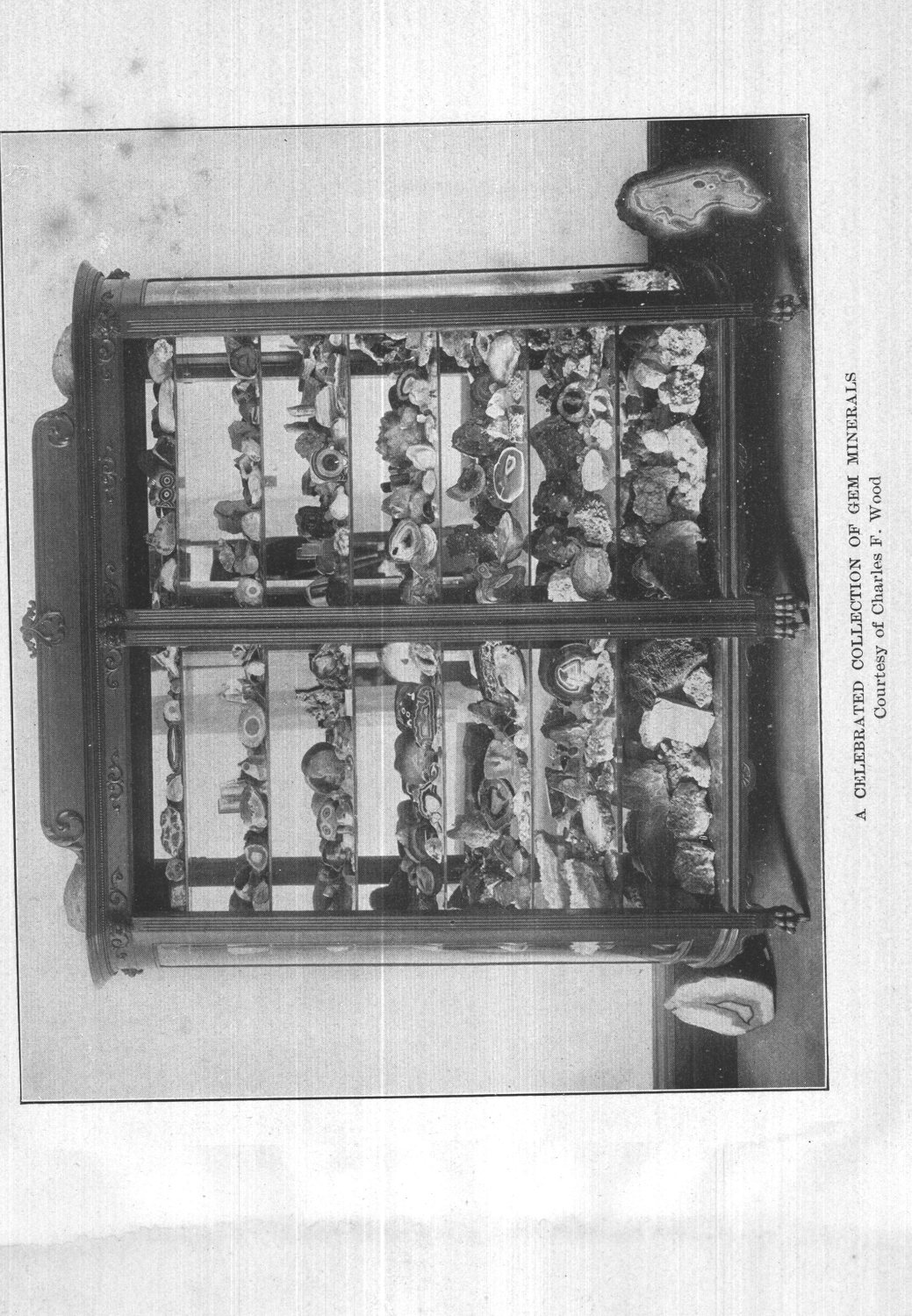
The growth of the mineral collection of the American Museum of Natural History has been gradual, beginning with the Bailey collection, which served as an introductory and fairly representative series of specimens. A valuable accession was the most remarkable group of specimens of malachite and azurite donated by the Copper Queen Consolidated Mining Company of Arizona, which, with subsequent additions from the same donor, is the most striking feature of the whole collection; it is assembled and installed in a single case at the north end of the small hall. After this invaluable acquisition of the green and blue carbonates of copper from Arizona, the Spang collection was purchased in the year 1891, which doubled the number of specimens possessed by the museum, and added many new varieties and kinds of minerals. In the nine years that followed many valuable additions came from generous benefactors, and in 1900 Mr. J. Pierpont Morgan purchased and presented to the museum the remarkable collection assembled by Mr. Clarence S. Bement of Philadelphia, characterised by the collector's superior scientific judgment and exquisite taste—which evolved from the field of specimens available throughout the world a great variety of forms representing the commoner minerals—and the exceptional perfection of the specimens.
While the rock-bottom upon which modern mineralogy is founded is chemical law, it might be said that crystallography is its foundation, so that minerals of the same chemical type are grouped together, in the modern scheme of exhibition; and, under that type, minerals of similar physical or crystallographic features are arranged in smaller subdivisions. To quote Professor Gratacap:
The forms of minerals are their most obvious characteristic. The six-sided prisms of quartz and beryl crystals, the trapezoidal or trapezoidal faces of garnet, the triangular faces of magnetite and the square faces of fluorite are unmistakable.
The branch of mineral science known as crystallography is now well developed and established, and it has been demonstrated that crystal form has a close dependence upon chemical composition. The arrangement of all specimens at the American Museum of Natural History, in both desk and wall cases, is exemplarily systematic, and in accordance with the classification of the sixth edition of Dana's System of Mineralogy. An intelligent inspection of the collection at this museum, for the novice in mineralogy, should begin with desk case No. 28, followed by case No. 27; these two cases contain introductory series presenting the chemical and physical features of minerals, together with explanatory tables and photographs. The models showing the formation of crystals are ingenious in design and excellent in construction, and illustrate the crystallographic system to the novice clearly and as no other device possibly could do. Visitors to the museum who are in the jewelry trade are likely to view with particular interest the choice specimens of gold exhibited in desk case No. 1, where it appears in sheets like rolled metal; in plates, with crystallised edges; in braided filaments made up of minute octahedrons with hollow faces; in twisted plates frequently attached to quartz, around which it curls like some irregular yellow flower; besides which there are cavernous, skeleton, and pitted crystals; peculiar distortions; reticulated and tree-shaped groups with spongy masses; and rounded water-worn nuggets. Case No. 27 also contains the fine collection of the New York Mineralogical Club of specimens of minerals occurring on Manhattan Island; these include garnets, zircon, and tourmalines and a few other gem minerals, although not all of gem quality.
In the south end of the small hall is the collection of gems which, while it is not as broadly representative of the semi-precious stones as it could be, provides an ocular demonstration of the appearance of typical gem minerals of good colour and qualities, advantageously cut. A brief visit to this collection, as a supplement to the study of gems through books, will provide a practical lesson that will clearly illustrate the written descriptions of precious stones, and leave a mental picture that is likely to be lasting.