Garnet and Carbuncle
Garnet is a noun that is applied to a variety of gem minerals red or brownish-red. Almandite, a stone of rich cherry, claret, or blood-red colour is the precious garnet. A variety of garnet recently established that is in high favour is rhodolite. The chemical bases of both of these leading varieties are the same, a silicate of iron and aluminium. Precious garnet has a hardness of about 7.5, with a specific gravity seldom less than 4. and occasionally as high as 4.3. Closely following almandite, or as jewellers call it, "almandine," in the favour of gem fanciers, is Bohemian garnet or pyrope, meaning "fire-like"; this has a range of colour from a deep blood red to almost black. Pyrope is slightly harder than almandite, and its specific gravity lies between 3.7 and 3.8. The fracture is brittle; refraction, single; lustre, vitreous; it is transparent to opaque. Most varieties of garnet fuse to brown or black glass.
In Dana's Mineralogy, Garnet is Carbunculus dodecahedrus: order Hyalina. In crystallography the primary form of garnet is the rhombic dodecahedron. The cleavage is indistinct parallel with the faces of the dodecahedron. Besides the primary twelve-sided form, with rhombic faces, the secondary forms of garnet crystals include trapezohedrons—twenty-four-sided forms—with faces shaped like trapeziums; then there are combinations of these forms, one of which has thirty-six faces. The tendency of garnet is to crystallise and it is usually found in crystals; these range from tiny ones the size of a grain of sand up to those of several pounds in weight.
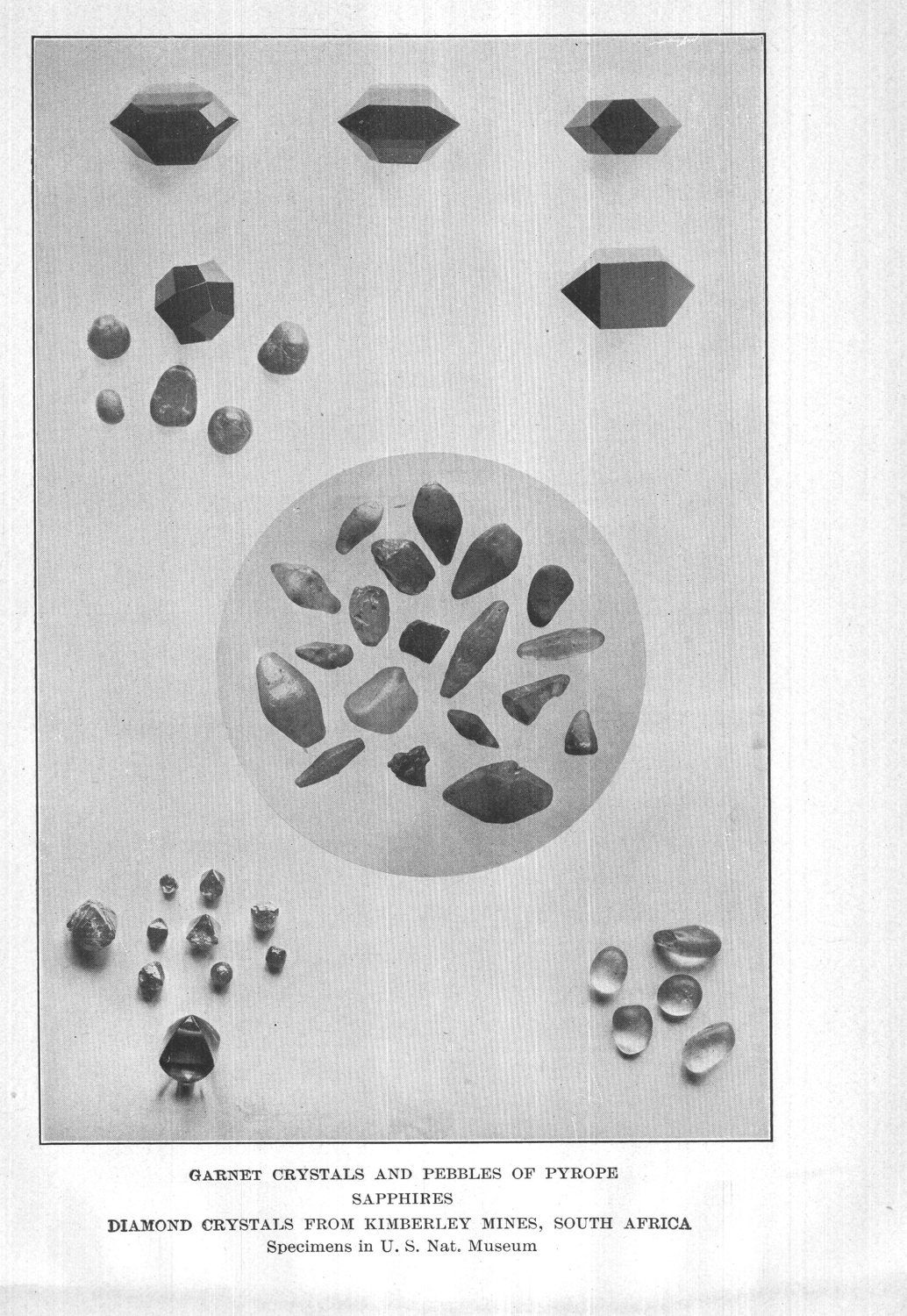
The name garnet, according to one version, is derived from the Latin granatus, meaning like a grain, because of the resemblance of its crystals in size and colour to the seeds of the pomegranate.
A carbuncle, in the popular conception, is a specific precious stone, but it does not exist in scientific mineralogy, and in the verbiage of dealers now, its meaning is merely any worthy red translucent stone cut en cabochon. Some writers, who seem otherwise generally well in formed, have fallen into this common error of recognising the word carbuncle as the name of a specific gem. Probably almost any fiery-red translucent ornamental stone in the days of ancient Rome was called carbunculus, derived from carbo, coal, and the name was bestowed because of the internal fire-like colour and reflection which is a common characteristic of the various stones now generally termed garnets. The garnet is among the stones earliest mentioned in the surviving literature of all ancient languages.