Legend and Character
The amethyst is a species of quartz that is now of more artistic than intrinsic value. The native beauty of the purple stone is indisputable. In folklore it has a prominent place as the natal stone of those born in the month of February, who, astrologically dwell in the sign of Aries in the Zodiac, and are dominated by the planet Mars. It is distinctively the precious stone of the Bishop, and also, rather incongruously, of Bacchus; and yet, despite its appropriation by these personages, respectively ecclesiastical and mythological, it is also used as an amulet believed to protect the wearer from the curse of excessive indulgence in stimulating beverages. The amethyst is the symbol of pure love; it is also the "soldier's stone"; it is the stone appropriate for mourning, and thus, in many ways it is invested with a strong sentimental interest. The signet ring of Cleopatra was an amethyst, engraved with the figure of Mithras, a Persian deity, symbol of the Divine Idea, Source of Light and Life. From the ring of Edward the Confessor was taken the amethyst that adorns the British crown, and this particular stone is, by tradition, imbued with the qualities of a prophylactic against contagious diseases.
There is an ancient myth that a beautiful nymph was beloved and beset by Bacchus, who in her effort to escape the imperious wooing of her ardent lover, was aided by her patron goddess and metamorphosed into an amethyst. Bacchus, baffled, in memory of his vanished love, bestowed on the stone the colour of the purple wine he best loved, and registered a vow that forevermore whoever would wear the amethyst should be preserved from intoxication, no matter how extensive his libations. In medieval times the amethyst was a favourite amulet as a preserver of the wearer in battle, and many a pious crusader who nightly told his beads, relied also upon the purple stone that hung as a protective charm beside his rosary. The amethyst was believed to be a good influence if worn by persons making petitions to princes, and also to be a puissant preventive of hailstorms and locusts. The association of the amethyst with sacerdotal things is old and long, for it is the pious or episcopal gem, and regarded as imparting especial dignity and beauty to the property of the Roman Church. The amethyst is sacred to St. Valentine, who is said to have always worn one.
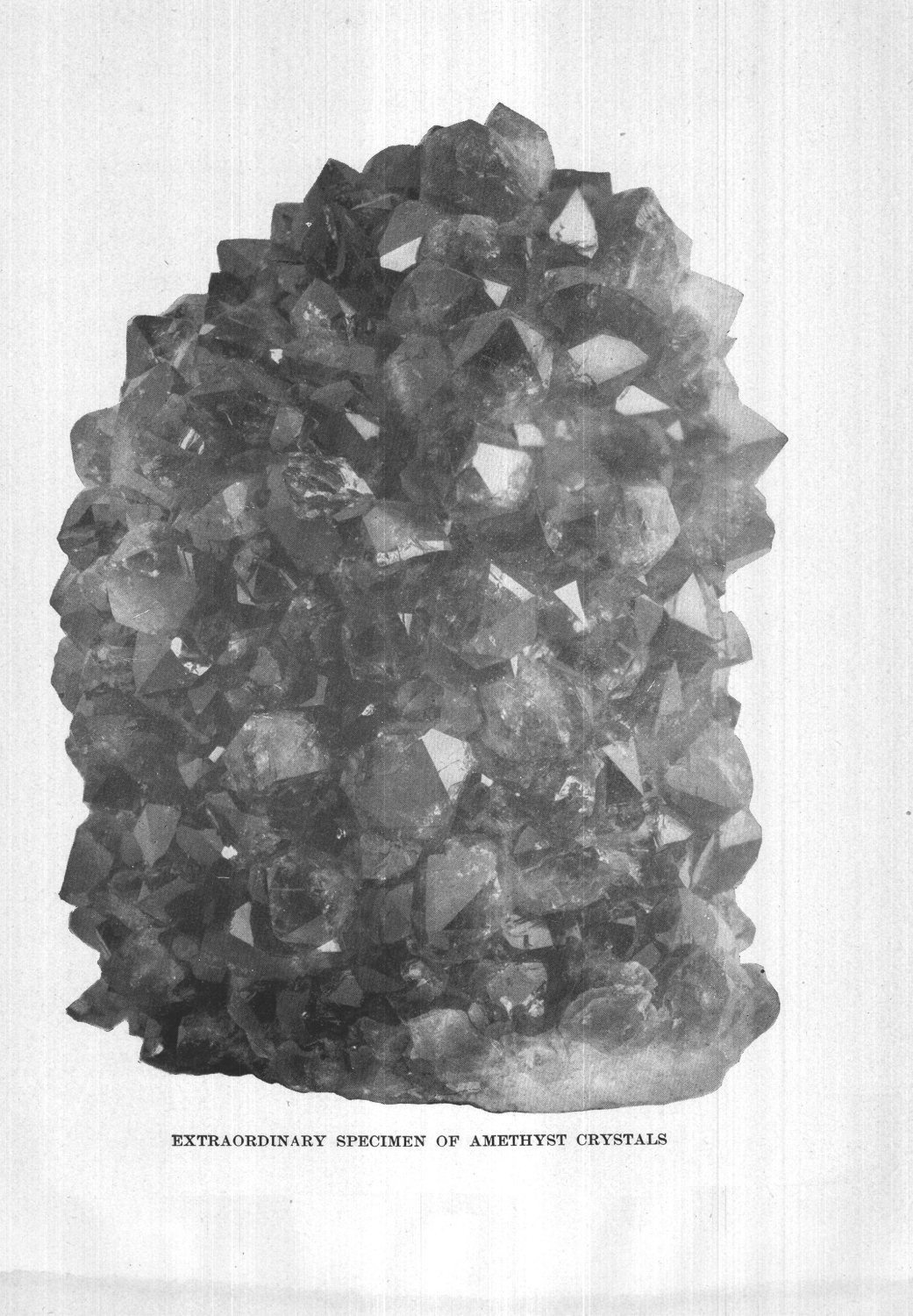
The word amethyst owes its root to the Greek word amethustos, meaning not drunken, and also construed to mean a remedy for drunkenness. Pliny, with customary quaintness, thought it prevented intoxication because it did not reach, although it approximated, the colour of wine.
Amethyst, a variety of quartz, plainly crystalline, is called by Dana, amethystine quartz. Its colour, which is diffused throughout the crystals or affects only their summits, is a clear purple or bluish-violet, and it is therefore sometimes called violet-quartz. The amethyst is of all degrees of colour from the slightest tint to so dark as to be almost opaque. Not always uniform, the colour is sometimes in spots and in some crystals shades gradually from light to dark. The dark reddish-purple colour is most highly prized; it has the advantage, too, of holding its value under all circumstances, for in an artificial light, especially if containing yellow rays, the pale stones lose their violet colour and become a dull grey. Some deeply coloured amethysts from Maine change to a wine colour in artificial light, thus becoming even more beautiful.
The amethyst's best claims to perpetual popular appreciation are its beauty of colour and its adaptability as an ornament to harmonica with a costume colour scheme. In the development of woman's discrimination in dress, she desires a jewel for every gown and ornaments for afternoon as well as for night, and for special occasions. For fabrics of pearl-grey, amethysts mounted in dull silver should be in high favour.