Home › Two Fops Among the Fishes › Two Fops Among the Fishes: Long-Eared
Two Fops Among the Fishes: Long-Eared
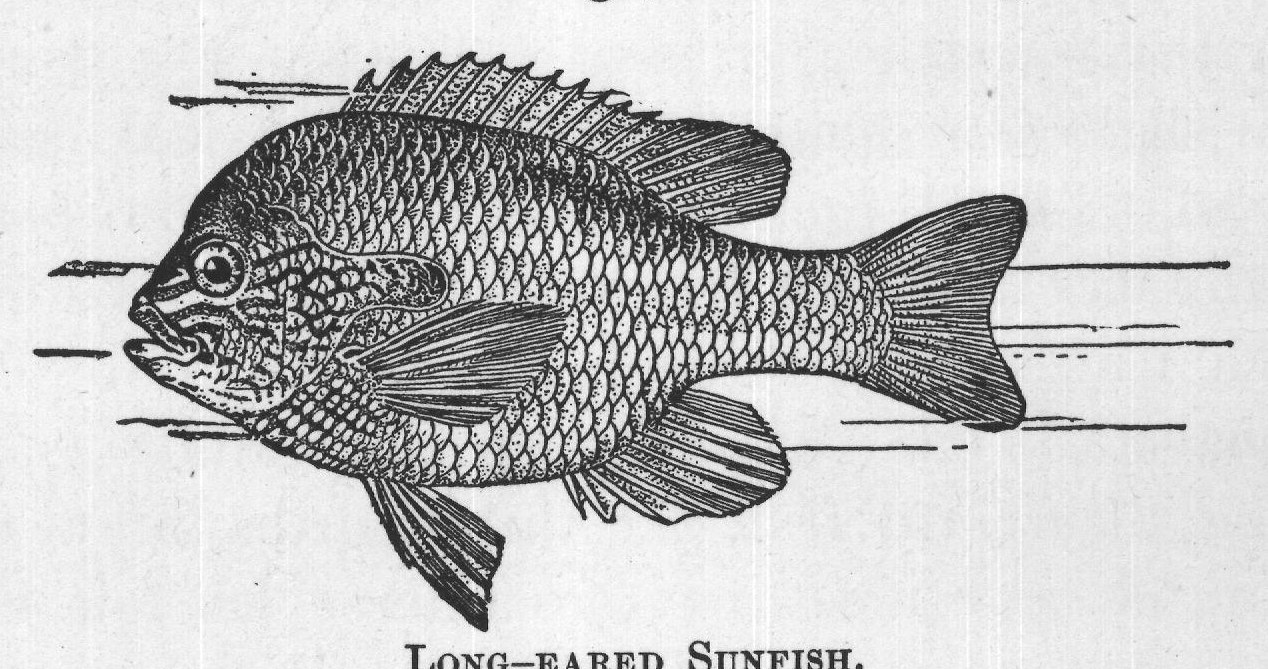
II. THE LONG-EARED SUNFISH. - Among the most brightly colored of all the freshwater members of the finny tribe is the long-eared sunfish. When full grown its length is about eight inches and the breadth one-half as much. The color is then a brilliant blue and orange, the former predominating LONG-EARED SUNFISH. above; the orange on the sides in spots, the blue in wavy, vertical streaks. The cheeks are orange with bright blue stripes; the fins with the membranes orange, and the rays blue. Extending back from the hind margin of each cheek is a conspicuous blackish membrane termed an “ear-flap," which in this species is longer than in any other of the sun-fish family, whence the specific name, megalotis, from two Greek words meaning "great" and "ear."
Within the placid pools of the brooks and larger streams of the State this sunfish has its favorite haunts. Mid-summer is the time when its habits can S Two Fops among the Fishes be best observed. On a recent August morn I sat for an hour or longer on the banks of a stream, which flows through a wooded blue-grass pasture, and watched the denizens of its waters. A peaceful calm existed, the water being without a ripple and with scarce the semblance of a flow - the air without the shadow of a breeze. Dragon flies lazily winged their way across the pool, now resting daintily upon a blade of sedge or swamp grass, now dipping the tips of their abdomens beneath the surface of the water while depositing their eggs. The only sounds of nature were the buzz of a bumble-bee feeding among the flowers of the Brunella at my side, and an occasional drawl of a dog-day locust from the branches of the sycamore which threw a grateful shade about me.
The sunfish "hung motionless" in the water, their heads towards me, holding their position only by a slow flapping of their dorsal and pectoral fins. Their nesting time over, their season's labor ended, it was with them, as with many other beings, a time of languor.
These long-eared fishes are the lords and ladies of the respective pools wherein they abide. When they move other smaller fry clear the way. If a worm or gnat, falling upon the surface, tempts them, it is theirs. A leaf falls near them and is seemingly unnoticed - a fly, and how quickly their dormant energy is put into motion. With a dart and a gulp the insect is swallowed, and a new stage of waiting expectancy is ushered in.
How admirably fitted their form for cleaving the water! They often seem to glide rather than propel themselves through its depths. Again, how swiftly the caudal fin moves when with straight unerring motion they dart upon their prey. At times one turns his body sideways, and, with a slow, upwardgliding motion, moves toward some object on the surface which is doubtfully "good to eat." He even takes it into his mouth and then, not having faith in his power to properly digest it, ejects it with force, and turning quickly darts back to the friendly shadow of a boulder beneath whose sides he has, in time of threatened danger, a safe retreat.
I throw a grasshopper into the pool. Like a flash six of the sunfish are after it. One reaches it a tenth of a second in advance of the others, and with a lightning-like gulp, which disturbs the serenity of the surface of the pool, swallows the kicking prey. The energy of the sun's heat and light, stored in grass, transmitted to move muscles in gigantic leaps, will, in a short time, wag a caudal fin and propel the owner through these watery depths.
Years are thus doubtless spent by these long-eared sunfish in a dreamy sort of existence, their energies quickened by the vernal season and growing duller on the approach of winter. Excepting the times when they are tempted by a wriggling worm on some boy's hook, theirs is a life exempt from danger. A kingfisher glancing down from his perch on the bent sycamore limb may, at times, discern them and lessen their ranks; but, methinks, the chub minnows, with fewer spines in their dorsal fins, are more agreeable to the king-fisher's palate. With all the tints of the rainbow gleaming from their sides they move to and fro, the brilliant rulers of these quiet pools.
Two Fops among the Fishes The king or monarch of those noted was most gorgeously arrayed. In addition to the hues above described, a streak of emerald bordered his dorsal and caudal fins and was bent around the edge of his upper lip-a green mustache, as it were. By tolling them with occasional bits of food I drew him and his retinue close into shore. There, for some time they rested, watching eagerly for additional morsels, As I was leaving I plucked from my sleeve an ant and threw it towards them. A dart, a gurgle, a gulp - the leader had leaped half his length from the water, and the ant was forever gone. The ripples receded and finally disappeared, and the last scene in this tragedy of nature was at an end.