Home › Contents › The Scissor Beak
The Scissor Beak
(FROM A JOURNAL OF RESEARCHES, ETC.) BY CHARLES DARWIN.
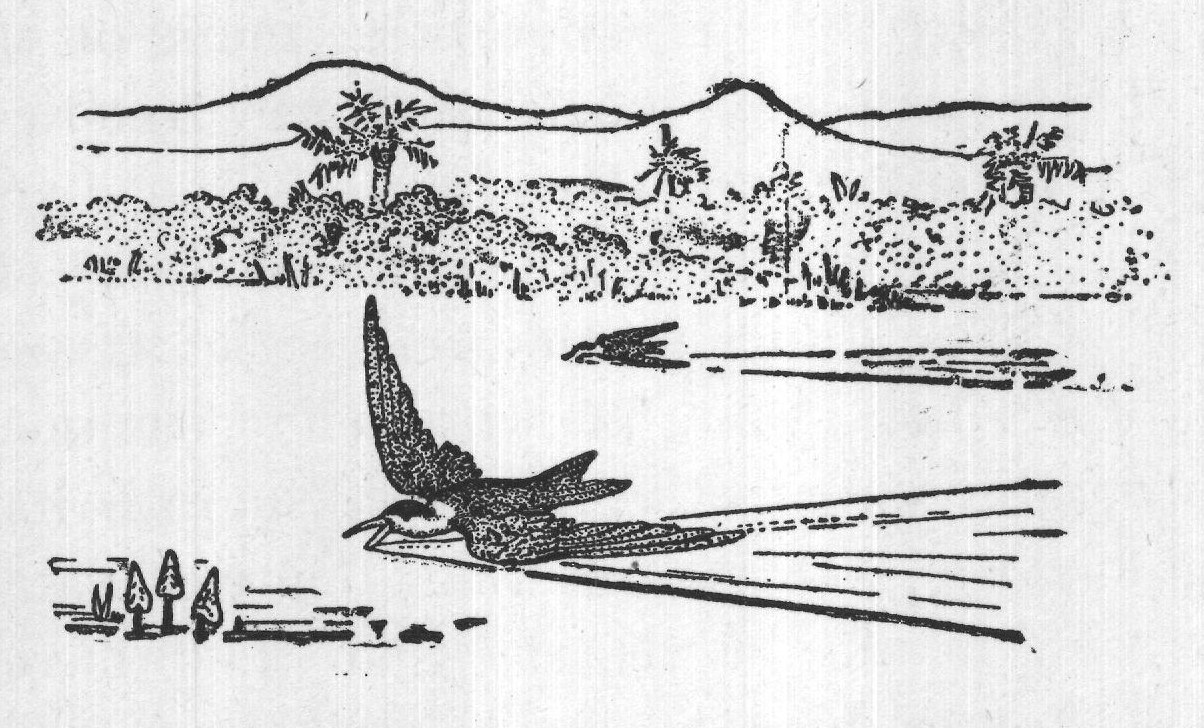
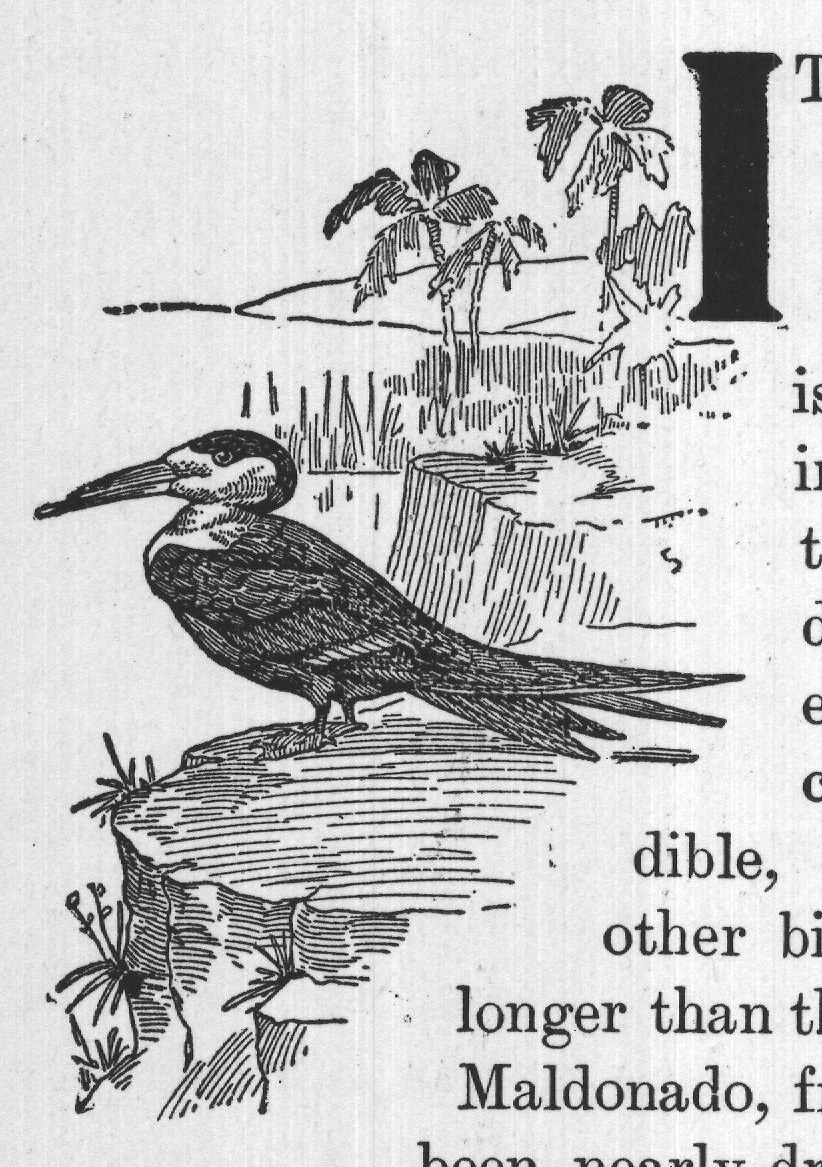
S T has short legs, web feet, extremely long-pointed wings, and is about the size of a tern. The beak is flattened laterally, that is, in a plane at right angles to that of a spoonbill or duck. It is as flat and elastic as an ivory papercutter, and the lower mandible, differently from every other bird, is an inch and a half longer than the upper. In a lake near Maldonado, from which the water had been nearly drained, and which, in consequence, swarmed with small fry, I saw several of these birds, generally in small flocks, flying rapidly backwards and forwards close to the surface of the lake. They kept their bills wide open, and the lower mandible half buried in the water. Thus skimming the surface, they ploughed it in their course; the water was quite smooth, and it formed a most curious spectacle to behold a flock, each bird leaving its narrow wake on the mirror-like surface. In their flight they frequently twist about with extreme quickness, and dexterously manage with their projecting lower mandible to plough up small fish, which are secured by the upper and shorter half of their scissorlike bills. This fact I repeatedly saw, as, like swallows, they continued to fly backwards and forwards close before me. Occasionally when leaving the surface of the water their flight was wild, irregular and rapid; then they uttered loud harsh cries. When these birds are fishing, the advantage of the long primary feathers of their wings, in keeping them dry, is very evident. When thus employed, their forms resemble the symbol by which many artists represent marine birds. Their tails are much used in steering their irregular course.
These birds are common far inland along the course of the Rio Parana; it is said that they remain here during the whole year, and breed in the marshes.
During the day they rest in flocks on the grassy plains, at some distance from the water. Being at anchor, as I have said, in one of the deep creeks between the islands of Parana, as the evening drew to a close, one of these scissor-beaks suddenly appeared. The water was quite still, and many little fish were rising. The bird continued for a long time to skim the surface, flying in its wild and irregular manner up and down the narrow canal, now dark with the growing night and the shadows of the overhanging trees. At Montevideo, I observed that some large flocks during the day עה The Scissor Beak remained on the mud-banks at the head of the harbor, in the same manner as on the grassy plains near the Parana; and every evening they took flight seaward.
From these facts I suspect that the Rhynchops generally fishes by night, at which time many of the lower animals come most abundantly to the surface. M.
Lesson states that he has seen these birds opening the shells of the mactrae buried in the sandbanks on the coast of Chile; from their weak bills, with the lower mandible so much projecting, their short legs and long wings, it is very improbable that this can be a general habit.