Home › The Man-Like Apes › The Man-Like Apes: Gaboon
The Man-Like Apes: Gaboon
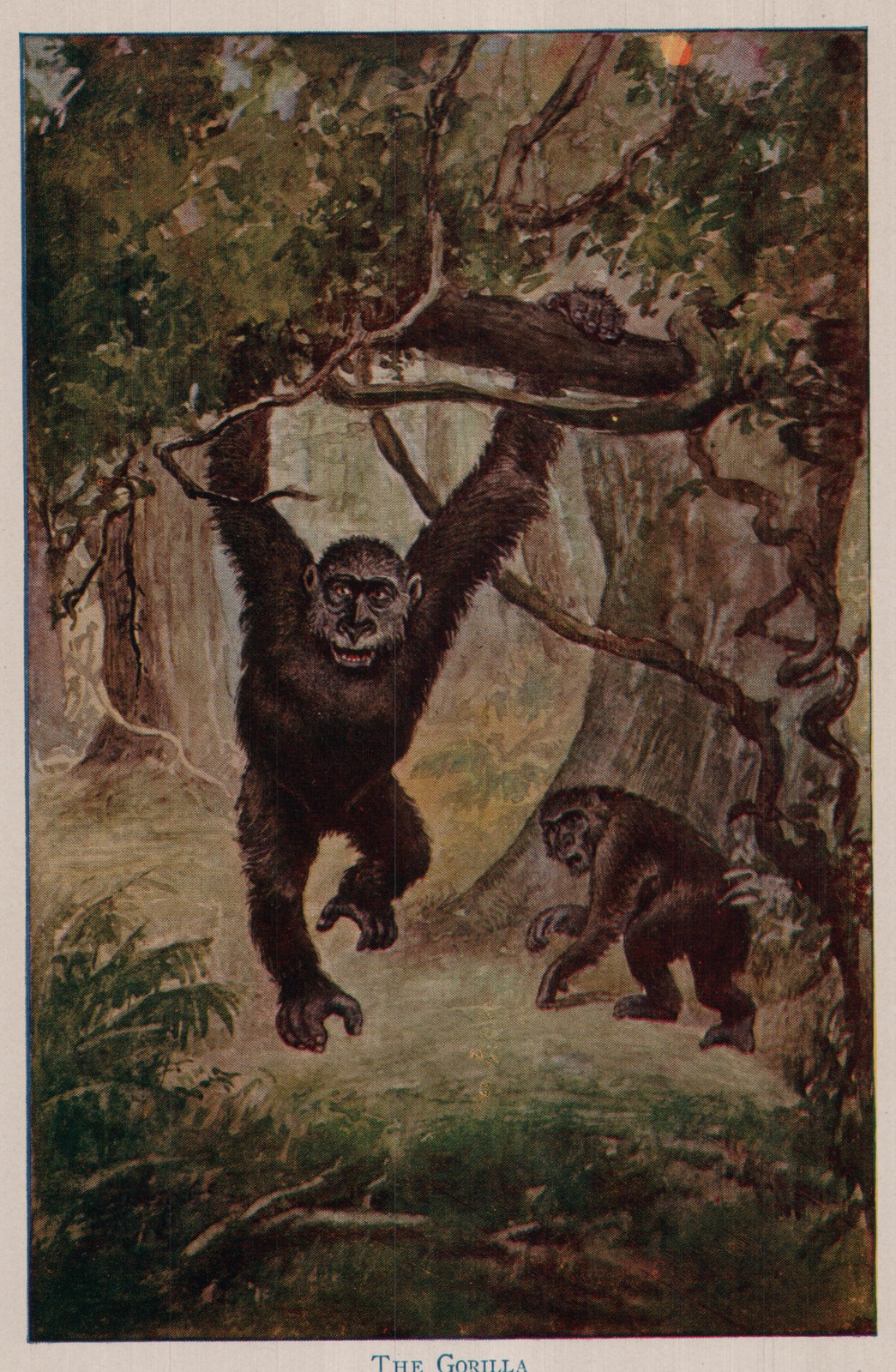
"It should be borne in mind that my account is based upon the statements of the aborigines of that region (the Gaboon). In this connection it may also be proper for me to remark that, having been a missionary resident for several years, studying, from habitual intercourse, the African mind and character, I felt myself prepared to discriminate and decide upon the probability of their statements. Besides, being familiar with the history and habits of its interesting congener (Trogniger, Geoff.), I was able to separate their accounts of the two animals, which, having the same locality and a similarity of habit, are confounded in the minds of the mass, especially as but few - such as traders to the interior, and huntsmen - have ever seen the animal in question. "The tribe from which our knowledge of the animal is derived, and whose territory forms its habitat, is the Mpongwe, occupying both banks of the River Gaboon, from its mouth to some fifty or sixty miles upward.... "If the word 'Pongo' be of African origin, it is probably a corruption of the word Mpongwe, the name of the tribe on the banks of the Gaboon, and hence applied to the region they inhabit. Their local name for the Chimpanzee is Enché-eko, as near as it can be Anglicized, from which the common term 'Jocko' probably comes. The Mpongwe apellation for its new congener is Engé-ena, prolonging the sound of the first vowel, and slightly sounding the second. "The habitat of the Engé-ena is the interior of Lower Guinea, while that of the Enché-eko is nearer the seaboard. "Its height is about five feet; it is disproportionately broad across the shoulders, thickly covered with coarse black hair, which is said to be similar in its arrangement to that of the Enché-eko; with age it becomes gray, which fact has given rise to the report that both animals are seen of different colors. "Head. - The prominent features of the head are the great width and elongation of the face, the depth of the molar region, the branches of the lower jaw being very deep and extending far backward, and the comparative smallness of the cranial portion; the eyes are very large, and said to be like those of the Enché-eko, a bright hazel; nose broad and flat, slightly elevated toward the root; the muzzle broad, and prominent lips and chin, with scattered gray hairs; the under lip highly mobile, and capable of great elongation when the animal is enraged, then hanging over the chin; skin of the face and ears naked and of a dark-brown, approaching to black. "The most remarkable feature of the head is a high ridge, or crest of hair, in the course of the sagittal suture, which meets posteriorly with a transverse ridge of the same, but less prominent, running round from the back of one ear to the other. The animal has the power of moving the scalp freely forward and back, and when enraged is said to contract it strongly over the brow, thus bringing down the hairy ridge and pointing the hair forward, so as to present an indescribably ferocious aspect. "Neck short, thick, and hairy; chest and shoulders very broad, and said to be fully double the size of the Enché-ekos; arms very long, reaching some way below THE GORILLA the knee - the forearm much the shortest; hands very large, the thumbs much larger than the fingers. .. "The gait is shuffling; the motion of the body, which is never upright as in man, but bent forward, is somewhat rolling, or from side to side. The arms being longer than the Chimpanzee, it does not stoop as much in walking; like that animal, it makes progression by thrusting its arms forward, resting the hands on the ground, and then giving the body a half-jumping, half-swinging motion between them. In this act it is said not to flex the fingers, as does the Chimpanzee, resting on its knuckles, but to extend them, making a fulcrum of the hand. When it assumes the walking posture, to which it is said to be much inclined, it balances its huge body by flexing its arms upward. "They live in bands, but are not so numerous as the Chimpanzees; the females generally exceed the other sex in number. My informants all agree in the assertion that but one adult male is seen in a band; that where the young males grow up a contest takes place for mastery, and the strongest, by killing and driving out the others, establishes himself as the head of the community."
Dr. Savage repudiates the stories about the Gorillas carrying off women and vanquishing elephants, and then adds: "Their dwellings, if they may be so called, are similar to those of the Chimpanzee, consisting simply of a few sticks and leafy branches, supported by the crotches and limbs of trees; they afford no shelter, and are occupied only at night. "They are exceedingly ferocious, and always offensive in their habits, never running from man, as does the Chimpanzee. They are objects of terror to the natives, and are never encountered by them except on the defensive. The few that have been captured were killed by elephant-hunters and native traders, as they came suddenly upon them while passing through the forests. "It is said that when the male is first seen he gives a terrific yell, that resounds far and wide through the forest, something like kh-ah! kh-ah! prolonged and shrill. His enormous jaws are widely opened at each expiration, his under-lip hangs over the chin, and the hairy ridge and scalp are contracted upon the brow, presenting an aspect of indescribable ferocity. "The females and young, at the first cry, quickly disappear. He then approaches the enemy in great fury, pouring out his horrid cries in quick succession. The hunter awaits his approach with his gun extended; if his aim is not sure he permits the animal to grasp the barrel, and as he carries it to his mouth (which is his habit) he fires. Should the gun fail to go off, the barrel (that of the ordinary musket, which is thin), is crushed between his teeth and the encounter soon proves fatal to the hunter. "In the wild state their habits are in general like those of the Trogloytes niger, building their nests loosely in trees, living on similar fruits, and changing their place of resort from force of circumstances."