Home › Some Strange Nurseries › Some Strange Nurseries: English
Some Strange Nurseries: English
Our commonest English lizard, for example, which frequents moors and sandhills, does not lay or deposit its eggs at all, but hatches them out in its own body, and so apparently brings them forth alive: while among snakes, the same habit occurs in the adder or viper. The very name viper, indeed, is a corruption of vivipara, the snake which produces living young. Still more closely do some birds resemble mammals in the habit of secreting a sort of milk for the sustenance of their nestlings. Most people think the phrase "pigeon's milk" is much like the phrase "the horse-marines," a burlesque name for an absurd and impossible monstrosity. But it is nothing of the sort: it answers to a real fact in the economy of certain doves, which eat grain or seeds, grind and digest it in their own gizzards into a fine soft pulp or porridge, and then feed their young with it from their crops and beaks. This is thus a sort of bird-like imitation of milk. Only the cow or the goat takes grass or leaves, chews, swallows, and digests them, and manufactures from them in her own body that much more nutritive substance, milk, with which all mammals feed their infant offspring.
Now, after this rather long preamble, I am going to show you in this present article a few other examples of special care taken of the young in certain quarters where it might be least expected. Fish are not creatures from which we look for marked domestic virtues: yet we may find them there abundantly. Let us begin with that familiar friend of our childhood, the common English stickleback.
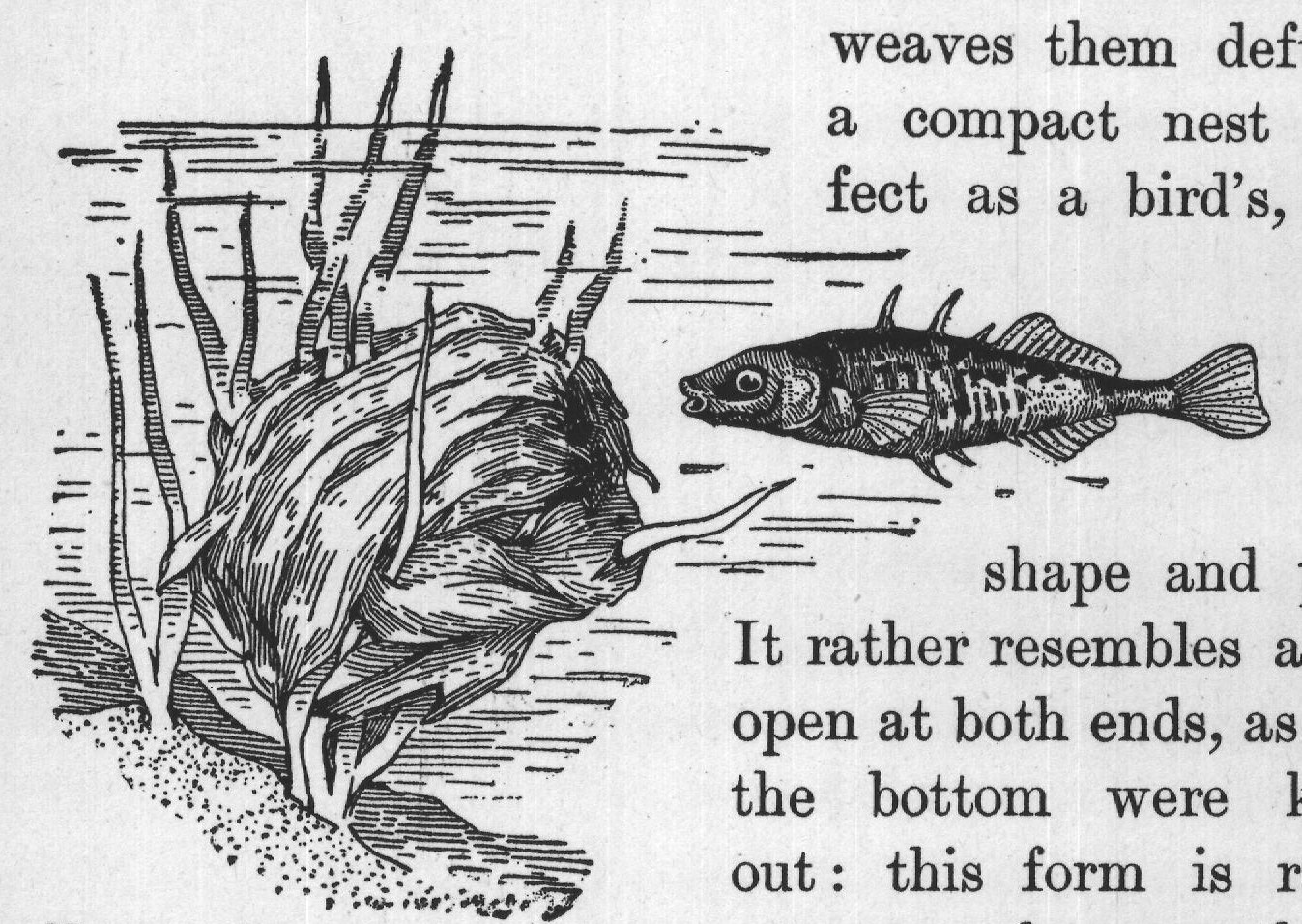
Which of us cannot look back in youth to the mysteries of the stickleback fisheries? Captains courageous, we sailed forth with bent pin and piece of thread, to woo the wily quarry with half an inch of chopped earthworm. For stickleback abound in every running stream and pond in England. They are beautiful little creatures, too, when you come to examine them, great favorites in the fresh-water aquarium; the male in particular is exquisitely colored, his hues growing brighter and his sheen more conspicuous at the pairing season.
There are many species of sticklebacks - in The England we have three very different kinds - but all are alike in one point which gives them their common name, that is to say, in their aggressive and protective prickliness. They are armed against all comers. dorsal fin is partly replaced in the whole family by strong spines or "stickles," which differ in number in the different species. One of our English sorts is a lover of salt water: he lives in the sea, especially off the Cornish coast, and has fifteen stickles or spines; on which account he is commonly known as the Fifteenspined Stickleback; our other two sorts belong to fresher waters, and are known as the Ten-spined and the Three-spined respectively.
The special peculiarity of the male stickleback consists in the fact that he is, above all things, a model father. In his acute sense of parental responsibility he has few equals. When spring comes round, he first exhibits his consciousness of his coming charge by suddenly enduing himself in a glowing coat of many colors and of iridescent brilliancy. That is in order to charm the eyes of the prospective mate, or rather mates, for I may as well confess the sad truth at once that our amiable friend is a good parent but an abandoned polygamist. We all know that "In the spring a fuller crimson comes upon the robin's breast; In the spring the wanton lapwing gets himself another crest; In the spring a livelier iris changes on the burnish'd dove; In the spring a young man's fancy lightly turns to thoughts of love."
Not to be out of the fashion, therefore, the romantic stickleback does precisely the same thing as all these distinguished and poetical compeers. And he does it for the same reason, too; because he wants to get himself an appropriate partner. "There is a great deal of human nature in man," it has been said: I am always inclined to add, "And there is a great deal of human nature in plants and animals." The more we know of our dumb relations, the more closely do we realize the kinship between us. Fish in the spring are like young men at a fair all eager for the attention of their prospective partners.